




Upper Mustang Trek Guide
The Upper Mustang trek is a restricted-area journey into the arid, Tibetan-Buddhist former kingdom of Lo, climbing the upper Kali Gandaki from Jomsom and Kagbeni through eroded desert canyons to the walled capital of Lo Manthang at 3,840 m.
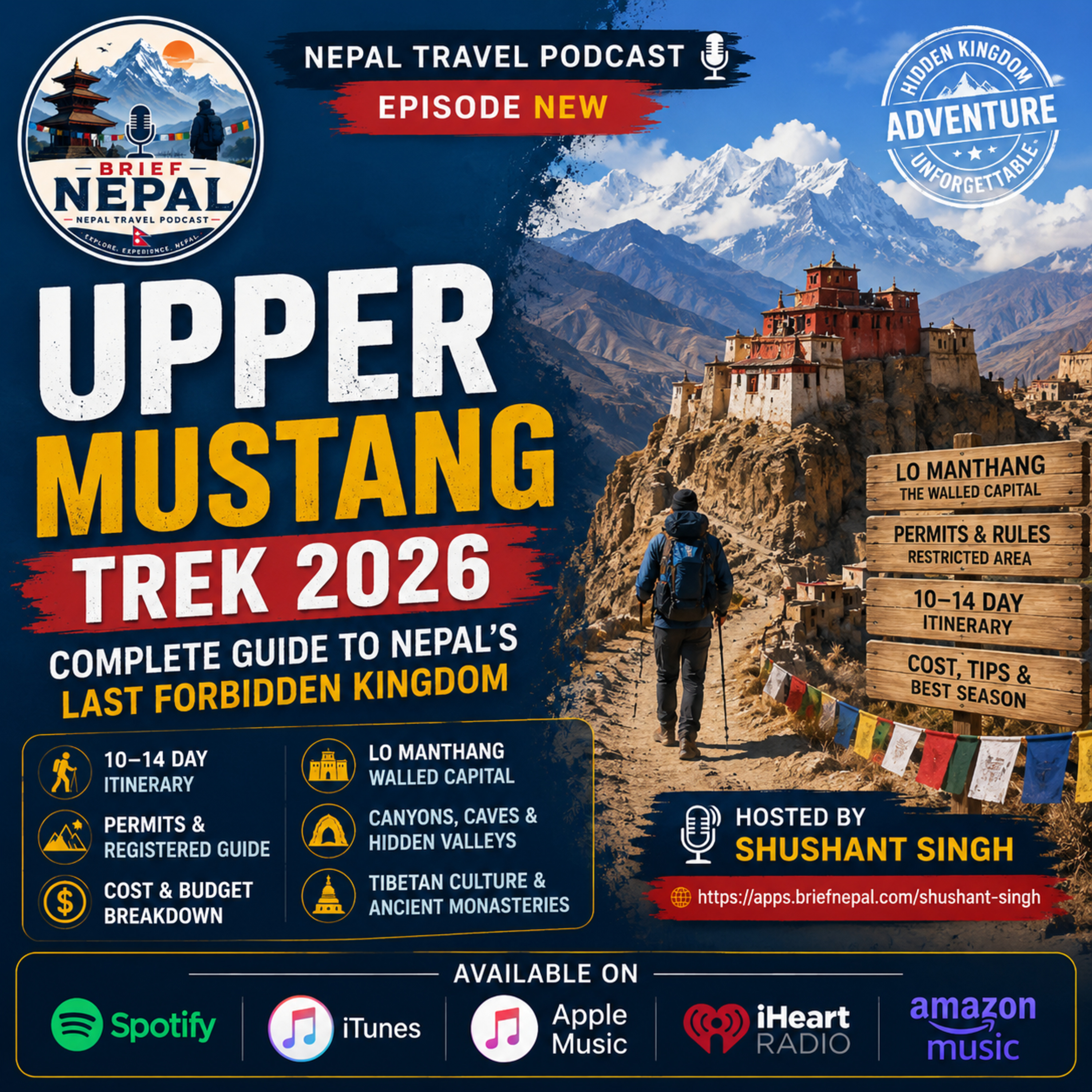
🎙️ Hosted by Shushant Singh | Nepal Travel PodcastStep beyond the ordinary and journey into Upper Mustang, one of Nepal’s most remote and culturally fascinating destinati…
▶ Listen on SpotifyShow notes & transcript →Follow the show →
🎧 Also on Apple Podcasts Castbox iHeartRadio
Watch: Upper Mustang Trek
🎬 "A Journey to the Edge of Tibet – Upper Mustang Trek, Nepal Himalaya" by Nicholas Eager on YouTube
Overview
The Upper Mustang trek leads into one of the most remote and culturally distinct corners of Nepal, the arid former kingdom of Lo, tucked in the rain-shadow north of the great Himalayan wall in Mustang district of Gandaki. Sealed to outsiders until 1992 and still a restricted area, this is a high desert plateau of wind-carved cliffs, ochre and grey badlands, and walled medieval villages that feels far closer to Tibet than to the green hills of the rest of Nepal. The cultural and spiritual life here remains profoundly Tibetan-Buddhist, and much of the landscape lies in the same trans-Himalayan zone as Upper Dolpo to the west.
The trek begins at Jomsom (2,720 m), usually reached by a short flight or drive from Pokhara, and follows the upper Kali Gandaki through the gateway village of Kagbeni and on through Chele, Syangboche, Ghami and Tsarang. The path climbs and drops over a series of passes around 4,000 m, with the high point near 4,230 m, crossing parched plateaus and dramatic eroded canyons before arriving at the great prize of the route: the walled capital of Lo Manthang (3,840 m), a compact medieval town of whitewashed houses, monasteries and the old royal palace.
Around Lo Manthang and along the trail lie some of Nepal's most remarkable cultural treasures: ancient gompas, mural-filled monasteries, and the enigmatic sky caves carved high into the cliffs. The return is often varied via Dhakmar, with its red cliffs, and the revered Ghar Gompa, one of the oldest monasteries in the region.
Most trekkers complete the route in 10 to 14 days. It is graded moderate in terms of terrain, with no high technical passes, but the combination of altitude, long dusty days, strong winds and remoteness makes it a serious undertaking. Because it sits in the rain-shadow, Upper Mustang can be trekked from March through November, including the monsoon, when most of Nepal is closed by rain.
Day-by-Day Itinerary
This is a classic Upper Mustang itinerary built around the walk up to Lo Manthang and a varied return. It can be shortened by fit groups or by using jeep transport on the new road, and extended with exploration days around Lo Manthang and side trips to the northern villages near the Tibetan border. The trek begins and ends at Jomsom, reached from Pokhara.
Day 1: Fly or drive Pokhara to Jomsom (2,720 m), trek to Kagbeni (2,810 m)

A short early flight or a longer drive from Pokhara to Jomsom, then an easy half-day walk up the wide Kali Gandaki valley to the fortress-like gateway village of Kagbeni, where the restricted-area checkpoint marks the entry into Upper Mustang. (3-4 hours walking.)
Day 2: Kagbeni to Chele (3,050 m)
Past the checkpoint and into the restricted zone, the trail follows the river then climbs into drier, more dramatic country to the village of Chele, perched above the gorge. The landscape turns increasingly desert-like. (6-7 hours.)
Day 3: Chele to Syangboche (3,800 m)
A demanding day crossing two passes around 3,800-3,900 m, with sweeping views over eroded canyons and distant snow peaks, descending and climbing repeatedly to the small settlement of Syangboche. (6-7 hours.)
Day 4: Syangboche to Ghami (3,520 m)
Over the Yamda La and other low passes, past chortens and the long mani wall near Ghami, to the green oasis village of Ghami set among barley fields. (5-6 hours.)
Day 5: Ghami to Tsarang (3,560 m)
Across a river and one of the longest mani walls in Nepal, climbing to the historic village of Tsarang with its old fort, monastery and former royal residence. (5-6 hours.)
Day 6: Tsarang to Lo Manthang (3,840 m)
A climb over the Lo La pass brings the first view of the walled capital, then a descent and short walk to Lo Manthang itself, the great prize of the trek. (4-5 hours.)
Day 7: Explore Lo Manthang and surroundings
A full day exploring the walled city, its monasteries, the royal palace and the surrounding villages. Many trekkers add a side trip to the sky caves at Chhoser or the northern border villages. A rest and culture day.
Day 8: Lo Manthang to Dhakmar (3,820 m) via Ghar Gompa
A varied return route crossing high country to visit the revered Ghar Gompa, one of the oldest monasteries in the region, then descending past striking red cliffs to Dhakmar. (6-7 hours.)
Day 9: Dhakmar to Ghiling (3,570 m)
A scenic day back through the heart of the plateau, passing chortens and barley terraces, descending towards Ghiling. (5-6 hours.)
Day 10: Ghiling to Chhusang (2,980 m)
Retracing south over the passes and dropping steadily towards the river to the village of Chhusang, with the desert landscape gradually softening. (6-7 hours.)
Day 11: Chhusang to Jomsom (2,720 m)

A final walk down the Kali Gandaki, exiting the restricted area at Kagbeni, and on to Jomsom to complete the trek. (6-7 hours, or shorter with jeep transport.)
Day 12: Fly or drive Jomsom to Pokhara

A morning flight or a drive back down to Pokhara. Build in a buffer day, as Jomsom flights are weather-dependent and can be delayed.
Difficulty & Fitness
The Upper Mustang trek is graded moderate in terms of terrain, with no technical climbing and no extreme high passes, but it is a longer and more demanding undertaking than that grade alone suggests. The challenges are altitude, distance, the desert environment and remoteness rather than steepness.
- Sustained altitude. Although the high point is around 4,230 m, you spend many days above 3,500 m and cross repeated passes near 4,000 m, so acclimatisation and steady pacing matter.
- Long, dry, dusty days. The walking is mostly on exposed trails through arid canyons, with strong afternoon winds, intense sun and dust. Many days involve 6-7 hours of up-and-down walking.
- Remoteness. This is a restricted, sparsely populated region. Facilities, supplies and medical help are limited, so self-sufficiency and a licensed guide are important.
- Variable lodging. Teahouses exist in the main villages but are simpler than on the Annapurna routes, and the new road has changed some of the trail experience.
You should be comfortable walking 6-7 hours a day for around two weeks at altitude. No previous high-altitude experience is required, but a base of regular hill walking and cardiovascular fitness beforehand will make the trek far more enjoyable. It is well within reach of fit, determined trekkers who are prepared for dust, wind and distance.
Permits & Regulations
Upper Mustang is a restricted area, and the permit rules are stricter than on the open Annapurna trails. You cannot trek here independently, and you must go through a registered agency with a licensed guide. The documents you need are:
- Restricted Area Permit (special permit), around USD 500 per person for the first 10 days, with an additional charge of roughly USD 50 per day beyond that. This is the headline cost of the trek.
- Annapurna Conservation Area Permit (ACAP), around NPR 3,000 for foreign nationals, since the route lies within the conservation area.
- A minimum of two trekkers is mandatory for the restricted-area permit, along with a licensed guide arranged through a registered agency.
The restricted-area rule predates the wider 2023 change, but Nepal now also requires trekkers on organised treks to use a licensed guide generally, which is in any case compulsory here. Carry your passport and several passport photos, keep permits handy for the checkpoint at Kagbeni and others along the route, and, because fees and rules for restricted areas can change, confirm the current requirements and exact costs with a registered agency before you travel.
Cost & Budget
Upper Mustang is one of the more expensive treks in Nepal, mainly because of the restricted-area special permit and the mandatory guide and minimum group size. Budgets vary widely with group size, the number of days and the level of comfort.
- Guided package: typically around NPR 240,000-370,000 per person depending on group size and duration. This usually covers the special permit, ACAP, guide, porter, ground transport, accommodation and meals on the trek.
- Permits: the restricted-area special permit is around USD 500 per person for 10 days (roughly USD 50 per day beyond), plus ACAP at around NPR 3,000. The permit is the single largest fixed cost.
- Transport: the flight or drive between Pokhara and Jomsom, plus any jeep transport on the new road inside Mustang.
- On-trail spending: carry enough Nepali rupees in cash for the whole trek, as there are no reliable ATMs in the villages, for extras, drinks and tips.
Smaller groups pay considerably more per head, since the fixed permit and guide costs are spread over fewer people, while larger groups bring the per-person price down. A generous tip for guides and porters is customary, and you should budget a small contingency for flight delays, extra nights or added exploration days around Lo Manthang.
Best Time to Trek
One of the great advantages of Upper Mustang is that it lies in the Himalayan rain-shadow, so it stays largely dry while the rest of Nepal is drenched. This gives an unusually long trekking window from March to November.
- Spring (March-May) brings warming days, blossoming apricot and apple trees in the villages, and generally clear skies, making it a fine time to walk into Lo.
- Monsoon (June-August) is actually a feasible and popular time here, since the rain-shadow keeps Upper Mustang mostly dry while the monsoon closes much of the country. It is one of the few Himalayan regions that works in summer.
- Autumn (September-November) offers stable, clear weather and is a classic season, with the famous Tiji festival sometimes coinciding with shoulder dates depending on the lunar calendar.
Deep winter (December-February) is harsh and very cold, with many lodges and much of the local population moving to lower elevations, so most trekking pauses then. Strong afternoon winds and dust are a feature of the valley in almost any season, so plan to walk in the calmer mornings and carry sun and wind protection year-round.
Packing, Safety & Tips
Acclimatisation
With a high point of around 4,230 m and many days above 3,500 m, altitude sickness is a real consideration. Ascend steadily, stay well hydrated in the dry air, and watch for headache, nausea, dizziness or breathlessness. If symptoms worsen, descend, the valley profile makes it possible to drop to lower villages. The day around Lo La and the higher passes is where care matters most.
Gear & packing
Pack for a high, dry, windy desert trek: a warm sleeping bag, a down or fleece layer, windproof and layered clothing, sturdy broken-in boots, trekking poles, strong sun protection, lip balm, dust buff or scarf, and a headlamp. Bring a reliable water-purification method, snacks, and a first-aid kit. The cold can be sharp at night even in the warmer months, and the wind and dust are relentless in the afternoons.
Communications & money
Phone signal is patchy and unreliable across much of Upper Mustang, especially north of Kagbeni. There are no dependable ATMs in the villages, so carry enough cash in Nepali rupees for the whole trek plus a buffer for extras and tips. Lodges deal in cash only.
Safety & insurance
Buy comprehensive travel insurance that covers trekking to your maximum altitude and includes helicopter evacuation, as this is a remote, restricted region where road or air rescue can be slow and costly to arrange without cover in place. Trek with a licensed guide and a registered agency, build a buffer day for the weather-dependent Jomsom flight, and be prepared for sudden wind, cold and dust.
Combining with other treks
Upper Mustang shares the lower Kali Gandaki with the Jomsom Muktinath route and the open Lower Mustang trek, so many trekkers add the sacred temple of Muktinath on the way in or out. Those wanting more high-mountain adventure can look to the Annapurna Circuit with Tilicho Lake, while the wilder trans-Himalayan country continues west towards Upper Dolpo. Base yourself in Pokhara before and after to arrange permits, transport and a guide.
Altitude Sickness (AMS) & Trek Safety
The Upper Mustang trek reaches 4,230 m, high enough that acute mountain sickness (AMS) is a genuine risk for most trekkers, so acclimatise deliberately. This section covers how to recognise altitude sickness, prevent it, prepare physically, and stay insured, it is general guidance, not medical advice.
Recognise the symptoms
| Level | Signs | What to do |
|---|---|---|
| Mild AMS | Headache, nausea or loss of appetite, dizziness, fatigue, broken sleep. | Stop ascending, rest, hydrate. Do not go higher until symptoms clear; descend if they do not. |
| Severe, HAPE (lungs) | Breathlessness at rest, persistent cough, frothy or pink spit, chest tightness, blue lips. | Descend immediately and treat as a medical emergency, arrange evacuation. |
| Severe, HACE (brain) | Confusion, clumsiness or loss of balance, crushing headache, drowsiness, hallucinations. | Descend immediately, HACE is life-threatening within hours. Evacuate. |
Prevent it: the golden rules
- Ascend slowly. Above 3,000 m, raise your sleeping altitude by no more than ~300–500 m per day and take the built-in acclimatisation days.
- Climb high, sleep low. Day-hike higher, then come back down to sleep.
- Hydrate (3–4 litres/day), eat well, and avoid alcohol, sleeping pills and smoking at altitude.
- Never ascend with AMS symptoms, and descend at once if they worsen, going down is the only reliable cure.
- Consider acetazolamide (Diamox) as a preventive/treatment aid, but only after discussing it with your doctor.
Get trek-fit
Start training 6–8 weeks out: build aerobic base with running, cycling or brisk hill walking 3–4 times a week; add stair and hill repeats carrying a loaded daypack (6–8 kg) to ready your legs for long descents; and finish with a couple of back-to-back long hiking days to rehearse multi-day fatigue. Strong quads and good cardio make altitude far more manageable.
Insurance & evacuation
Buy travel insurance that explicitly covers trekking up to 4,230 m and helicopter evacuation, a rescue from altitude is essential and very expensive without cover. Carry your policy number and your operator’s emergency contact, and keep the booking details of any guide with you.
Frequently Asked Questions
How many days does the Upper Mustang trek take?
The Upper Mustang trek usually takes 10 to 14 days, including the flight or drive between Pokhara and Jomsom and an exploration day around Lo Manthang. Fit groups or those using jeep transport on the new road can trim it, while extra side trips to the sky caves and northern villages can extend it.
How hard is the Upper Mustang trek?
It is graded moderate in terrain, with no technical passes, but it is a serious two-week undertaking. The difficulty comes from sustained altitude above 3,500 m, long dry and dusty days, strong afternoon winds and the remoteness of a restricted region, rather than from steepness.
How high is the Upper Mustang trek?
The high point is around 4,230 m on the passes en route, and you spend many days above 3,500 m. The walled capital of Lo Manthang sits at 3,840 m, while the trek starts at Jomsom at 2,720 m. The route crosses several passes near 4,000 m.
What permits do I need for the Upper Mustang trek?
Upper Mustang is a restricted area, so you need a Restricted Area Permit (around USD 500 per person for 10 days, plus about USD 50 per day beyond) and the Annapurna Conservation Area Permit (around NPR 3,000). A licensed guide and a minimum of two trekkers are mandatory. Confirm current fees with a registered agency.
How much does the Upper Mustang trek cost?
A guided package typically costs around NPR 240,000-370,000 per person depending on group size and duration, usually covering the special permit, ACAP, guide, porter, transport, lodging and meals. The restricted-area permit at around USD 500 per person is the single largest fixed cost, and smaller groups pay more per head.
What is the best time to do the Upper Mustang trek?
Because Upper Mustang lies in the rain-shadow, it can be trekked from March to November, including the monsoon, when most of Nepal is closed by rain. Spring and autumn are classic seasons with clear skies, and the monsoon is a feasible, popular window here. Deep winter is harsh and very cold.
Do I need a guide for the Upper Mustang trek?
Yes. As a restricted area, Upper Mustang requires a licensed guide and a registered agency, and a minimum of two trekkers is mandatory for the permit. Independent trekking is not permitted here, and the 2023 licensed-guide rule reinforces this. Arrange everything through a registered agency before you travel.
Where does the Upper Mustang trek start?
It starts at Jomsom (2,720 m), reached by a short flight or a drive from Pokhara. From there you walk up the Kali Gandaki to Kagbeni, where the restricted-area checkpoint marks the entry into Upper Mustang, then on through Chele, Ghami and Tsarang to Lo Manthang.
What is special about Lo Manthang?
Lo Manthang is the walled medieval capital of the former kingdom of Lo, sitting at 3,840 m. It is a compact town of whitewashed houses, ancient monasteries and the old royal palace, surrounded by villages, sky caves and gompas, and is the cultural highlight and turning point of the Upper Mustang trek.
Is altitude sickness a risk on the Upper Mustang trek?
Yes, it is a real consideration, as you spend many days above 3,500 m and cross passes near 4,000 m, with a high point around 4,230 m. Ascend steadily, stay hydrated in the dry air, and watch for symptoms. The valley profile makes it possible to descend to lower villages if you feel unwell.
Can I trek Upper Mustang during the monsoon?
Yes. Upper Mustang lies in the Himalayan rain-shadow north of the main range, so it stays largely dry while the monsoon drenches the rest of Nepal. It is one of the few Himalayan regions that works well in summer, though afternoon winds and dust remain a feature.
Is there road access in Upper Mustang?
Yes. A rough road now reaches Lo Manthang, and jeep transport can be used for parts of the route, which has changed some of the trail experience. Many itineraries still walk the classic trail, but the road offers options for shortening the trek or saving time on the return.
Is the Upper Mustang trek suitable for beginners?
It can suit fit, determined first-time Himalayan trekkers, since the terrain is moderate with no technical passes. However, the sustained altitude, long dusty days, strong winds and remoteness make it more demanding than its grade suggests, so a good base of hill-walking fitness is strongly recommended.
Compare with Other Nepal Treks
How Upper Mustang stacks up against other popular Nepal treks, at a glance, to help you choose and plan.
| Trek | Difficulty | Max Altitude | Duration | Best Season | Region |
|---|---|---|---|---|---|
| Upper MustangThis trek | 🟡 Moderate | 4,230 m | 10–14 days | Mar–Nov | Mustang, Gandaki |
| Lower Mustang | 🟡 Moderate | 3,800 m | 5–8 days | Mar–Nov | Mustang, Gandaki |
| Jomsom Muktinath | 🟡 Moderate | 3,760 m | 7–10 days | Mar–Nov | Mustang, Gandaki |
Why these grades?
Upper Mustang 🟡 Moderate, A restricted trek into the arid Tibetan-Buddhist kingdom of Lo, reaching around 4,230 m on its high passes en route to the walled city of Lo Manthang; moderate altitude and good lodges, with the costly permit and long drives the main hurdles.
Lower Mustang 🟡 Moderate, An open trek through the dramatic Kali Gandaki rain-shadow to Jomsom, Kagbeni and Muktinath at around 3,800 m, with good lodges, road access and moderate altitude; a scenic, accessible introduction to trans-Himalayan Mustang.
Jomsom Muktinath 🟡 Moderate, The classic Kali Gandaki pilgrim trek to the sacred temple of Muktinath at 3,760 m, with good lodges, road and flight access and moderate altitude; an accessible, culturally rich walk through the deepest gorge on earth.
Reviews & Ratings
No reviews yet. Be the first to share your experience of Upper Mustang!
Official sources
Fees and rules on this page come from the bodies that set them. They do change, sometimes mid-season, so check the primary source before you pay anything.
- National Trust for Nature Conservation Annapurna Conservation Area (ACAP) permitsntnc.org.np
- Dept. of National Parks & Wildlife Conservation National park & conservation area entry feesdnpwc.gov.np
By the BriefNepal Travel Desk
Researched and maintained by our Nepal-based editorial team and reviewed for accuracy. Last updated September 3, 2026. Prices, permits and conditions change, always verify before you travel. Spotted something out of date? Let us know.
Nepal Trip Planning Tools
Estimate your costs and trekking permits in seconds, built on real, current Nepali prices.
💰 Trip Cost Calculator
🎫 Trek Permit Calculator
Estimates only, fees and prices change with season and policy. Confirm with a registered agency and the Nepal Tourism Board before you travel.
Nepal Currency Converter
Live exchange rates for the Nepalese Rupee (NPR) against every world currency, handy for budgeting the prices in our guides.
Live mid-market rates. For information only, banks and exchanges apply their own margins.
Planning a trip to Nepal?
Join the BriefNepal Travel list for seasonal tips, new guides and our free Nepal trip-planning checklist. No spam, unsubscribe anytime.
Explore More of Nepal
 Lower MustangJomsom, Kagbeni and Muktinath in the dramatic Kali Gandaki rain-shadow.
 Jomsom MuktinathThe classic Kali Gandaki pilgrim trek to the sacred temple of Muktinath.
 Upper DolpoA restricted trans-Himalayan trek to Shey Phoksundo and ancient Bon villages.
 Annapurna CircuitThe classic Himalayan circuit over the Thorong La to Muktinath.