


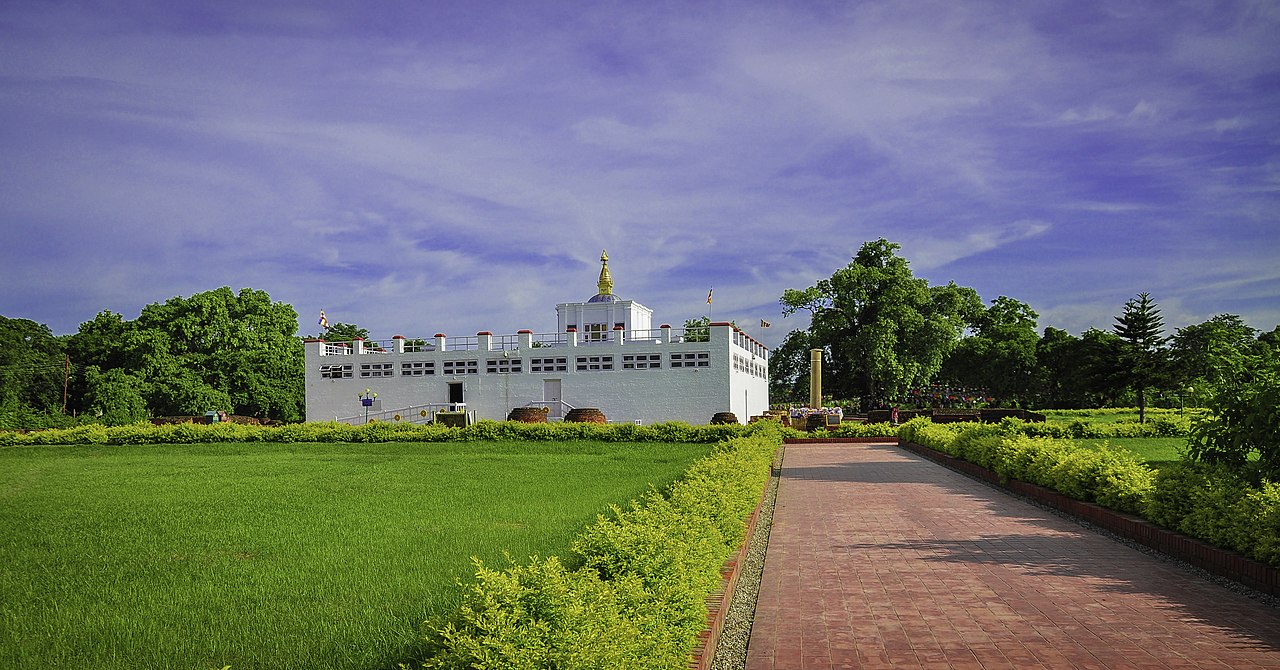


Muktinath Travel Guide
Perched at 3,710 metres in the windswept Mustang valley, Muktinath is one of the rare holy places sacred to both Hindus and Buddhists, a temple of salvation where pilgrims bathe under 108 spouts beside a flame that has burned for centuries.
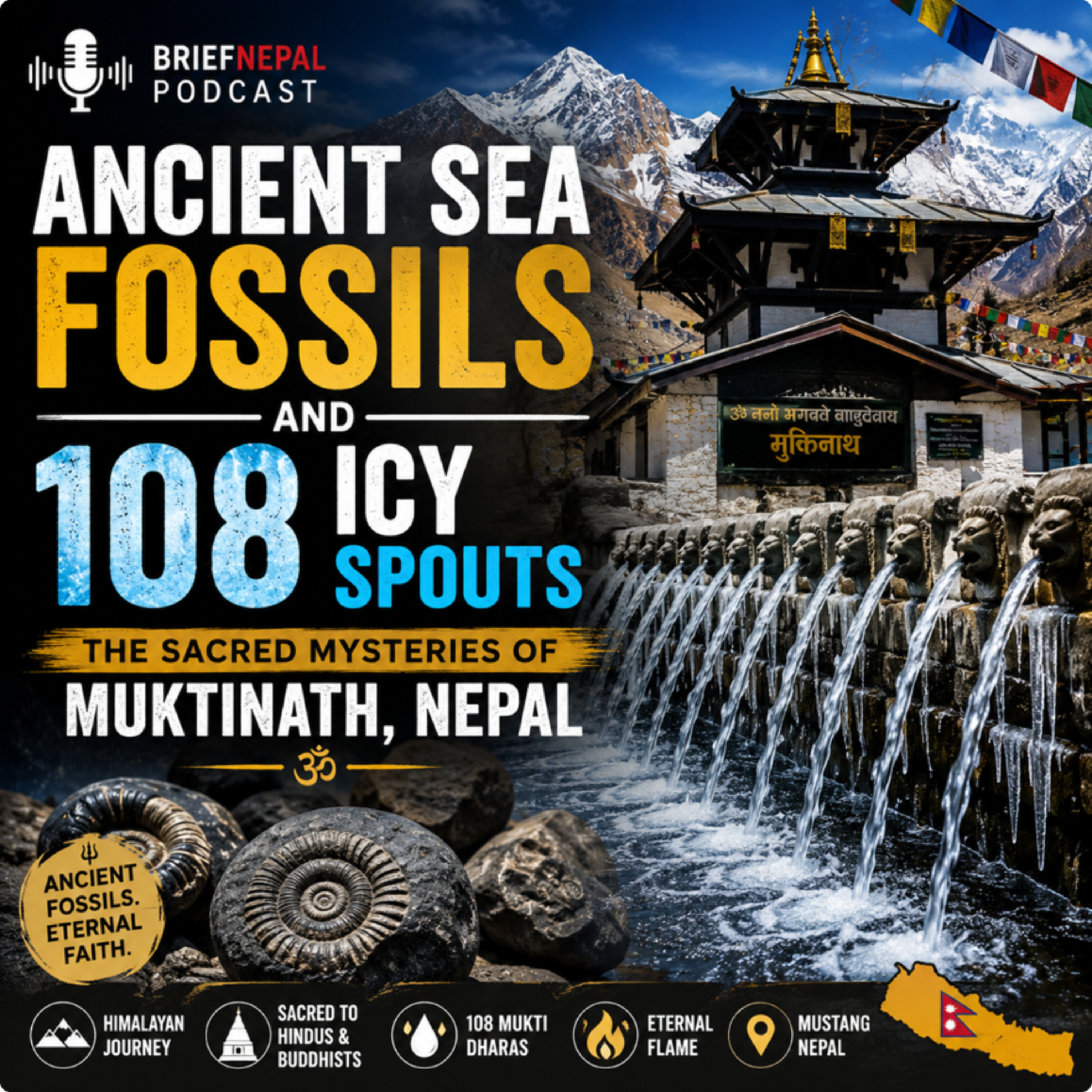
How can 380-million-year-old sea fossils be found high in the Himalayas? Why do thousands of pilgrims brave the freezing waters flowing from 108 sacred spouts every year?…
▶ Listen on SpotifyShow notes & transcript →Follow the show →
🎧 Also on Apple Podcasts Castbox iHeartRadio
A glimpse of Muktinath


Introduction
Muktinath is one of the most revered pilgrimage sites in the Himalaya, set at an altitude of about 3,710 metres (12,170 feet) in the Mustang district of north-central Nepal. Its name comes from two Sanskrit words, mukti, meaning liberation or salvation, and nath, meaning lord, so Muktinath is literally "the lord of salvation." For Hindus it is one of the 108 Divya Desams of Lord Vishnu and the holiest of them in the mountains; for Tibetan Buddhists it is Chumig Gyatsa, "the hundred waters," a sacred dwelling of the bodhisattva of compassion. Few places in the world are worshipped so deeply by two great faiths at once, and fewer still combine that with such a dramatic high-mountain setting.
The temple sits in the rain shadow of the Annapurna and Dhaulagiri massifs, in a stark, treeless landscape of ochre cliffs, prayer flags and snow peaks that feels closer to Tibet than to the green hills of lower Nepal. Pilgrims have walked here for well over a thousand years, following the deep gorge of the sacred Kali Gandaki river, the only river in the world to yield Shaligram, the black ammonite fossils worshipped as Vishnu himself. Today the same journey can be done by jeep, by a short mountain flight to Jomsom, by a multi-day trek over the Thorong La pass, or even by helicopter, but the sense of arrival at the temple gate is unchanged.
This guide covers everything a traveller or pilgrim needs to plan a trip to Muktinath: the religious significance for both faiths, what to see and do at the site, the best time to go, every way to reach it from Pokhara and Kathmandu, the permits and costs involved, where to eat and sleep along the route, and the practical tips, especially on altitude and cold, that make the high-mountain journey safe and rewarding.
Top Attractions
Muktinath Vishnu Temple (Mukti Kshetra)
The heart of the pilgrimage: a small pagoda-style shrine housing a golden image of Lord Vishnu, set in a walled courtyard at around 3,710 metres. For Hindus this is Mukti Kshetra, the "place of salvation (mukti)", and one of the 108 sacred Divya Desams, the holy abodes of Vishnu revered across the Hindu world and the only one located in the Himalayas. Pilgrims believe a visit here washes away the sins of past lives and helps the soul towards moksha, liberation from the cycle of rebirth.
108 Bull-Head Water Spouts (Muktidhara)
Behind the main temple, a semicircular wall carries 108 brass spouts shaped like bull (or cow) heads, each pouring an icy stream of glacier-fed water. Devotees run beneath all 108 in turn, then bathe in the two adjacent ponds, as an act of purification said to cleanse a lifetime of sins. The number 108 is sacred in both Hindu and Buddhist tradition; the freezing water makes the holy bath a genuine test of devotion at this altitude.
Jwala Mai Temple (Eternal Flame)
A short walk below the main shrine stands the small Jwala Mai temple, where a natural eternal flame burns from the rock and earth beside a spring. Fed by an underground natural-gas seep, the flame appears to burn from water and stone alike, a phenomenon revered as a miracle and one of the rare places sacred to fire, water and earth together. It is treasured by Hindus as a manifestation of Brahma and by Buddhists as a sacred flame.
Mebar Lha Gompa (Chumig Gyatsa)
The Buddhist heart of the site, this gompa (monastery) is run by nuns and sits within the same sacred compound. Tibetan Buddhists call the place Chumig Gyatsa, meaning "hundred waters," and revere it as one of the 24 great Tantric places and a dwelling of Avalokiteshvara, the bodhisattva of compassion (Chenrezig). Guru Rinpoche (Padmasambhava) is said to have meditated here on his way to Tibet, making it a deeply holy stop on the Buddhist map of the Himalaya.
Shaligram (Sacred Ammonite Fossils)
The Kali Gandaki River below Muktinath is the world's only source of Shaligram, black ammonite fossils, the petrified remains of ancient sea creatures from when the Himalaya were ocean floor. Hindus venerate the Shaligram as a natural, self-manifested form of Lord Vishnu and keep them on home and temple altars across India and Nepal. Pilgrims search the riverbanks and buy authentic stones in Kagbeni and Jomsom; their presence is one reason Muktinath grew into such a powerful Vishnu shrine.
Ranipauwa Village
The base settlement for the pilgrimage, Ranipauwa sits just below the temple at around 3,710 metres and is where the road, the lodges, shops and restaurants are concentrated. From here it is a steady 15–20 minute uphill walk (or a short pony ride) to the temple gate. Almost every visitor stays, eats or at least stops here, and it is the best place to acclimatise, warm up and stock up before climbing to the shrine.
Jomsom & Marpha (En Route)
Jomsom (2,720m) is the administrative hub of Lower Mustang, with the region's airport and a busy bazaar; most jeeps and treks to Muktinath pass through it. An hour south lies Marpha, a beautiful whitewashed Thakali village famous across Nepal for its apple orchards, apple brandy and cider, and its tidy stone-paved lanes. Both make rewarding overnight stops that help with acclimatisation and showcase the food and culture of Mustang.
Kagbeni (Gateway Village)
At the confluence where the trail to Upper Mustang begins, the medieval village of Kagbeni (2,800m) is the traditional gateway to Muktinath. Its mud-brick lanes, ancient Kag Chode monastery and a riverside Vishnu shrine draw pilgrims who perform rituals for departed ancestors (shraddha) here and at Muktinath. Kagbeni is also one of the best spots to find Shaligram fossils and to feel the abrupt shift from green lowlands into the arid trans-Himalayan landscape.
History & Religious Significance
Muktinath's sanctity is ancient and shared. The site is mentioned in Hindu scripture as Mukti Kshetra or Mukti Dham, the "place of salvation," and is counted among the 108 Divya Desams, the holy abodes of Lord Vishnu celebrated by the Tamil Alvar saints and revered by Vaishnavites across the Hindu world. It is the only Divya Desam outside the Indian subcontinent's lowlands and the only one set high in the Himalaya. Hindus believe that a pilgrimage to Muktinath, together with the holy bath under its 108 spouts, frees the devotee from the cycle of rebirth and grants moksha, the final liberation of the soul.
The connection to Vishnu is bound up with the Shaligram. The Kali Gandaki river below the temple is the world's sole source of these black ammonite fossils, which Hindus venerate as a swayambhu (self-manifested) form of Vishnu. Pilgrims have gathered Shaligram here for millennia, and many perform shraddha rites for departed ancestors at Muktinath and the nearby village of Kagbeni, believing the merit earned at this place is especially powerful.
For Tibetan Buddhists the same site is Chumig Gyatsa, "the hundred waters," and one of the 24 great Tantric places of the Himalaya. It is held to be a dwelling of Avalokiteshvara (Chenrezig), the bodhisattva of compassion, and tradition says Guru Rinpoche (Padmasambhava), who carried Buddhism to Tibet in the 8th century, meditated here on his journey north. The flame that burns from the rock at the Jwala Mai temple, beside flowing water, is treasured as a sacred miracle in which the three elements of earth, water and fire coexist. The same Buddhist nuns who tend the Mebar Lha Gompa care for the shrine, and Hindu and Buddhist worshippers move through the compound side by side, a rare living example of two faiths sharing one holy ground.
Geologically, the landscape itself tells the deeper story: the Shaligram fossils are the remains of sea creatures from the Tethys Ocean that once lay where the Himalaya now stand, lifted skyward when the Indian and Asian plates collided. The eternal flame is fed by a natural-gas seep in the same rock. Science and scripture meet at Muktinath, which only deepens the sense of standing somewhere genuinely set apart.
What to See & Do
Muktinath is compact, the core sites cluster within a single walled compound above Ranipauwa, but each carries deep meaning, and the surrounding valley adds days of worthwhile exploring. Here is how to make the most of a visit:
- Take the holy bath under the 108 spouts. The signature ritual: walk beneath all 108 bull-head spouts in sequence as the freezing glacier water pours over you, then dip in the two sacred ponds. Most pilgrims do this at first light, dry off quickly and change into warm layers, the cold is fierce at 3,710 m.
- Worship at the Vishnu temple. Receive darshan of the golden Vishnu image, offer flowers and prasad, and circumambulate the shrine. Photography inside the inner sanctum is usually restricted, so follow the priests' guidance.
- See the eternal flame at Jwala Mai. Step into the small temple below the main shrine to watch the natural flame burning from rock and water, a highlight for visitors of every faith.
- Visit the Mebar Lha Gompa. Spin the prayer wheels, light a butter lamp and take in the Tibetan-Buddhist heart of Chumig Gyatsa, cared for by the resident nuns.
- Search for or buy Shaligram. Look along the Kali Gandaki banks, or buy authentic ammonite fossils in Kagbeni and Jomsom to take home as a sacred keepsake.
- Explore Kagbeni and the Upper Mustang gateway. Wander the medieval mud-brick village, see the old Kag Chode monastery and the riverside Vishnu shrine, and feel the threshold to the forbidden kingdom of Upper Mustang beyond.
- Stop in Marpha and Jomsom. Taste Marpha's famous apples, apple brandy and cider, walk its whitewashed lanes, and soak up the Thakali culture and bazaar life of Jomsom.
- Soak up the mountain panorama. On clear mornings the views of Dhaulagiri, Nilgiri and the Annapurnas from the temple ridge are extraordinary, reason enough to be up early.
Best Time to Visit
The best times to visit Muktinath are spring (March to June) and autumn (September to November), when the skies are clearest, the trails and roads are open, and the temperatures, while cold at night, are manageable by day. Autumn in particular brings crisp visibility and the great festival season, and it overlaps with the prime trekking window for those arriving on foot.
Because Muktinath lies in the rain shadow of the Annapurna and Dhaulagiri ranges, the heavy summer monsoon that drenches the rest of Nepal largely passes it by, Mustang stays comparatively dry even in July and August, which makes the pilgrimage possible in the monsoon when much of the country is washed out. The trade-off is strong afternoon winds funnelling up the Kali Gandaki gorge (usually picking up by late morning) and the risk of flight delays and landslides on the access road.
Winter (December to February) is the hardest season. Heavy snow regularly blocks the road and the high passes, the temple area can be bitterly cold with sub-zero nights, and many lodges in Ranipauwa close or run on skeleton staff. Pilgrims still come on clear winter days, but the journey is far less reliable and a road closure can strand you. If your dates are flexible, aim for April–May or October for the best balance of weather, access and atmosphere.
How to Reach Muktinath
Muktinath sits at about 3,710 metres in Lower Mustang, and almost every route to it runs up the deep gorge of the Kali Gandaki. There are four main ways to get there, and many pilgrims combine them, for example flying one way and driving the other.
By flight via Jomsom (fastest)
The quickest option is to fly from Pokhara to Jomsom (2,720m) on a short, spectacular 20–25 minute mountain flight through the gorge between Annapurna and Dhaulagiri. From Jomsom airport it is a 1.5–2 hour jeep ride up to Ranipauwa, then a short walk to the temple. Jomsom flights operate in the early morning only, before the valley winds rise, and are frequently delayed or cancelled by weather, always keep a buffer day.
By road (jeep or bus up the Kali Gandaki)
The classic overland pilgrimage runs from Pokhara to Beni, then up the Kali Gandaki valley through Tatopani (with its hot springs), Ghasa, Marpha and Jomsom to Ranipauwa and Muktinath. Shared and private jeeps make the trip; the lower section is paved but the upper valley is rough, dusty mountain road. Allow a long day or, better, two days from Pokhara by jeep (roughly 8–10+ hours of driving in total), breaking the journey at Tatopani, Marpha or Jomsom to acclimatise. Local buses run as far as Jomsom from Beni and Pokhara but are slow and crowded.
On foot (Annapurna Circuit / Thorong La)
The most rewarding way for trekkers is to walk in over the Thorong La pass (5,416m) on the Annapurna Circuit, descending to Muktinath from the high pass, a classic multi-day trek that approaches the temple from the north. Others trek up the Kali Gandaki valley trail from Jomsom or Kagbeni in a day or two. Trekking gives the best acclimatisation and scenery but needs a week or more and proper preparation.
By helicopter
For pilgrims short on time or unable to manage the road, helicopter tours run from Pokhara (and sometimes Kathmandu) directly to a helipad near Ranipauwa, often as a half-day round trip with a couple of hours at the temple. It is by far the fastest and most comfortable option, and popular with older devotees, but it is expensive and the rapid gain to 3,710 m gives no time to acclimatise, go slowly at the temple and watch for altitude symptoms.
Muktinath Yatra from India
Muktinath is one of the most revered pilgrimage destinations for Indian devotees. It is a Divya Desam, one of the 108 sacred abodes of Lord Vishnu venerated in the Vaishnavite tradition, and is honoured across India as a great Mukti Kshetra (place of liberation). Every year large numbers of pilgrims travel from India for darshan, and the good news is that reaching Muktinath from India is straightforward.
Visa and documents
Indian citizens do not need a visa to enter Nepal. You should carry a valid government photo ID, a passport or a voter ID card (Aadhaar is not universally accepted for the crossing, so a passport or voter ID is safest), and it is wise to keep a few passport photos and photocopies for permits and hotels.
Getting into Nepal
- By air: the simplest route is a flight to Kathmandu (from Delhi, Varanasi, Lucknow, Kolkata, Mumbai and other cities) or directly to Bhairahawa (Gautam Buddha International Airport) or Pokhara where services are available. From Kathmandu or Pokhara you then follow the standard routes above.
- Overland via the border: popular crossings are Sunauli–Bhairahawa (from Gorakhpur and eastern Uttar Pradesh), Raxaul–Birgunj (from Bihar) and Kakarbhitta (from West Bengal). From the border, buses and jeeps run to Pokhara, the gateway for Muktinath.
From Pokhara to Muktinath
Once in Pokhara, every option in the How to Reach section applies: the short flight via Jomsom, the jeep journey up the Kali Gandaki, the Jomsom–Muktinath trek, or a helicopter tour that many elderly Indian pilgrims choose for comfort. See our full Pokhara to Jomsom guide for that leg, and the Muktinath cost breakdown for current permit and transport prices.
A wider pilgrim circuit
Many Indian pilgrims combine Muktinath with Nepal's other great sacred sites: Pashupatinath in Kathmandu, the Buddha's birthplace at Lumbini, and the Janaki Mandir of Sita at Janakpur, all within a single Nepal trip.
Costs & Permits
Muktinath lies inside the Annapurna Conservation Area, so every visitor needs the relevant permits, and the high-mountain logistics make it pricier than lowland trips. Approximate 2026 costs (per person, in Nepali rupees):
| Item | Cost | Notes |
|---|---|---|
| ACAP permit (foreigners) | NPR 3,000 | Annapurna Conservation Area Permit; SAARC nationals pay less. Buy in Pokhara, Kathmandu or Besisahar. |
| ACAP permit (Indian / SAARC) | NPR 1,000 | Reduced rate for SAARC-country citizens. |
| TIMS card (trekkers) | NPR 1,000–2,000 | Needed if trekking in; not required if you only drive/fly to the temple. |
| Pokhara–Jomsom flight (one way) | NPR 8,000–12,000 | 20–25 min mountain flight; price varies by season. |
| Shared jeep (Jomsom–Muktinath) | NPR 1,500–3,000 | Per seat, one way; private jeep costs more. |
| Private jeep (Pokhara round trip) | NPR 30,000–50,000 | 2–3 day package; split among a group to reduce cost. |
| Helicopter charter (Pokhara) | Premium, quoted in lakhs of rupees | Per charter on a shared flight; varies widely with group size. |
On-the-ground spending: a dal bhat set in Ranipauwa or Jomsom runs around NPR 500–900 (prices climb with altitude), a basic lodge room NPR 800–3,000, and the temple itself charges no entry fee. Budget extra for porters, ponies up to the temple, tips and warm gear. There are a few ATMs in Jomsom but they are unreliable at altitude, carry enough cash in Nepali rupees from Pokhara to cover the whole trip.
Food & Where to Eat
Food along the Muktinath route is hearty mountain fare, built to fuel a cold, high-altitude journey. The region is the homeland of the Thakali people, and the local Thakali thali (dal bhat), rice, lentils, vegetable and meat curry, greens and fiery pickle, with refills, is widely considered among the best versions of Nepal's national dish. Lodges in Ranipauwa, Jomsom and the villages en route all serve it.
Beyond dal bhat, expect Tibetan and Himalayan staples: thukpa (noodle soup), tenthuk, momos, tsampa porridge and butter tea, all warming and easy on the stomach at altitude. Marpha is a culinary highlight, its orchards produce famous apples turned into fresh fruit, dried apples, apple pie, cider and the locally distilled apple brandy. In Jomsom and Ranipauwa you will also find simple bakeries, eggs and Western breakfasts aimed at trekkers.
Eating at altitude: favour freshly cooked, hot vegetarian food and warm drinks, eat lightly the day you arrive at 3,710 m while your body adjusts, and stay well hydrated. Drink bottled, filtered or boiled water, a reusable bottle with a filter or purification tablets cuts plastic waste, which is a real problem in the mountains, and saves money. Go easy on alcohol, including Marpha brandy, until you are acclimatised.
Where to Stay
Most pilgrims stay in Ranipauwa, the village directly below the temple at around 3,710 m, where a cluster of guesthouses, pilgrim rest houses (dharamshalas) and small hotels line the road. Rooms are simple, twin beds, shared or basic private bathrooms, and limited heating, but they put you within a short walk of the shrine, which is ideal for the early-morning holy bath. Some larger pilgrim hotels and dharamshalas cater specifically to Indian devotees.
Jomsom (2,720m), about 1.5–2 hours below by jeep, has the widest choice of comfortable lodges and a few better-equipped hotels, and its lower altitude makes it a sensible, warmer overnight stop that also aids acclimatisation. Marpha and Kagbeni offer characterful village guesthouses for those travelling more slowly, and Tatopani is a popular lower-valley halt thanks to its hot springs.
- Pilgrim lodges & dharamshalas (Ranipauwa): basic, cheap and closest to the temple; best for a quick darshan-focused trip.
- Trekker lodges (Jomsom, Marpha, Kagbeni): comfortable teahouses with hot showers (often gas-heated and chargeable) and good food.
- Better hotels (Jomsom): a handful of mid-range properties with more reliable heating, hot water and Wi-Fi.
Book ahead during the autumn and spring peaks and around major Hindu festivals, when Indian pilgrim groups fill Ranipauwa. In winter, confirm in advance that your chosen lodge is open, as many close when the snow comes.
Travel Tips
- Respect the altitude. At 3,710 m, Acute Mountain Sickness (AMS) is a real risk, especially if you arrive fast by helicopter or flight. Ascend gradually where you can, drink plenty of water, avoid alcohol on arrival, and descend if you develop a bad headache, nausea or breathlessness. Spending a night in Jomsom (2,720m) first helps your body adjust.
- Dress for serious cold. Even in summer the temple area is cold and windy, and mornings near freezing. Bring warm layers, a windproof jacket, hat and gloves, and a quick-drying towel and change of clothes for the holy bath under the spouts.
- Sensible footwear for the spouts. The temple steps and the area around the 108 spouts are wet, icy and slippery; you will be barefoot for the ritual, so wear shoes that are easy to remove and have sandals or grippy slip-ons for the wet stone.
- Start the temple visit early. The morning is calmest and clearest; afternoon winds funnel up the Kali Gandaki and can be fierce, and morning flights are also less likely to be cancelled.
- Carry cash. ATMs at altitude are scarce and unreliable; bring enough Nepali rupees from Pokhara for the whole trip, including permits, lodges, food, ponies and tips.
- Build in buffer days. Jomsom flights and the access road are both weather-dependent and frequently disrupted; never plan the trip with no margin if you have a fixed onward flight.
- Get your permits before you go. Buy the ACAP permit (and TIMS, if trekking) in Pokhara or Kathmandu; checkpoints along the route will ask to see them.
- Consider a pony or porter. Older pilgrims can hire a pony or a porter in Ranipauwa for the final climb to the temple gate, which is steep at this altitude.
- Travel insurance with high-altitude and helicopter cover. Given the altitude and remoteness, choose a policy that covers trekking to your planned height and emergency helicopter evacuation.
- Combine the journey. Many visitors pair Muktinath with the wider Mustang region or treat it as a Himalayan complement to the lowland Hindu pilgrimage at Pashupatinath in Kathmandu.
Frequently Asked Questions
How do I reach Muktinath from Pokhara?
From Pokhara you can fly to Jomsom (a 20–25 minute mountain flight) and take a 1.5–2 hour jeep up to Ranipauwa, or drive the whole way by jeep up the Kali Gandaki valley through Beni, Tatopani, Marpha and Jomsom in one long or two relaxed days. Helicopter tours from Pokhara are the fastest option, and trekkers can walk in over the Thorong La pass.
How high is Muktinath and is altitude sickness a risk?
Muktinath sits at about 3,710 metres (12,170 feet), high enough that Acute Mountain Sickness (AMS) is a real risk, especially if you arrive quickly by flight or helicopter. Ascend gradually where possible, stay hydrated, avoid alcohol on arrival, and descend if you develop a severe headache, nausea or breathlessness. A night in Jomsom (2,720m) first helps you acclimatise.
What is the best time to visit Muktinath?
The best times are spring (March to June) and autumn (September to November), with clear skies and open roads. Because Muktinath lies in a rain shadow it stays relatively dry even in the summer monsoon, so July–August is also possible. Winter (December–February) is hardest, as heavy snow often closes the road and the high passes.
Why is Muktinath sacred to both Hindus and Buddhists?
For Hindus, Muktinath is Mukti Kshetra, the "place of salvation," and one of the 108 Divya Desams of Lord Vishnu, where pilgrimage and the holy bath are believed to grant moksha. For Tibetan Buddhists it is Chumig Gyatsa, "the hundred waters," one of the 24 great Tantric places and a dwelling of Avalokiteshvara, where Guru Rinpoche is said to have meditated. Both faiths worship at the same shrine and its eternal flame.
Can you drive all the way to Muktinath?
Yes. A jeep can drive from Pokhara up the Kali Gandaki valley through Beni, Tatopani, Marpha and Jomsom to Ranipauwa, just below the temple, from where it is a short uphill walk to the shrine. The lower section is paved and the upper valley is rough mountain road; in winter snow can block the route entirely.
What is the meaning of the 108 water spouts at Muktinath?
Behind the main temple are 108 brass bull-head spouts pouring icy glacier water, and pilgrims bathe under all 108 in sequence as an act of purification believed to wash away a lifetime of sins. The number 108 is sacred in both Hindu and Buddhist tradition, which is why the spouts and the site itself ("hundred waters") carry that number.
What is the eternal flame at Muktinath?
At the small Jwala Mai temple below the main shrine, a natural flame burns continuously from the rock and earth beside flowing spring water, fed by an underground natural-gas seep. It is revered as a sacred miracle in which earth, water and fire coexist, and is honoured by both Hindus and Buddhists.
Is there a helicopter to Muktinath?
Yes. Helicopter tours run from Pokhara (and sometimes Kathmandu) directly to a helipad near Ranipauwa, often as a half-day round trip with a couple of hours at the temple. It is the fastest and most comfortable option and popular with older pilgrims, but it is expensive and the rapid ascent to 3,710 m leaves no time to acclimatise.
What permits do I need to visit Muktinath?
Muktinath is inside the Annapurna Conservation Area, so you need an ACAP permit (around NPR 3,000 for foreigners, less for SAARC nationals), which you buy in Pokhara, Kathmandu or Besisahar. Trekkers also need a TIMS card. There is no entry fee for the temple itself.
How much does a trip to Muktinath cost?
Costs depend on how you travel. A shared-jeep pilgrimage with basic lodges is the cheapest; the ACAP permit is around NPR 3,000 for foreigners, a one-way Pokhara–Jomsom flight is roughly NPR 8,000–12,000, a private jeep round trip NPR 30,000–50,000, and helicopter charters are a premium option quoted in lakhs of rupees. Lodges and meals are more expensive than in the lowlands because of the altitude, so budget roughly NPR 4,000–8,000 per day on the ground depending on how you travel.
What is Shaligram and why is it important at Muktinath?
Shaligram are black ammonite fossils found only in the Kali Gandaki river below Muktinath, the petrified remains of sea creatures from when the Himalaya were ocean floor. Hindus venerate them as a self-manifested (swayambhu) form of Lord Vishnu and keep them on home and temple altars, which is one reason Muktinath grew into such a powerful Vishnu shrine.
How many days do you need for Muktinath?
If you fly to Jomsom or take a helicopter, the pilgrimage can be done in two to three days from Pokhara, including a buffer for weather. By jeep, allow three to four days round trip from Pokhara to travel safely and acclimatise. Trekking in over the Thorong La pass on the Annapurna Circuit takes a week or more.
Where is Muktinath located?
Muktinath is in the Mustang district of north-central Nepal, in the trans-Himalayan region in the rain shadow of the Annapurna and Dhaulagiri massifs, at an altitude of about 3,710 metres. The nearest hub is Jomsom, and the gateway town for the whole journey is Pokhara.
What should I wear and pack for Muktinath?
Pack warm layers, a windproof jacket, hat and gloves even in summer, as the temple area is cold and windy with near-freezing mornings. Bring a quick-drying towel and a change of clothes for the holy bath under the 108 spouts, easy-to-remove footwear plus grippy sandals for the wet stone, sun protection, and any altitude medication you may need.
Can non-Hindus visit Muktinath?
Yes. Muktinath welcomes visitors of all faiths and nationalities, it is sacred to both Hindus and Buddhists, and travellers of any background can enter the compound, see the eternal flame, visit the gompa and walk among the 108 spouts. Follow the priests' guidance inside the inner sanctum, where photography may be restricted.
How do I reach Muktinath from India?
First enter Nepal, then head to Pokhara, the gateway for Muktinath. The easiest way is to fly to Kathmandu (from Delhi, Varanasi, Lucknow, Kolkata and other cities) or directly to Bhairahawa or Pokhara. Overland, the main border crossings are Sunauli–Bhairahawa (from Gorakhpur), Raxaul–Birgunj (from Bihar) and Kakarbhitta (from West Bengal), with onward buses or jeeps to Pokhara. From Pokhara you reach Muktinath by the Jomsom flight, a jeep up the Kali Gandaki, a trek, or a helicopter tour.
Do Indian citizens need a visa for Muktinath or Nepal?
No. Indian nationals do not need a visa to enter Nepal. Carry a valid government photo ID such as a passport or voter ID card (a passport or voter ID is safer than Aadhaar at the border), plus a few passport photos and photocopies for permits and hotels.
Is Muktinath one of the Divya Desams?
Yes. Muktinath (Thiru Saligramam) is one of the 108 Divya Desams, the holy abodes of Lord Vishnu revered in the Vaishnavite tradition, and the only one located outside India, high in the Nepal Himalaya. This is a major reason it draws so many pilgrims from across India.
Can elderly pilgrims visit Muktinath?
Yes, and many do. Older or less mobile pilgrims usually choose the helicopter tour from Pokhara (a comfortable half-day round trip) or a Jomsom flight followed by a short jeep ride and a gentle walk to the temple. Because Muktinath sits at 3,710 m, take it slowly on arrival, rest, hydrate, and watch for altitude symptoms, as the ascent is rapid.
Reviews & Ratings
One of the best place to visit, for peace spirtiuality and happiness
Official sources
Fees and rules on this page come from the bodies that set them. They do change, sometimes mid-season, so check the primary source before you pay anything.
- National Trust for Nature Conservation Annapurna Conservation Area (ACAP) permitsntnc.org.np
- Trekking Agencies' Association of Nepal TIMS card rules & feeswww.taan.org.np
- Department of Immigration Nepal visa on arrival, fees & extensionswww.immigration.gov.np
- Dept. of National Parks & Wildlife Conservation National park & conservation area entry feesdnpwc.gov.np

By the BriefNepal Travel Desk
Researched and maintained by our Nepal-based editorial team and reviewed for accuracy. Last updated September 3, 2026. Prices, permits and conditions change, always verify before you travel. Spotted something out of date? Let us know.
Nepal Currency Converter
Live exchange rates for the Nepalese Rupee (NPR) against every world currency, handy for budgeting the prices in our guides.
Live mid-market rates. For information only, banks and exchanges apply their own margins.
Planning a trip to Nepal?
Join the BriefNepal Travel list for seasonal tips, new guides and our free Nepal trip-planning checklist. No spam, unsubscribe anytime.
