


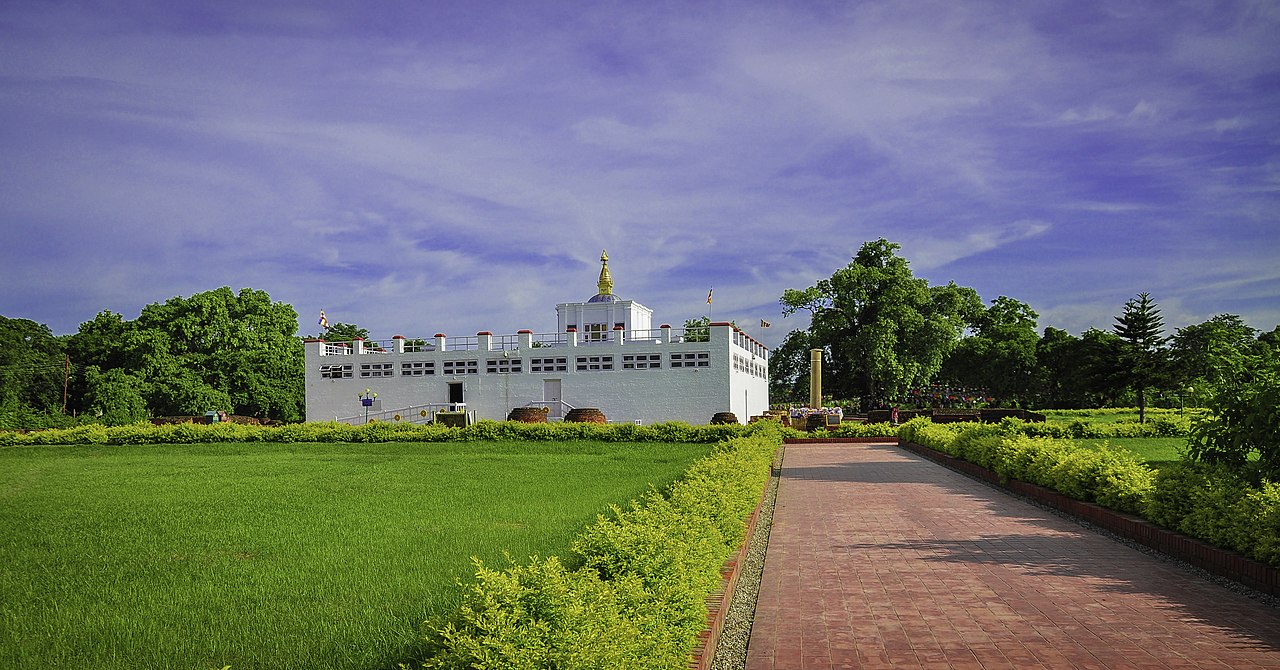


Nepal in Monsoon
When the warm, wet clouds roll in from the Bay of Bengal, Nepal turns electric green, terraced paddies shimmer, waterfalls thunder back to life, and the crowds melt away.
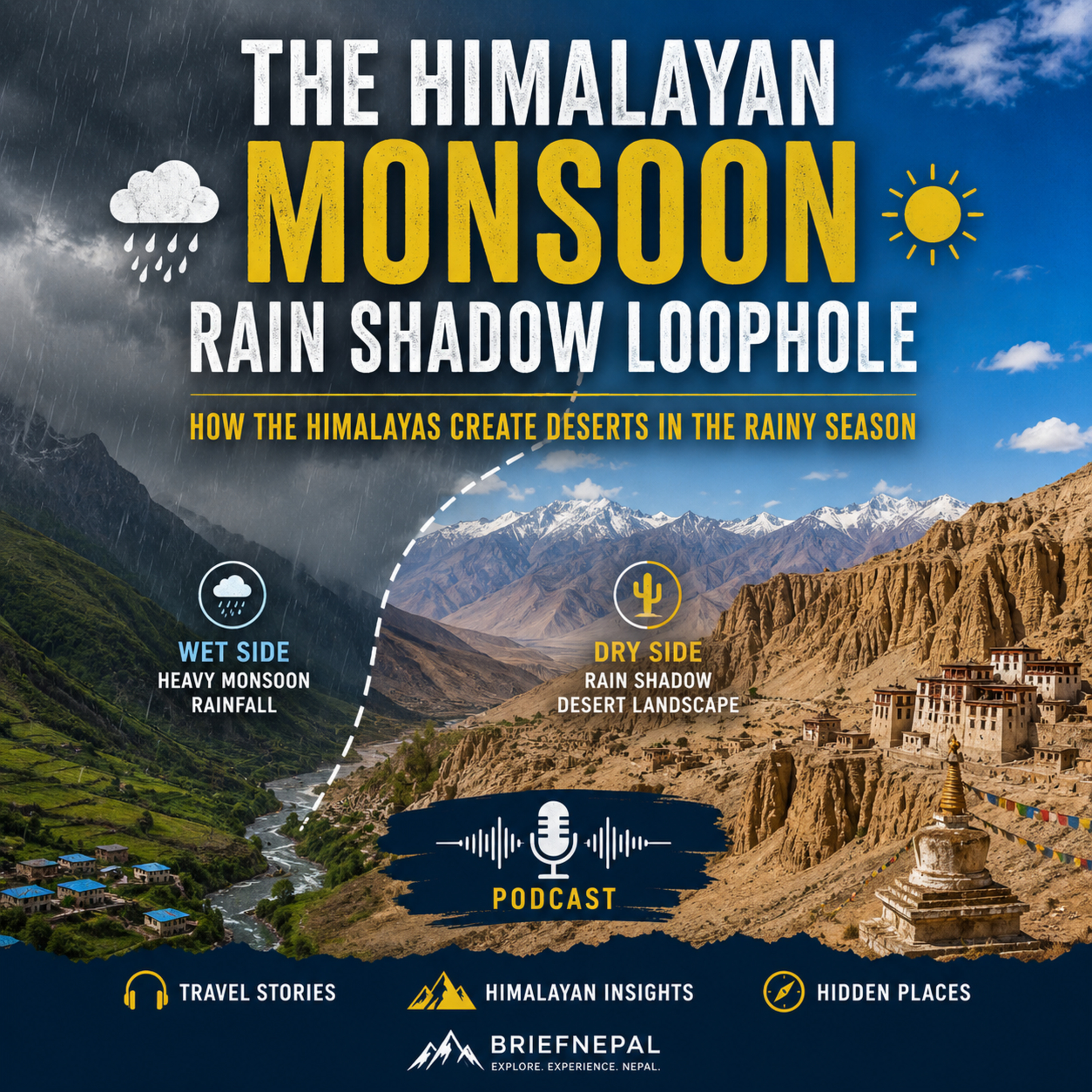
The Himalayan Monsoon Rain Shadow LoopholeJourney beyond the monsoon into one of the Himalayas' best-kept secrets. In this episode, we explore the fascinating phenome…
▶ Listen on SpotifyShow notes & transcript →Follow the show →
🎧 Also on Apple Podcasts Castbox iHeartRadio
A glimpse of Nepal in Monsoon


Overview
Monsoon is Nepal's most misunderstood season. The summer rains run roughly from mid-June through August, lingering into early September before the skies clear for autumn. During these months Nepal receives the bulk of its yearly rainfall, by most estimates around 80% of the annual total, as moisture-laden clouds sweep up from the Bay of Bengal and pile against the Himalaya. It is the season most guidebooks tell you to avoid, and for trekking the high classic routes they are largely right. But monsoon is also the season Nepalis love best: the season of planting, of green so intense it looks unreal, and of some of the country's most joyful festivals.
Crucially, "monsoon" does not mean constant rain. Across most of Nepal the pattern is heavy afternoon and overnight downpours with bright, washed-clean mornings, you can lose a few hours, not whole days. The hills turn emerald, rice paddies fill and shimmer, rivers run high and waterfalls reappear on every cliff. And there is one decisive advantage that changes the whole calculation: large parts of Nepal lie in the rain shadow of the high Himalaya, where the monsoon barely reaches, making summer one of the only times to trek the spectacular trans-Himalayan deserts of Mustang and Dolpo.
In brief, the trade-off looks like this. The downsides: obscured mountain views, muddy and leech-prone trails, occasional flight delays and road landslides, high humidity and Terai heat. The upsides: dramatic green landscapes, the fewest tourists of the year, the lowest prices for flights and rooms, vibrant festivals, and unbeatable access to the rain-shadow trekking regions. For the flexible, photography-minded or budget-conscious traveller, or anyone heading to Mustang or Dolpo, monsoon can be a quietly brilliant time to visit Nepal.
Weather & Rainfall
The defining feature of Nepal's monsoon is its rhythm. Most days follow a predictable arc: clear or partly cloudy mornings, building cloud through midday, then heavy rain in the late afternoon and overnight, often clearing again by dawn. This is why early starts are gold in summer, you do your sightseeing or walking in the bright morning hours and shelter through the afternoon storms. Genuine all-day rain happens, but it is the exception rather than the rule across most regions.
Temperatures are warm and the air is humid. In the Kathmandu Valley (~1,400 m) expect daytime highs around 25–29°C and muggy, sticky nights near 19–21°C. Pokhara is similar but wetter, it is one of the rainiest places in Nepal. The Terai lowlands (Chitwan, Lumbini, the southern plains) are the hot, sweaty extreme, with highs frequently 32–36°C and oppressive humidity; this is the most uncomfortable region in summer. Up in the hills and lower mountains it stays milder, and the high rain-shadow valleys of Mustang and Dolpo are cooler and strikingly dry.
| Region | Typical monsoon day temp | Conditions |
|---|---|---|
| Kathmandu Valley | 25–29°C | Humid, afternoon/overnight rain, green & clean mornings |
| Pokhara | 26–30°C | Very wet, lush, lake and clouds; rare clear mountain windows |
| Terai (Chitwan, Lumbini) | 32–36°C | Hot and very humid, heavy rain, high rivers |
| Mustang & Dolpo (rain shadow) | 15–25°C (lower by altitude) | Dry, sunny, cool nights — trekkable in summer |
Two trail hazards are worth knowing about. First, leeches: in the wet forests of the hills (anywhere with damp, vegetated lower-altitude trails) land leeches come out in force during monsoon. They are harmless but unpleasant, see the packing and tips sections for how to deal with them. Second, trails and dirt roads become muddy and slippery, and river crossings can be high. None of this is dangerous with care, but it changes the character of summer walking. Mountain views are the real casualty: the high peaks are usually wrapped in cloud, with only fleeting clear windows, so monsoon is not the season for guaranteed Himalayan panoramas, except, again, in the rain shadow.
Nepal in June, July & August: Month by Month
The monsoon is not one uniform block of rain — each month has its own character, and it changes what you can comfortably do.
Nepal in June
The monsoon usually arrives in mid-June, sweeping west across the country over a week or two. Early June can still feel like late spring — hot, hazy and dry — while late June brings the first proper downpours. Kathmandu turns humid and sticky (highs around 27–29°C), the Terai swelters, and rice planting fills the fields with the festive bustle of Ropain. A good month to catch low prices before the rains fully settle in, and a fine time to start a Mustang or Dolpo itinerary as the rain-shadow season opens.
Nepal in July
The wettest month of the year almost everywhere. Expect heavy overnight and afternoon rain, dramatic skies, thundering rivers and the hills at their greenest. Mountain views are rare, flights to Lukla and Jomsom are frequently delayed, and hill roads suffer landslides — build slack into any itinerary. This is peak season for the rain-shadow routes: Upper Mustang and Upper Dolpo are dry, sunny and at their best while the rest of the country drips.
Nepal in August
Still solidly wet, but the second half often brings longer clear spells, and the festival calendar lights up — Janai Purnima and Gai Jatra, with the women's festival of Teej following in late August or September depending on the year. Humidity stays high and trails stay muddy and leech-prone, but by late August the worst is usually past and September's clearing skies are within sight. Mustang's Yartung horse festival makes late August special in the rain shadow.
Where to Go in Monsoon
The secret to a great monsoon trip in Nepal is to go where the rain doesn't, or to lean into the green rather than fight it. There are three broad strategies.
Rain-shadow trekking: the monsoon trump card
North of the main Himalayan crest, several regions sit in a deep rain shadow: the high peaks wring the moisture out of the clouds before they reach the trans-Himalayan valleys, leaving them dry, sunny and trekkable all summer. This is monsoon's killer advantage and the reason serious trekkers come in July and August at all.
- Upper Mustang, the old forbidden kingdom of Lo, a Tibetan-Buddhist desert of ochre cliffs, cave dwellings and the walled capital of Lo Manthang. Almost rainless in summer, it is arguably the single best monsoon trek in Nepal, and August coincides with the colourful Yartung horse festival.
- Dolpo, remote, wild and high, home to the turquoise Phoksundo Lake and ancient Bon and Buddhist culture. Lower and Upper Dolpo lie firmly in the rain shadow and are classic summer expeditions for those wanting true wilderness.
- Nar Phu, a hidden pair of medieval valleys off the Annapurna Circuit, tucked behind the mountains and far drier than the main route, making a fine off-season adventure.
- Manang & the upper Annapurna Circuit, the northern, Tibetan-influenced sections beyond the Annapurnas get markedly less rain than the green lower trail, another summer-viable option.
These treks need permits and (for the restricted areas) a registered guide, so arrange them through an agency. The reward is dry trails, clear high-desert skies and dramatic light while the rest of Nepal is under cloud.
City and valley sightseeing
Monsoon is a fine time for cultural sightseeing, which carries on rain or shine. Kathmandu's temples, Durbar Squares and stupas, and Pokhara's lakeside, look their best against brooding monsoon skies and washed-clean air, and you will share them with a fraction of the usual crowds. Plan monuments and museums around the morning-clear, afternoon-wet rhythm, and keep a poncho in your daypack. Pokhara in particular is moody and beautiful in the rain, with Phewa Lake full and the surrounding hills impossibly green, just don't count on mountain reflections.
Green hills, tea gardens and pilgrimage
The monsoon is when Nepal's hill country is at its most photogenic. The eastern tea town of Ilam is gloriously green, its rolling tea gardens drenched and glowing, one of the most rewarding monsoon destinations in the country. Pilgrims also continue to travel in summer: the sacred temple of Muktinath, set high in the Mustang rain shadow above the Kali Gandaki, is accessible (and busy with domestic pilgrims) through the rains. And everywhere across the middle hills the terraced rice paddies are flooded and brilliant green, the defining image of monsoon Nepal.
Festivals & Events
If the rains keep you off the high trails, the monsoon's festivals more than make up for it. Late summer is one of the liveliest stretches of the Nepali cultural calendar, and the Kathmandu Valley in particular puts on a string of vivid celebrations. (Dates shift each year because they follow the lunar calendar.)
- Janai Purnima (the full moon of late July/August), the sacred-thread festival, when Hindu men renew the janai they wear across the chest and devotees tie protective raksha bandhan threads on their wrists. Thousands of pilgrims also visit high lakes such as Gosaikunda. In the Kathmandu Valley the same day brings the famous kwati, a hearty soup of nine sprouted beans.
- Gai Jatra (the "festival of cows," the day after Janai Purnima), a wonderfully cathartic Newar festival commemorating those who died in the past year, with cow processions, costumed children, satire, masks and street theatre, especially in Kathmandu, Bhaktapur and Patan.
- Krishna Janmashtami (August/September), the birthday of Lord Krishna, marked with fasting, all-night singing and crowds at Krishna temples; the Krishna Mandir in Patan Durbar Square is the focal point in the valley.
- Teej (late August/September), the great women's festival, when Hindu women dress in brilliant red, fast, sing and dance for the wellbeing of their families. Temples such as Pashupatinath fill with red-clad worshippers, one of the most colourful sights of the late monsoon.
Up in Mustang, the Yartung horse festival around the August full moon brings horse races, singing and dancing to Lo Manthang and Muktinath, a brilliant pairing with a rain-shadow trek. Travelling in monsoon means you experience these festivals with locals rather than as a tourist spectacle, which is part of the season's quiet appeal.
What to Pack
Monsoon packing is all about staying dry, drying fast, and protecting your gear. Pack light but smart:
- Rain gear: a good breathable rain jacket plus a cheap, packable poncho (the poncho also covers your daypack). A small folding umbrella is genuinely useful for city sightseeing and light hill rain.
- Quick-dry clothing: synthetic or merino tops and trousers that dry overnight, cotton stays soggy for days in the humidity. Bring more underwear and socks than you think; nothing dries quickly.
- Footwear: waterproof or quick-draining shoes/boots, plus sandals for camp and town. Expect wet feet on the trail regardless, a second pair to rotate is worth it.
- Leech defence: leech socks (tightly woven gaiter-socks worn over your trousers) are the best protection on hill trails. Carry a small bag of salt or some insect repellent, a pinch of salt or a dab of repellent makes a leech drop off instantly. Long trousers tucked in help.
- Waterproof bags: the single most important monsoon item. Line your backpack with a heavy-duty liner or dry bag, and carry zip-lock or dry bags for electronics, documents, passport and camera. A waterproof phone pouch is handy.
- Other essentials: insect repellent (mosquitoes thrive, especially in the Terai), a quick-dry travel towel, a headlamp for power cuts, water-purification tablets or a filter, basic first aid with anti-fungal/anti-chafe cream (humidity causes skin problems), and a couple of large bin bags for separating wet kit.
Tip: assume everything will get damp at some point. The travellers who enjoy monsoon are the ones who waterproof their valuables, accept wet outerwear as normal, and keep one dry set of clothes and socks sealed away for the end of each day.
Pros & Cons of Monsoon
Whether monsoon suits you comes down to what you want from the trip. Here is the honest balance sheet.
Pros
- The landscape is at its most beautiful, emerald hills, flooded paddy terraces and waterfalls everywhere. It is the most photogenic green season of the year.
- Far fewer tourists. Trails, temples and lakesides that heave in autumn are blissfully quiet; you get popular sites almost to yourself.
- The lowest prices of the year on flights, hotels and tours, with plenty of room to negotiate, monsoon is low season.
- Rain-shadow trekking in Mustang, Dolpo and Nar Phu is at its best, dry and clear while the rest of Nepal is wet.
- Vibrant festivals, Janai Purnima, Gai Jatra, Krishna Janmashtami and Teej fall in the late monsoon, experienced with locals.
- Lush, active wildlife and dramatic skies make for atmospheric photography.
Cons
- Mountain views are usually clouded, outside the rain shadow, don't expect reliable Himalayan panoramas.
- Muddy, slippery trails and leeches on the wet lower-altitude hill routes.
- Flight delays and cancellations. Cloud frequently disrupts domestic mountain flights (to Lukla, Pokhara, Jomsom and the like).
- Road landslides and washouts can block or slow highways and rough mountain roads.
- Heat and humidity, especially in the Terai, which is genuinely sweaty and uncomfortable.
- More mosquitoes and a higher risk of stomach upsets in the warm, wet conditions.
Tips for Monsoon Travel
A few practical habits make the difference between a frustrating monsoon trip and a great one. The golden rule is build in flexibility, the season rewards travellers who are relaxed about timing.
- Expect flight delays, and plan for them. Cloud regularly disrupts domestic flights to and from mountain airstrips (Lukla, Jomsom, Pokhara). Book the earliest flight of the day, when skies are clearest, and never schedule a tight connection. Allow a buffer of 1–2 days before any international departure.
- Mind the roads. Landslides and washouts can close or delay mountain highways during heavy rain. Favour domestic flights over long drives where you can, travel road sections in the morning, and keep your itinerary loose enough to absorb a lost day.
- Build buffer days into the whole trip. Don't string together back-to-back fixed commitments. A couple of spare days turn a weather setback into a relaxed extra morning rather than a missed flight home.
- Start early every day. Sightsee, trek and travel in the bright morning window, and plan to be under cover by the afternoon storms.
- Choose the rain shadow for trekking. If summer Himalayan trekking is the goal, point yourself at Mustang, Dolpo, Nar Phu or upper Manang rather than the green, leech-heavy classic routes.
- Deal with leeches calmly. Don't pull them off, a pinch of salt, a dab of repellent or a flick with a fingernail makes them drop. Wear leech socks, check your legs at breaks, and don't panic; the bites are harmless if itchy.
- Be water-wise. Warm, wet conditions raise the risk of stomach bugs. Drink treated, filtered or bottled water, eat freshly cooked hot food, and carry basic medicines.
- Protect your electronics in dry bags or zip-locks from the moment you land, humidity and surprise downpours are relentless.
- Use the low season. Negotiate room rates, enjoy quiet sites, and consider it a fair trade for the rain, monsoon is when Nepal is cheapest and least crowded.
Frequently Asked Questions
Is monsoon a bad time to visit Nepal?
Not necessarily. Monsoon (June to August) is poor for high-mountain trekking with clear views, but it is excellent for green scenery, festivals, low prices, light crowds and rain-shadow treks like Mustang and Dolpo. For flexible, budget or photography-minded travellers it can be a rewarding season; for guaranteed Himalayan panoramas it is the wrong time.
When is the monsoon season in Nepal?
Nepal's monsoon runs roughly from mid-June through August, often lingering into early September before autumn skies clear. These summer months bring the great majority of the year's rainfall.
How much does it rain during the Nepal monsoon?
A lot, by most estimates around 80% of Nepal's annual rainfall falls during the monsoon months. But it usually comes as heavy afternoon and overnight downpours with bright, clear mornings, rather than constant all-day rain. The rain-shadow regions north of the high Himalaya, such as Mustang and Dolpo, stay largely dry.
Does it rain all day during monsoon in Nepal?
Rarely. Across most of Nepal the typical pattern is clear or partly cloudy mornings, building cloud at midday, then heavy rain in the late afternoon and overnight, often clearing by dawn. All-day rain happens but is the exception, which is why early starts work so well in summer.
Where can you trek in Nepal during the monsoon?
Head for the rain-shadow regions north of the main Himalayan crest, where the monsoon barely reaches: Upper Mustang, Dolpo (around Phoksundo Lake), Nar Phu, and the upper, Tibetan-influenced sections of the Annapurna Circuit around Manang. These stay dry, sunny and trekkable through summer while the lower green routes are wet and leech-prone.
Why are Mustang and Dolpo good for monsoon trekking?
They lie in the rain shadow of the high Himalaya, the peaks wring the moisture out of the clouds before they reach these trans-Himalayan valleys, leaving them dry and sunny all summer. That makes June to August one of the best times to trek there, unlike most of Nepal.
Are there leeches on the trails in monsoon?
Yes. Land leeches are common on the wet, vegetated lower-altitude hill trails during monsoon. They are harmless but annoying. Wear leech socks, tuck in your trousers, and carry salt or insect repellent, a pinch of salt or a dab of repellent makes a leech drop off instantly. Don't pull them off forcibly.
Is it cheaper to visit Nepal in monsoon?
Yes. Monsoon is the low season, so it brings the lowest prices of the year on flights, hotels and tours, with plenty of room to negotiate room rates. Sites and trails are also far less crowded.
Will my flights be delayed during the monsoon?
Possibly. Cloud frequently disrupts domestic mountain flights, to Lukla, Pokhara, Jomsom and similar airstrips, causing delays and cancellations in monsoon. Book the earliest flight of the day, avoid tight connections, and leave a 1 to 2 day buffer before any international departure.
Are roads safe in Nepal during the monsoon?
Highways are generally open but landslides and washouts can block or slow mountain roads during heavy rain. Travel road sections in the morning, favour domestic flights over long drives where possible, and keep your itinerary flexible enough to absorb a lost day.
How hot is Nepal in monsoon?
Warm and humid. The Kathmandu Valley sees daytime highs around 25 to 29°C, Pokhara a little warmer and wetter, while the Terai lowlands such as Chitwan and Lumbini are hot and very humid at 32 to 36°C. The high rain-shadow valleys of Mustang and Dolpo are cooler and dry.
Can you still see the mountains in monsoon?
Only in fleeting windows outside the rain shadow, the high peaks are usually wrapped in cloud during summer, so reliable Himalayan panoramas are not the season's strength. The exception is the rain-shadow regions like Mustang, where the high-desert skies are often clear.
What festivals happen during the Nepal monsoon?
Late summer is rich in festivals: Janai Purnima (the sacred-thread festival), Gai Jatra (the festival of cows), Krishna Janmashtami (Krishna's birthday) and Teej (the women's festival, in late August or September), plus the Yartung horse festival in Mustang. Dates shift each year with the lunar calendar.
What should I pack for Nepal in monsoon?
Pack rain gear (jacket and packable poncho, plus an umbrella for towns), quick-dry synthetic or merino clothing, waterproof or quick-draining footwear, leech socks and salt for the trails, and, most important, dry bags or zip-locks to waterproof your passport, electronics and camera. Add insect repellent, a quick-dry towel and basic first aid.
Is it worth visiting Nepal in the monsoon?
For the right traveller, absolutely. If you want lush green landscapes, vibrant festivals, the lowest prices and fewest crowds of the year, or you are heading to rain-shadow treks like Mustang and Dolpo, monsoon is a quietly brilliant time to visit. If you mainly want clear mountain views and dry trails on the classic routes, choose autumn or spring instead.
Reviews & Ratings
No reviews yet. Be the first to share your experience of Nepal in Monsoon!
Official sources
Fees and rules on this page come from the bodies that set them. They do change, sometimes mid-season, so check the primary source before you pay anything.
- Nepal Tourism Board Official Nepal tourism informationntb.gov.np
By the BriefNepal Travel Desk
Researched and maintained by our Nepal-based editorial team and reviewed for accuracy. Last updated September 3, 2026. Prices, permits and conditions change, always verify before you travel. Spotted something out of date? Let us know.
Nepal Currency Converter
Live exchange rates for the Nepalese Rupee (NPR) against every world currency, handy for budgeting the prices in our guides.
Live mid-market rates. For information only, banks and exchanges apply their own margins.
Planning a trip to Nepal?
Join the BriefNepal Travel list for seasonal tips, new guides and our free Nepal trip-planning checklist. No spam, unsubscribe anytime.