




Everest Base Camp Trek Guide
Trek through the high heart of the Khumbu, past spinning prayer wheels and Sherpa villages, to stand at 5,364m beneath the highest mountain on Earth.
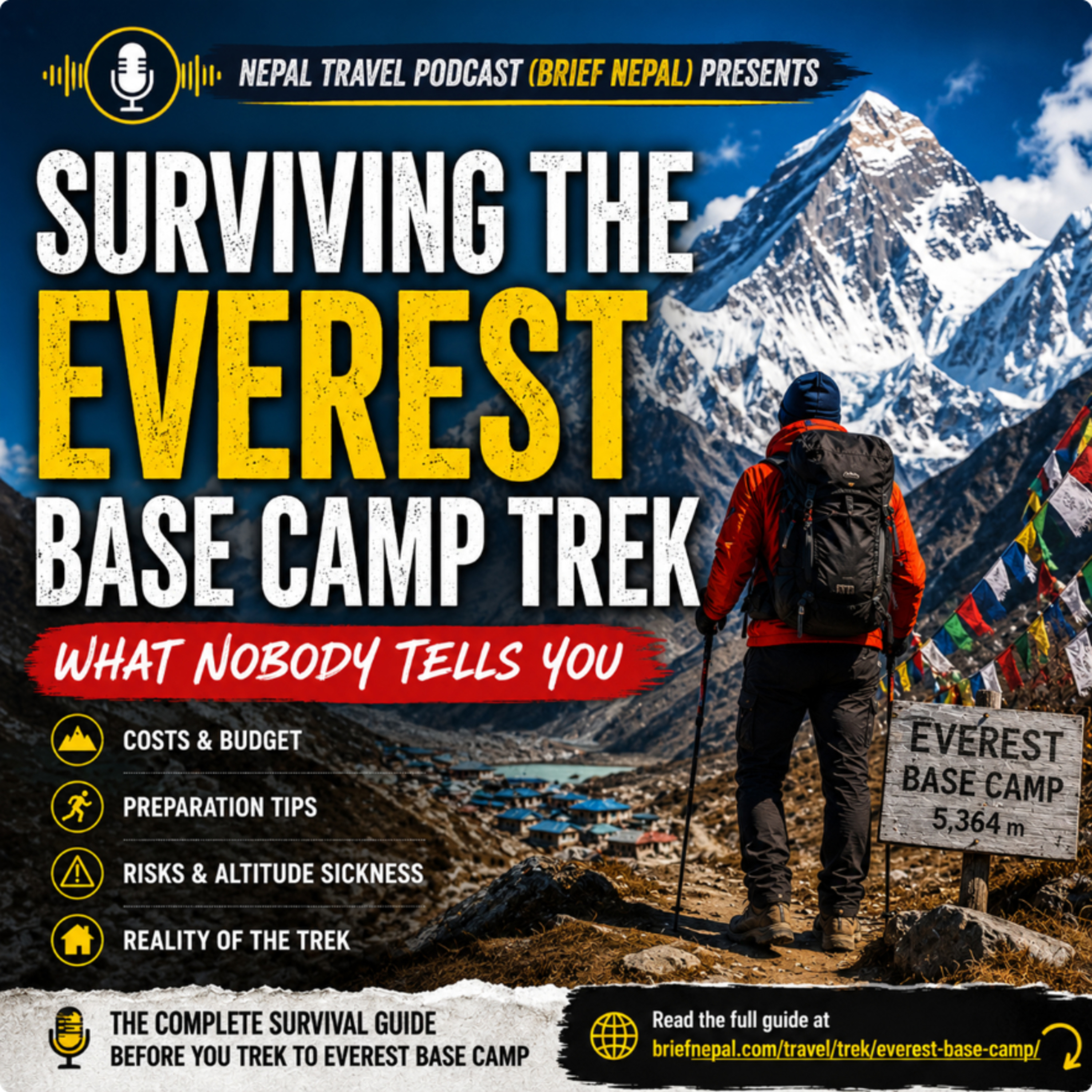
Everest Base Camp is on the bucket list of thousands of adventurers every year. But beyond the breathtaking mountain views and iconic photos lies a journey filled with ph…
▶ Listen on SpotifyShow notes & transcript →Follow the show →
🎧 Also on Apple Podcasts Castbox
A glimpse of Everest Base Camp


Watch: Everest Base Camp Trek
🎬 "Hiking 50 miles to Everest Base Camp in Nepal" by Kraig Adams on YouTube
Overview
The Everest Base Camp Trek is the most famous high-altitude walk on the planet, a roughly 130 km round trip through Nepal's Khumbu region that carries you from the airstrip at Lukla (2,860m) to the foot of Mount Everest (Sagarmatha, 8,848.86m) and the panoramic viewpoint of Kala Patthar. It is not a climbing expedition; you never touch a rope or crampon. Instead it is a long, demanding trek on well-trodden mountain trails, sleeping in Sherpa-run teahouses, that rewards ordinary fit walkers with one of the great experiences of mountain travel.
The trek follows the historic approach used by mountaineers since the 1950s. From Lukla the trail climbs the Dudh Koshi valley to Namche Bazaar (3,440m), the bustling Sherpa trading hub, then on past the famous Tengboche Monastery (3,860m) to Dingboche, Lobuche and finally Gorak Shep (5,164m). From there two prizes await: Everest Base Camp itself at 5,364m, where expedition tents cluster on the Khumbu Glacier in spring, and the dawn climb to Kala Patthar (5,545m), the highest point of the trek and the single best place to see Everest's summit pyramid glow at sunrise.
The classic itinerary takes 12 to 14 days round trip from Lukla, including two essential acclimatisation days. The maximum sleeping altitude is around 5,160m and the highest point reached on foot is Kala Patthar at 5,545m. This is a trek for reasonably fit, healthy people who can walk five to seven hours a day for two weeks; no technical skills are needed, but the altitude is real and must be respected.
Why is it so iconic? Few trails combine such raw scale, eight-thousanders Everest, Lhotse and Nuptse, plus the perfect spire of Ama Dablam, with such a living culture. The Khumbu is the homeland of the Sherpa people, dotted with monasteries, mani walls, chortens and prayer flags, all inside Sagarmatha National Park, a UNESCO World Heritage Site. Most journeys begin and end in Kathmandu, where you arrange permits, pick up last-minute gear and catch the early-morning mountain flight into Lukla.
Day-by-Day Itinerary
The classic Everest Base Camp route is the 12-day Lukla-to-Lukla plan with two essential acclimatisation days, at Namche and Dingboche. Most agencies add a day or two of buffer in Kathmandu for Lukla flight delays, giving the 14-day trips you will see advertised.
- Day 1: Fly Kathmandu to Lukla (2,860m), trek to Phakding (2,610m)
- Day 2: Phakding to Namche Bazaar (3,440m)
- Day 3: Acclimatisation day at Namche Bazaar (3,440m)
- Day 4: Namche Bazaar to Tengboche (3,860m)
- Day 5: Tengboche to Dingboche (4,410m)
- Day 6: Acclimatisation day at Dingboche (4,410m)
- Day 7: Dingboche to Lobuche (4,940m)
- Day 8: Lobuche to Gorak Shep (5,164m), then Everest Base Camp (5,364m)
- Day 9: Kala Patthar (5,545m) sunrise, descend to Pheriche (4,240m)
- Day 10: Pheriche to Namche Bazaar (3,440m)
- Day 11: Namche Bazaar to Lukla (2,860m)
- Day 12: Fly Lukla to Kathmandu
Always build a spare day into your trip for Lukla flight delays, the single most common scheduling problem on the trek.
Read the full EBC itinerary guide, day by day with walking times →
Difficulty & Fitness
The Everest Base Camp Trek is rated strenuous, but not technical. There is no climbing or mountaineering skill required, it is a long, sustained hike. You walk five to seven hours a day for roughly two weeks on rocky trails with relentless ups and downs, and what makes it hard is the combination of duration, daily ascent and, above all, altitude.
Altitude is the real challenge. At Kala Patthar (5,545m) you breathe roughly half the oxygen available at sea level, which is why the itinerary builds in acclimatisation days. Fitness does not make you immune to altitude sickness, but good fitness means you arrive less exhausted. Train for two to three months with long hill walks, ideally carrying a loaded daypack on consecutive days.
Read the full EBC difficulty & fitness guide, with a training plan →
Permits & Regulations
Two permits are required for the Everest Base Camp Trek, costing roughly NPR 5,000 total. Carry your passport and a couple of passport photos.
- Sagarmatha National Park Entry Permit: around NPR 3,000 for foreign nationals, less for SAARC citizens.
- Khumbu Pasang Lhamu Rural Municipality Permit: around NPR 2,000 per person, which has replaced the old TIMS card for this region.
A licensed guide is now required in Sagarmatha, so fully independent solo trekking is no longer permitted. A guided package normally arranges both permits and the guide for you. Treat fees as estimates and confirm current rates before departure.
Read the full EBC permits guide: costs, the guide rule and how to apply →
Best Time to Trek
There are two prime seasons. Autumn (late September to November) is the most popular: the monsoon has cleared the air, skies are crisp and mountain views are at their sharpest, though trails are busiest in October. Spring (March to May) is the second peak, with blooming rhododendrons lower down and Base Camp alive with expedition tents during the climbing season.
Winter (December to February) is feasible for well-prepared trekkers but bitterly cold, with some high teahouses closed. Monsoon (June to August) is the least suitable: rain, leeches, cloud-hidden peaks and frequent Lukla flight cancellations.
Read the full month-by-month guide to the best time for EBC →
Cost & Budget
The total cost depends on whether you take a full guided package or trek more independently with a hired guide. A guided package typically costs NPR 130,000–220,000, while trekking independently with a registered guide runs around NPR 70,000–120,000. The single biggest fixed cost is the Lukla flight, roughly NPR 18,000–24,000 each way and rarely discounted.
On the trail, budget roughly NPR 3,500-6,000 per day for meals, hot drinks and charging lower down, rising to NPR 6,000-9,000 near Gorak Shep as everything is carried up by porter or yak. Add a guide at NPR 3,500-5,000 a day, a porter at NPR 2,500-3,500 a day, plus tips, gear and travel insurance.
Read the full EBC cost guide: line-by-line breakdown and sample budgets →
Packing, Safety & Tips
Altitude sickness & safety
Acute Mountain Sickness (AMS) is the biggest risk on this trek and can affect anyone, regardless of age or fitness. Ascend slowly, never skip the acclimatisation days at Namche and Dingboche, hydrate well, avoid alcohol high up, and descend immediately if symptoms worsen rather than trying to push on. Carry travel insurance that explicitly covers trekking to at least 5,600m with helicopter evacuation, standard policies often exclude high-altitude activity.
Read the full EBC altitude sickness & safety guide →
What to pack
Pack a layered clothing system, a warm down jacket and a sleeping bag rated to around -15°C for the cold nights, broken-in waterproof boots, trekking poles, sun protection, a head torch for the Kala Patthar dawn, and water purification. Bulky gear can be rented in Thamel before you fly out.
Read the full EBC packing list: complete gear checklist →
The Lukla flight and delays
Flights to Lukla, one of the world's most dramatic airstrips, are highly weather-dependent and frequently delayed or cancelled. In peak season they often operate from Manthali (Ramechhap), a 4-5 hour drive from Kathmandu. Always build at least one or two buffer days into your trip so a delay does not cost you your onward flight home.
Connectivity
Mobile coverage reaches surprisingly high on the trail: an Ncell SIM works in much of the Khumbu, and the Everest Link Wi-Fi network sells data cards in teahouses, though both slow and grow pricier the higher you climb. Carry a power bank, as charging is paid and limited at altitude.
Altitude Sickness (AMS) & Trek Safety
The Everest Base Camp trek climbs to 5,545 m, well into the zone where acute mountain sickness (AMS) is a serious, potentially fatal risk, careful acclimatisation is non-negotiable. This section covers how to recognise altitude sickness, prevent it, prepare physically, and stay insured, it is general guidance, not medical advice.
Recognise the symptoms
| Level | Signs | What to do |
|---|---|---|
| Mild AMS | Headache, nausea or loss of appetite, dizziness, fatigue, broken sleep. | Stop ascending, rest, hydrate. Do not go higher until symptoms clear; descend if they do not. |
| Severe, HAPE (lungs) | Breathlessness at rest, persistent cough, frothy or pink spit, chest tightness, blue lips. | Descend immediately and treat as a medical emergency, arrange evacuation. |
| Severe, HACE (brain) | Confusion, clumsiness or loss of balance, crushing headache, drowsiness, hallucinations. | Descend immediately, HACE is life-threatening within hours. Evacuate. |
Prevent it: the golden rules
- Ascend slowly. Above 3,000 m, raise your sleeping altitude by no more than ~300–500 m per day and take the built-in acclimatisation days.
- Climb high, sleep low. Day-hike higher, then come back down to sleep.
- Hydrate (3–4 litres/day), eat well, and avoid alcohol, sleeping pills and smoking at altitude.
- Never ascend with AMS symptoms, and descend at once if they worsen, going down is the only reliable cure.
- Consider acetazolamide (Diamox) as a preventive/treatment aid, but only after discussing it with your doctor.
Get trek-fit
Start training 6–8 weeks out: build aerobic base with running, cycling or brisk hill walking 3–4 times a week; add stair and hill repeats carrying a loaded daypack (6–8 kg) to ready your legs for long descents; and finish with a couple of back-to-back long hiking days to rehearse multi-day fatigue. Strong quads and good cardio make altitude far more manageable.
Insurance & evacuation
Buy travel insurance that explicitly covers trekking up to 5,545 m and helicopter evacuation, a rescue from altitude is essential and very expensive without cover. Carry your policy number and your operator’s emergency contact, and keep the booking details of any guide with you.
Everest Base Camp: specific hazards
The high Lobuche–Gorak Shep section is bitterly cold, and the Lukla flight is highly weather-dependent, build in buffer days so you are never tempted to rush the ascent.
Frequently Asked Questions
How many days does the Everest Base Camp trek take?
The classic Everest Base Camp trek takes 12 to 14 days round trip from Lukla, including two essential acclimatisation days at Namche Bazaar and Dingboche. Most agencies add a day or two in Kathmandu as a buffer against Lukla flight delays, so full trips are usually advertised as 12 to 16 days.
How hard is the Everest Base Camp trek?
It is rated strenuous but not technical. There is no climbing or mountaineering skill required, but you walk five to seven hours a day for about two weeks on rocky trails, and the high altitude is the main challenge. Reasonably fit, healthy walkers who train beforehand can complete it.
How much does the Everest Base Camp trek cost?
A guided package typically costs NPR 130,000 to NPR 220,000 or more, while trekking more independently with a hired guide runs around NPR 70,000 to NPR 120,000. The biggest fixed cost is the Lukla flight at roughly NPR 18,000 to NPR 24,000 each way, plus permits, food, lodging, guide and porter fees, and insurance.
What permits do I need for the Everest Base Camp trek?
You need two permits: the Sagarmatha National Park Entry Permit (around NPR 3,000) and the Khumbu Pasang Lhamu Rural Municipality Permit (around NPR 2,000), which has replaced the old TIMS card for this region. Together they cost roughly NPR 5,000, and a guided package usually arranges them for you.
Do I need a guide for the Everest Base Camp trek?
Yes. Nepal requires trekkers in its national parks and protected areas, including Sagarmatha (Everest), to be accompanied by a licensed guide, so fully independent solo trekking is officially no longer allowed. A guide also handles permits and logistics and watches you for early signs of altitude sickness.
What is the best time to trek to Everest Base Camp?
The two best seasons are autumn, from late September to November, with the clearest skies and sharpest mountain views, and spring, from March to May, when rhododendrons bloom and the climbing season fills Base Camp with tents. Winter is cold but clear, and the monsoon from June to August is the least suitable.
How high is Everest Base Camp?
Everest Base Camp sits at 5,364 metres (17,598 feet). The highest point most trekkers reach is the nearby viewpoint of Kala Patthar at 5,545 metres, which offers the best sunrise view of Everest. The highest place you sleep is Gorak Shep at about 5,164 metres.
What is altitude sickness and how do I prevent it on the EBC trek?
Altitude sickness, or AMS, happens when you ascend too fast for your body to adjust to the thinner air, causing headache, nausea and poor sleep, and in severe cases life-threatening fluid in the lungs or brain. Prevent it by ascending slowly, taking the acclimatisation days, drinking plenty of water, avoiding alcohol, considering Diamox, and descending at once if symptoms worsen.
Why is the Lukla flight so risky and often delayed?
Lukla airport has a short, steep runway in a deep mountain valley and no instrument landing, so flights only operate in clear weather and are frequently delayed or cancelled. In peak seasons they often depart from Manthali (Ramechhap), a 4 to 5 hour drive from Kathmandu. Always build in buffer days so a delay does not affect your flight home.
Can beginners do the Everest Base Camp trek?
Yes, beginners with no prior trekking experience regularly complete the trek, provided they are in good general health and train beforehand. It requires no technical skills, only the endurance to walk several hours a day for two weeks and the discipline to acclimatise slowly. A few months of regular hiking and cardio preparation makes a big difference.
What is the age limit for the Everest Base Camp trek?
There is no strict age limit. Children as young as eight or nine and trekkers in their seventies have completed it. What matters is general health, fitness and how your body handles altitude rather than age alone. Anyone with heart, lung or other serious conditions should consult a doctor first.
What is the success rate of the Everest Base Camp trek?
Success rates are high for trekkers who follow a sensible itinerary with proper acclimatisation days, with most reputable operators reporting that the large majority of clients reach Base Camp. The most common reason for not completing it is altitude sickness from ascending too quickly, which slow pacing and rest days largely prevent.
How fit do I need to be for the Everest Base Camp trek?
You need a good level of aerobic fitness and endurance, enough to walk five to seven hours a day on hilly terrain for about two weeks. A useful benchmark is being able to hike six hours over hills carrying a 5 to 7 kilogram daypack comfortably. Train for two to three months with long walks, hill climbs and cardio.
What kind of travel insurance do I need for Everest Base Camp?
You need a policy that explicitly covers trekking up to at least 5,600 metres and includes helicopter evacuation and emergency medical treatment. Standard travel insurance often excludes high-altitude activity, so check the wording carefully, because a helicopter rescue from the high Khumbu can cost many thousands of dollars without cover.
Where does the Everest Base Camp trek start?
The trek starts at Lukla (2,860 metres), reached by a short, scenic flight from Kathmandu or, in peak season, from Manthali (Ramechhap). Almost all journeys begin and end in Kathmandu, where you arrange permits, buy or rent gear and catch the early-morning mountain flight.
Is the Everest Base Camp trek worth it?
For most trekkers it is the trip of a lifetime: close-up views of Everest, Lhotse, Nuptse and Ama Dablam, immersion in Sherpa culture, ancient monasteries and the sense of standing at the foot of the world's highest mountain. It is demanding and the altitude is serious, but few treks deliver such scale and reward.
Compare with Other Nepal Treks
How Everest Base Camp stacks up against other popular Nepal treks, at a glance, to help you choose and plan.
| Trek | Difficulty | Max Altitude | Duration | Best Season | Region |
|---|---|---|---|---|---|
| Everest Base CampThis trek | 🟠 Challenging | 5,545 m | 12–14 days | Mar–May & Sep–Nov | Khumbu, Solukhumbu |
| Annapurna Base Camp | 🟡 Moderate | 4,130 m | 7–10 days | Mar–May & Oct–Nov | Annapurna, Gandaki |
| Poon Hill | 🟢 Easy | 3,210 m | 3–5 days | Oct–Apr | Ghorepani, Gandaki |
Why these grades?
Everest Base Camp 🟠 Challenging, Reaches 5,364 m at base camp and 5,545 m on Kala Patthar over 12+ days at altitude, with the dramatic Lukla flight, but a busy, well-marked trail and excellent teahouses keep it within reach of fit first-timers.
Annapurna Base Camp 🟡 Moderate, Tops out at 4,130 m in the Annapurna Sanctuary with comfortable teahouses and gentle, steady altitude gain, making it one of the best first Himalayan treks; the main effort is the long stone staircases.
Poon Hill 🟢 Easy, Stays low, peaking near 3,210 m at the Poon Hill viewpoint over just 3–5 short days on well-built stone trails, with comfortable teahouses and almost no altitude risk, an ideal first Himalayan walk for beginners and families.
Reviews & Ratings
No reviews yet. Be the first to share your experience of Everest Base Camp!
By the BriefNepal Travel Desk
Researched and maintained by our Nepal-based editorial team and reviewed for accuracy. Last updated July 27, 2026. Prices, permits and conditions change, always verify before you travel. Spotted something out of date? Let us know.
Nepal Trip Planning Tools
Estimate your costs and trekking permits in seconds, built on real, current Nepali prices.
💰 Trip Cost Calculator
🎫 Trek Permit Calculator
Estimates only, fees and prices change with season and policy. Confirm with a registered agency and the Nepal Tourism Board before you travel.
Plan & Book Your Everest Base Camp Trip
Booking links may be affiliate partnerships, they help keep BriefNepal free and never change the price you pay.
Nepal Currency Converter
Live exchange rates for the Nepalese Rupee (NPR) against every world currency, handy for budgeting the prices in our guides.
Live mid-market rates. For information only, banks and exchanges apply their own margins.
Planning a trip to Nepal?
Join the BriefNepal Travel list for seasonal tips, new guides and our free Nepal trip-planning checklist. No spam, unsubscribe anytime.

