



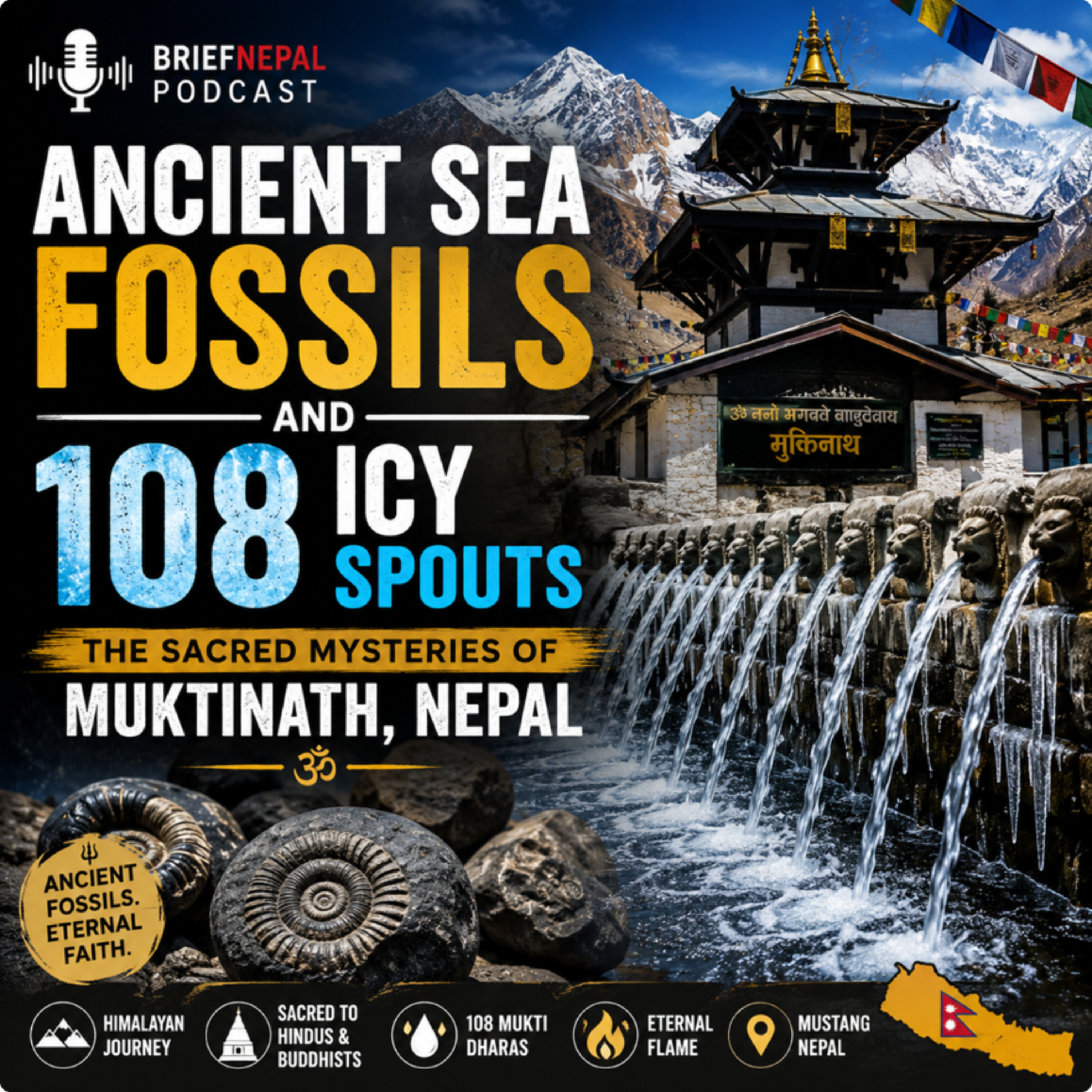
Ancient Sea Fossils & 108 Icy Spouts | The Sacred Mysteries of Muktinath, Nepal
▶ Listen on Spotify Follow the show →
🎧 Also on Apple Podcasts Castbox iHeartRadio
About This Episode
How can 380-million-year-old sea fossils be found high in the Himalayas? Why do thousands of pilgrims brave the freezing waters flowing from 108 sacred spouts every year? And what makes Muktinath one of the world's most unique pilgrimage sites, revered by both Hindus and Buddhists?
In this episode of the BriefNepal Podcast, we uncover the timeless mysteries of Muktinath Temple, nestled at an altitude of 3,800 meters in Nepal's Mustang district. From the sacred Shaligram fossils discovered in the Kali Gandaki River to the spiritual significance of the 108 Mukti Dharas, this journey explores the fascinating blend of geology, mythology, history, and faith that has drawn pilgrims for centuries.
You'll also discover the legend behind the eternal natural flame, the cultural importance of Muktinath, practical travel tips for visitors, and why this Himalayan sanctuary is considered a place of liberation.
🌐 Read the complete travel guide:
https://briefnepal.com/travel/pilgrimage/muktinath
📰 Explore more travel stories from Nepal:
🇳🇵 Discover more about Nepal:
In this episode:https://briefnepal.com/travel/pilgrimage/muktinath
🌊 Ancient sea fossils (Shaligrams) in the Himalayas
💧 The spiritual meaning of the 108 icy water spouts
🔥 The mystery of Muktinath's eternal flame
🕉️ Why Muktinath is sacred to both Hindus and Buddhists
🏔️ Travel tips for visiting one of Nepal's holiest destinations
If you enjoy exploring Nepal's hidden stories, ancient history, culture, and breathtaking destinations, follow the BriefNepal Podcast on Spotify and share this episode with fellow travelers and history lovers. Every follow helps us bring more incredible stories from the heart of Nepal. 🇳🇵🎧
Full Transcript
Auto-generated transcript — may contain small errors.
Imagine waking up before dawn and the air is just so thin and violently cold that every single breath feels like you're swallowing shattered glass, but that sounds rough. Right. And then you step outside barefoot onto this wet icy stone. You've got these jagged ochre cliffs and snow-capped peaks above you, and then you voluntarily run beneath the stream of freezing glacier-fed water.
Just yeah, brightened into the ice water. Exactly. And then another stream and another all the way up to 108 of them. So welcome to another deep dive.
Today we are looking at the Muktinath Travel Guide 2026, which was put together by the brief Nepal travel desk. Yeah, and it is just a really remarkable document. It details the entire anatomy of this sacred space. I mean, Muktinath is a temple complex sitting at 3,710 meters.
Which is what, over 12,000 feet, right? Yeah, well, over 12,000 feet up in the Mustang district of Nepal. And it basically serves as this profound geographical anomaly that has somehow translated into a shared holy ground. It draws in followers from two of the world's major religions.
Okay, let's unpack this because my big guiding question for you today as we go through this guide is honestly just why? Why do people travel thousands of miles endure grueling altitude and brave this incredibly harsh terrain just to stand in freezing glacier water? Well, to really understand that motivation, you have to look at the physical environment first because Muktinath sits in a landscape that completely defies what you typically expect from the Himalayas. Yeah.
You know, you are not walking into this lush forested valley. Right, so to put this in perspective for everyone listening, if you picture that typical postcard image of Nepal with the endless green hills and dense jungles, you have to throw that completely at the window. Totally. You are traveling to a place where the landscape looks way more like the arid wind scoured Tibetan plateau because the entire region sits in the rain shadow of two massive mountain ranges, the Annapurna and Dhaulagiri massifs.
Exactly. And the mechanics of that rain shadow mean those towering peaks basically act like a giant physical wall. So when the heavy summer monsoons roll up from the Indian Ocean, the clouds hit those peaks, dump all their rain on the southern side, and while only this dry moisture starved air actually makes it over the top in a Mustang, leaving it totally bone dry. Yeah.
That meteorological phenomenon creates a stark, treeless environment, just towering ochre cliffs and endless ducks dotted with prayer flags. But the real secret to why this specific spot became so revered, it actually lies buried in the earth itself. Wait, you mean the fossils? Yeah, it goes back millions of years to this massive geological shift.
See, right below the temple complex runs the deep gorge of the Kali Gandaki River. And this specific river valley is the only source in the entire world for something called the chalagram. The black Ammonite fossils, I was reading about this and it is just wild. Yes, these are the petrified remains of ancient sea creatures.
Millions of years ago, the space where the Himalayas now stand, that was actually the floor of the Tethys Ocean. And ocean, where the high-ish mountains on earth are now. Right. And when the Indian and Asian tectonic plates collided, they pushed that ancient ocean floor upward, literally miles into the sky.
So you have these beautiful spiraled marine fossils just resting in an alpine desert. Wow. So if you try to visualize that tectonic collision, it's essentially like a slow-motion car crash on a planetary scale. The Indian subcontinent rams into Asia and the hood of the car, which was the ocean floor, crumples and buckles upward, taking all that ancient sea life with it.
That's a great way to picture it, yeah. Wait, so if you think about it, the holiest object at this high-altitude mountain shrine is actually a fossilized sea creature. That is like finding a seashell on a snowy peak and realizing it's the key to the universe. What's fascinating here is how that specific geological history directly informs the theology of the site.
Because for Hindus, these ancient sea fossils aren't just, you know, cool rocks. They are venerated as a swayambu, which translates to a self-manifested form of Lord Vishnu. So the earth just created it naturally. Exactly.
The theology centers on the idea that the earth naturally produced these intricate spirals, and they visually echo the cosmic discus held by Vishnu. It turns a scientific curiosity into an object of ultimate devotion. That is so fascinating. It turns the whole river valley into a literal map of the divine.
Yeah, and it makes it a place of deep ancestral reverence, too. The guide notes that a lot of pilgrims will stop in the nearby medieval village of Kagbeni to perform shrada rites for their departed ancestors. They believe the spiritual merit earned at this very specific geological intersection of time, earth, and eternity is incredibly powerful for the souls of the dead. It makes complete sense, though, a place where the ancient ocean literally meets the sky would totally feel like a portal to another world.
But the earth and the fossils, that's just the foundation. The extreme environment there also kind of weaponizes water. Oh, absolutely. Because right behind the main pagoda-style Vishnu temple, there's this semi-circular wall, and protruding from this wall are 108 brass spouts, all shaped like the heads of bulls or cows.
And this is the Muktidhara. Yeah, the physical core of the pilgrimage, and honestly, perhaps the most demanding aspect of the entire journey. Here's where it gets really interesting, because devotees will strip down in that biting morning air and they physically run under all 108 of these icy streams, one by one. Just brutal.
And if that wasn't enough, they finish the ritual by plunging into two adjacent pools. Now, the theological belief is that this cleanses a lifetime of sins. But consider the biological reality of what is happening to you. When you plunge into freezing water, you trigger a mammalian gasp reflex.
Right, you just involuntarily suck in air. Yes, but at 12,000 feet, there is barely any oxygen in that air to begin with. Your blood vessels are violently constricting to protect your core organs. So imagine testing your devotion by triggering that level of physiological shock at an altitude where morning temperatures are basically freezing.
Would you have the grit to do it? Because it is the ultimate spiritually mandated ice bucket challenge. It really is. But you know, that profound physical shock to the system is an integral part of the spiritual mechanism.
The number 108 holds deep, sacred weight in both Hindu and Buddhist traditions, often representing the wholeness of existence or the complete journey of the soul. So it's about breaking yourself down to build yourself back up. Exactly. The suffering endured while moving through those 108 spouts burns away the ego.
But the freezing water is actually only half of the elemental marvel of Muktinath. Right, there's the fire. Yeah, just a short walk below the main shrine brings you to the Duolomai temple. And inside this small enclosure, a natural eternal flame burns continuously straight out of the rock and earth, mere inches from a flowing spring.
Which is incredible. You have fire, water, and earth all physically touching each other without destroying one another. It's wild. The scientific explanation points to an underground natural gas seep.
Gas gets trapped in the geological faults we discussed earlier, slowly escaping to the surface where it ignites. But spiritually, it is revered as an absolute miracle where these normally opposing volatile elements just peacefully coexist. And both religions view it as sacred, right? Yeah, Hindus treasure this eternal flame as a manifestation of the creator God, Brahma.
And at the very same time, Buddhists revere it as a deeply sacred fire. I mean, humans are naturally drawn to elemental anomalies and this site just provides an impossible combination. Having two entirely separate belief systems looking at the exact same natural gas seep and finding two different yet equally profound meanings really brings us to the harmony of the place. We have Hindus and Buddhists worshiping in the exact same walled compound.
Yeah, let's examine the Hindu perspective on that first. For them, the site is known as Mukti Kshetra, which translates to the place of salvation or liberation. It is recognized as one of the 108 Divya desams, the most holy abodes of Lord Vishnu. And it's unique among them, isn't it?
Very. Muktinath is a complete outlier because it's the only Divya desam located outside the Indian lowlands. It's the sole location in the high Himalayas. And visiting it and surviving that holy bath is believed to grant moksha, which is the ultimate liberation from the endless cycle of death and rebirth.
The ultimate spiritual exit strategy, basically. But then just a few steps away, the Tibetan Buddhist perspective is unfolding with entirely different rituals. Right, because for Tibetan Buddhists, this exact same site is known as Chumig-gatsa, meaning the Hundred Waters. They revere it as one of the 24 great tantric places of the Himalayas.
And in tantric Buddhism, they actually use the harsh environment, right? Exactly. Extreme hostile environments are often utilized to accelerate the path to enlightenment. The harshness forces the mind to focus.
It is considered a dwelling place of Avalokiteshvara, the bodhisattva of compassion. Oh, wow. And the site also holds powerful historical weight because Guru Rinpoche, the legendary figure who brought Buddhism to Tibet, is recorded to have stopped and meditated here in the 8th century. Okay, but with two massive, distinct belief systems operating in one tiny compound, how does it not turn into a turf war?
I mean, human history is littered with conflicts over sacred spaces. Is it the sheer difficulty of surviving the environment that forces this peaceful coexistence? I love that observation, actually. If we connect this to the bigger picture, you uncover a striking model for coexistence.
In a world defined by territorial claims over holy ground, Muktinath operates on shared stewardship. Wait, really? They share the duties? They do.
The Maybar-Lagampa, the Buddhist monastery on the site, is run by Buddhist nuns. And those same nuns are the caretakers who physically tend to the Duolomai shrine and its eternal flame, which is deeply worshiped by Hindus. Worshippers of both faiths just move through the ground side by side. That is beautiful.
It's like the sheer hostility of the environment forces that cooperation. When everyone is struggling to just read the thin air and survive the freezing temperatures, dogmatic borders just melt away. Striped down survival really does demand harmony. It does, and that harsh reality is exactly what you face just trying to reach the temple gates.
The Travel Guide outlines a massive logistical ordeal. Getting to Muktinath in 2026 requires paying a steep price in physical endurance. So, let's break down the rights for you if you're actually planning to go. Yeah, the choices available really offer a sliding scale of risk, time, and physical demand.
So, the classic method for a trekker is on foot, hiking in as part of the Annapurna circuit. This requires ascending over the Thirang La Pass, which sits at a breathless 5,416 meters. That is extremely high. Right.
At that altitude, the oxygen density is roughly half of what it is at sea level. Every single step requires monumental effort. But for those without a week to acclimatize and hike, there is aviation. Right, the mountain flights.
Yeah, a 20-25 minute mountain flight runs from the city of Pokhara directly to Jumpsum. But the guide is very clear that these flights only operate in the early morning. Because by the afternoon, Fierce winds funnel up the Kullygondocki gorge, turning it into a literal wind tunnel that grounds all aircraft. And the physics of that wind tunnel are just fascinating.
As the sun heats the high, arid Tibetan plateau, the hot air rises rapidly, and this creates a vacuum effect, violently sucking the colder, heavier air from the southern lowlands straight up to the narrow gorge. He just rips right through the valley. Exactly. It creates daily gale force winds by midday.
It's intense. So if you prefer the ground, you can take a shared or private jeep up that same gorge from Pokhara. It's an eight to ten hour, completely bone rattling ride over dusty, unpaved mountain roads. You pass through villages like Tatapani, known for hot springs and Marfa.
But then you have the extreme modern shortcut, the luxury option. Ah, the helicopters. Yes, you can hire a helicopter directly from Pokhara and land at the helipad right near the temple. Which introduces a really complex paradox regarding modern pilgrimage.
So what does this all mean? The guide notes that a helicopter charter is quoted in lacks of rupees. For context, one lack is 100,000 rupees, making this an incredibly expensive endeavor. But beyond the financial cost, if you take a helicopter, you rob your body of the biological necessity to acclimatize.
Which is incredibly dangerous. Right, the guide warns that jumping straight from the lowlands to 3,710 meters puts you at severe risk for acute mountain sickness or AMS. By skipping the slow ascent, you invite a condition where the pressure changes cause fluid to leak into your lungs and brain. It causes blinding headaches, severe nausea, and, you know, it can be fatal.
It's no joke. It's not. But it makes you wonder, does skipping the physical struggle fundamentally change the liberation of the pilgrimage? If you buy your way over the hardship, do you still earn the spiritual payout?
That is the big question. The democratization of travel through technology often clashes with the traditional mechanics of spiritual seeking. The mountain demands a toll whether that's paid in time, physical suffering, or just immense financial cost. And the logistical realities outlined in the guide ensure that really nobody escapes the burden of planning.
No kidding. First, there is the paperwork. You have to secure an Annapurna Conservation Area Project permit, or ACAP. For foreigners, that costs 3,000 Nepali rupees.
The guide notes that $6.56 U.S. converts to roughly 1,000 Nepali rupees, so the permit is about 20 U.S. dollars. Which is pretty reasonable, considering.
It is. And that fee is crucial because thousands of pilgrims moving through a fragile alpine desert create a massive footprint. And the funds go toward managing waste and protecting the ecosystem. Along with the permit, you also have to account for elevated costs across the board.
Flights can run up to 12,000 rupees one way. But the most critical directive in the guide regarding finances is the absolute necessity of carrying physical cash. Oh yeah, do not rely on plastic. No, ATMs and towns like Jomsom frequently fail.
The infrastructure just cannot support it up there. You have power grids reliant on local hydroplants that freeze or fail. And ATMs depend on satellite connections that easily drop out when mountain weather rolls into the deep gorge. You cannot swipe a card at 12,000 feet when the grid goes dark.
Definitely not. And keeping your body fueled requires relying entirely on local supply chains. Yeah, everything you consume has been hauled up those perilous roads by jeep or mule train. The region is the homeland of the Thakali people who are historically known as merchants who controlled the ancient salt trade routes between Tibet and Nepal.
And they have incredible food. They do. They serve a dish called Thakali Dalbot, which is this heavily fortified platter of rice, lentil soup, curries and spicy peckles. It is specifically designed to provide massive caloric energy for the cold.
And you'll also find Tibetan staples like momos and thukmanoodle soup. The guide also highlights Marfa, which is this whitewashed stone village famous for its apple orchards. They produce fresh cider and a locally distilled apple brandy that is practically legendary across Nepal. Which is tempting, but you have to be careful.
Right, because consuming alcohol at high altitude depresses your respiratory system, which is the exact opposite of what your body needs to fight off AMS. The focus really needs to be on survival gear instead. The winds we discussed earlier are relentless, even in summer. You need heavy windproof layers.
And good shoes. Critically, yes, you need footwear with serious grip. When you approach those 108 spouts, you are walking on slick, wet stone that turns to pure ice in the morning air. Yeah, you don't want to slip there.
Yeah. Most travelers base themselves in Ranapawa village, which is located just below the temple complex. The infrastructure there is a mix of traditional pilgrim rest houses called thramshallas and basic lodges. You sleep there, wake up in the freezing darkness, and make the slow, oxygen-deprived 15-20 minute uphill climb to the gates.
Muktinath is a place where tectonic shifts literally smash the ocean floor into the sky. It created a landscape so extreme, so harsh, and yet so miraculously strange that it naturally became a focal point for human salvation. It really is a marvel. Whether you are a Hindu seeking to break the cycle of rebirth, a Buddhist utilizing the hostile environment to trace the path to enlightenment, or just a secular traveler pushing your physical limits on the ultimate Himalayan trek, this valley demands absolute reverence.
This raises an important question, though, about how the geography we navigate shapes our internal state. I mean, the physical resistance of the mountain is the catalyst for transformation. It challenges you to consider your own threshold. Which path do you take, Ray?
Exactly. Would you choose the slow, punishing, jeep ride up the Kali Gandaki, feeling the air fin out, mile by dusty mile? Or would you choose the dizzying helicopter flight bypassing the endurance test but shocking your biological systems at the summit? It is a profound choice between earning the view or buying the altitude.
But, you know, I want to leave you with a completely different thought to mullover building on the precarious nature of this entire environment. We established that the Kali Gandaki River is the sole source of the shellogram fossils. Right. Nowhere else in the world.
Nowhere, pilgrims have been pulling these ancient sea creatures from the river banks for over a thousand years, taking pieces of the Tethys ocean home and their pockets as sacred keepsakes. But, beyond the finite supply of the fossils, consider the water itself. The glacial melt. Yeah.
The 108 spouts of Muktidhara are fed directly by glacial meltwater from the surrounding peaks. As global climate change accelerates, those Himalayan glaciers are retreating at an unprecedented rate. What happens to the place of salvation when the ancient ice disappears? Wow.
What happens to the hundred waters when the spouts run dry? When the mountain can no longer offer the freezing shock of absolution, will the spiritual power remain in the dry rock or will it vanish with the ice? Is the true salvation in the fossil you take or the mountain you leave behind? That is an unsettling yet very necessary question for the future of the Himalayas.
Keep digging deep.
Guides Mentioned in This Episode
 MustangThe forbidden kingdom, a Tibetan high desert beyond the Himalaya.
 MuktinathSacred to Hindus and Buddhists alike, at 3,710m in Mustang.
 Upper MustangA restricted trek to the walled city of Lo Manthang in the old Forbidden Kingdom.Lower MustangJomsom, Kagbeni and Muktinath in the dramatic Kali Gandaki rain-shadow.
Planning a trip to Nepal?
Join the BriefNepal Travel list for seasonal tips, new guides and our free Nepal trip-planning checklist. No spam, unsubscribe anytime.