


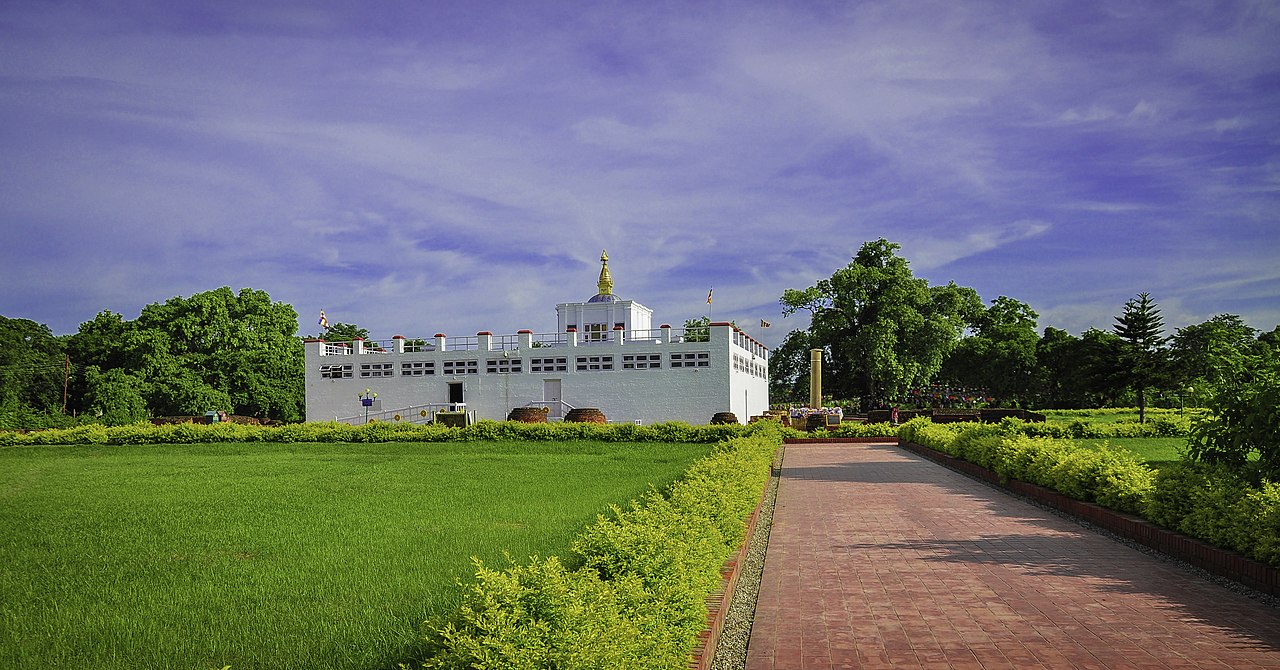


Mustang Travel Guide
Once a forbidden Buddhist kingdom in Nepal's Tibetan high desert, Mustang is a wind-carved land of ochre cliffs, walled cities and ancient cave temples that sits in the rain shadow of the Himalaya.
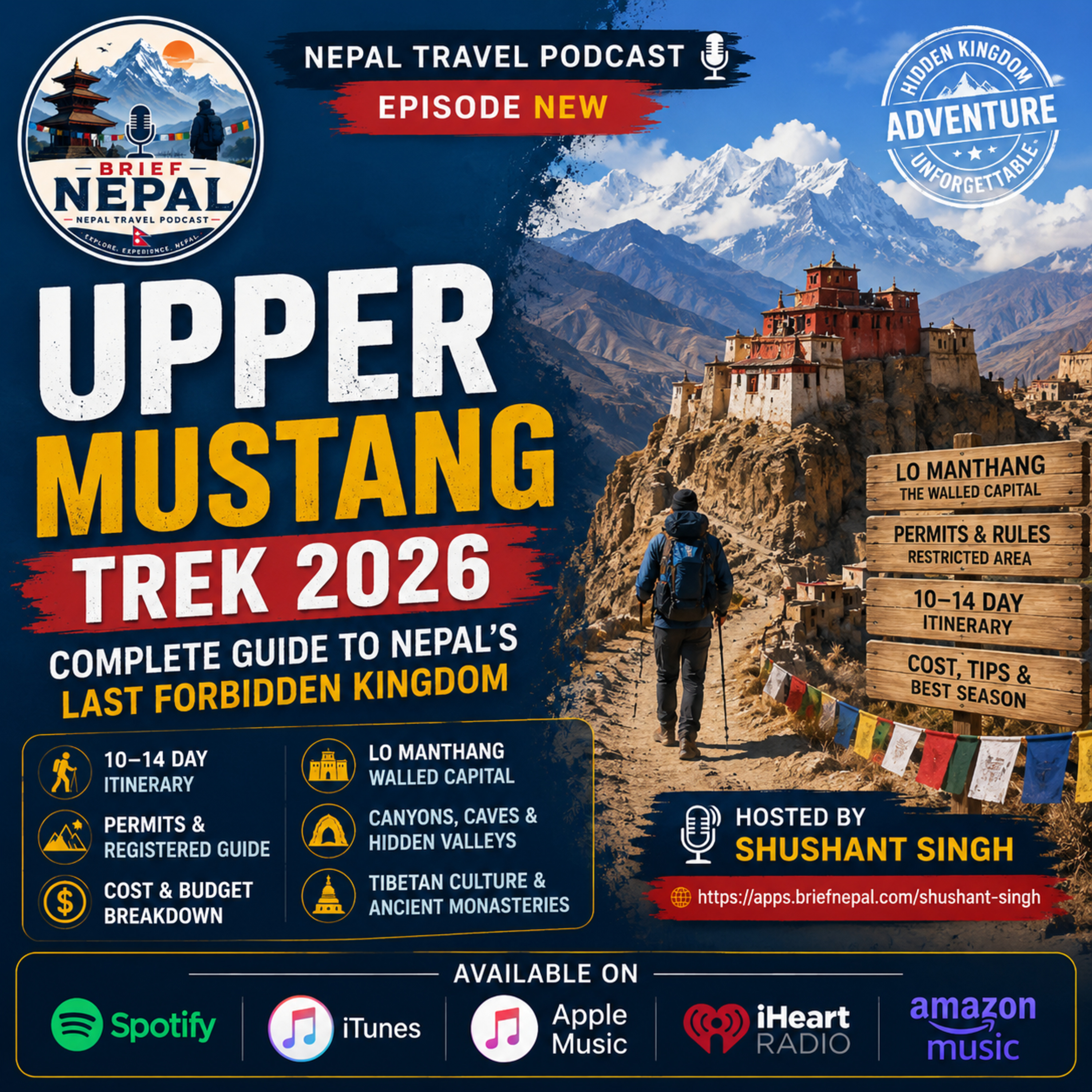
🎙️ Hosted by Shushant Singh | Nepal Travel PodcastStep beyond the ordinary and journey into Upper Mustang, one of Nepal’s most remote and culturally fascinating destinati…
▶ Listen on SpotifyShow notes & transcript →Follow the show →
🎧 Also on Apple Podcasts Castbox iHeartRadio
A glimpse of Mustang


Introduction
Mustang is one of Nepal\'s most extraordinary regions, a remote, high-altitude district tucked behind the main Himalayan range in the far north-central part of the country, bordering Tibet. Because it lies in the rain shadow of the Annapurna and Dhaulagiri massifs, almost no monsoon reaches it, and the landscape looks nothing like the green hills most people picture when they imagine Nepal. Instead you find a stark, luminous Tibetan plateau: eroded cliffs streaked red, ochre and grey, wind-scoured canyons, barley terraces clinging to riverbanks, and whitewashed villages crowned with Buddhist monasteries and fluttering prayer flags.
Travellers usually divide Mustang into two halves. Lower Mustang, Jomsom, Kagbeni, Marpha and the Muktinath valley, is open to all foreign visitors and needs only the standard Annapurna Conservation Area Permit (ACAP) and a TIMS card. Upper Mustang, the old Kingdom of Lo with its walled capital at Lo Manthang, is a Restricted Area: foreigners need a special permit costing about NPR 65,000–70,000 (US$500) for the first 10 days, must travel with a registered guide through a licensed agency, and must be in a group of at least two trekkers. For decades Upper Mustang was completely closed to outsiders, which is why it is still sometimes called the "forbidden kingdom", and why its Tibetan Buddhist culture survives so intact.
This guide covers everything you need to plan a trip: the unmissable attractions, the all-important permit rules, how long to stay, the best season (Mustang is famously one of the few places worth visiting even in the monsoon), how to reach it from Pokhara, what things cost, where to eat and sleep in the teahouses, and the practical tips that make a high-desert journey smoother.
Top Attractions
Lo Manthang (Walled Capital of Upper Mustang)
The medieval walled city of Lo Manthang is the jewel of Upper Mustang and the historic seat of the Kingdom of Lo. Inside its mud-brick ramparts sit the former royal palace, narrow whitewashed lanes and three magnificent 15th-century monasteries, Jampa, Thubchen and Chode, filled with towering Buddha statues and rare Tibetan murals. Sitting at about 3,840 m, it feels like a fragment of old Tibet preserved in Nepal. Reaching it requires the Upper Mustang Restricted Area Permit (about NPR 65,000–70,000 (US$500) for the first 10 days) and a registered guide.
Kagbeni (Gateway Village)
Kagbeni is the atmospheric gateway between Lower and Upper Mustang, a tightly packed medieval village of mud houses, irrigation channels and a red-walled monastery where green barley fields meet the bare desert. The police checkpost here marks the boundary of the restricted zone, beyond it you need the Upper Mustang permit. It is also a stop on the pilgrimage route to Muktinath and a favourite overnight for trekkers and jeep travellers.
Jomsom (District Headquarters & Airport)
Jomsom is the administrative capital of Mustang district and the region\'s transport hub, strung along the windy Kali Gandaki riverbed at about 2,720 m. Its small STOL airport receives short, scenic flights from Pokhara, and the bazaar is the place to stock up, hire jeeps, arrange permits and acclimatise. Most journeys into both Lower and Upper Mustang begin or end here.
Muktinath Temple
One of the most sacred pilgrimage sites in Nepal, holy to both Hindus and Buddhists, set at around 3,800 m above Jomsom. Pilgrims bathe under its 108 water spouts and visit the eternal natural flame fed by underground gas. It is the spiritual high point of any Mustang trip and easily reached from the Lower Mustang road. Read the full Muktinath guide →
Kali Gandaki Gorge (World's Deepest)
The Kali Gandaki carves the deepest gorge on Earth, running between the 8,000 m giants of Dhaulagiri and Annapurna with a vertical drop of more than 5,500 m from peak to river. This ancient trade corridor between Tibet and India is also where pilgrims search the riverbed for shaligram, black ammonite fossils revered as sacred forms of Vishnu, proof that this high desert was once an ocean floor.
Marpha (Apple Village & Brandy)
Perhaps the prettiest village in Lower Mustang, Marpha is a spotless Thakali settlement of flat-roofed whitewashed houses, flagstone lanes and orchards. It is famous across Nepal for its apples, turned into fresh cider, dried fruit, jam and the local apple brandy. A handsome hilltop monastery overlooks the village, and the Thakali kitchens here serve some of the best dal bhat in the country.
Sky Caves of Mustang (Chhoser)
Honeycombing the cliffs near Chhoser, north of Lo Manthang, are thousands of mysterious man-made caves dug high into the sheer rock, some up to 2,000 years old. The five-storey Jhong cave complex can be climbed via wooden ladders, revealing rooms once used for burial, meditation, storage and refuge. Among the most enigmatic archaeological sites in the Himalaya, they are a highlight of any Upper Mustang itinerary.
Tiji Festival
The three-day Tiji Festival is Upper Mustang\'s most spectacular event, held each spring (usually in May) in the central square of Lo Manthang. Monks in elaborate costumes and masks perform sacred cham dances re-enacting the triumph of good over evil, watched by villagers in their finest dress. Permits and lodgings sell out fast around Tiji, so book months ahead if you want to witness it.
History
For centuries Mustang was an independent Buddhist kingdom known as the Kingdom of Lo, founded in 1380 by the warrior Ame Pal, who built the walled city of Lo Manthang as his capital. Strategically placed on the salt-and-wool trade route between the Tibetan plateau and the Indian lowlands, Lo grew wealthy controlling caravans that threaded up the Kali Gandaki gorge. Its culture, language and Tibetan Buddhist faith are essentially Tibetan, and the great monasteries of Lo Manthang, Jampa, Thubchen and Chode, date from this golden age in the 15th century.
The kingdom later came under the influence of the Gorkha rulers who unified Nepal in the 18th century, but Lo retained a hereditary king (the raja or gyalpo of Mustang) and a remarkable degree of autonomy well into modern times. The last king, Jigme Dorje Palbar Bista, was formally recognised until Nepal abolished its monarchies in 2008, though he remained a deeply respected cultural figure until his death in 2016.
Because of its sensitive border with Tibet, and its role as a base for Khampa resistance fighters during the Cold War, Upper Mustang was sealed off from foreign travellers until 1992. When it finally reopened, the government kept it a tightly controlled Restricted Area with a high permit fee, partly to protect its fragile environment and its astonishingly well-preserved Tibetan Buddhist heritage. That long isolation is exactly why a visit today feels like stepping into a living medieval world that has all but vanished elsewhere on the plateau.
Things to Do
Mustang rewards both the gentle traveller doing Lower Mustang by jeep and the committed trekker walking all the way to Lo Manthang. Here are the experiences worth building into your trip:
- Explore Lo Manthang. Spend at least two nights in the walled capital, touring its three great monasteries, the old royal palace and the surrounding villages of Chhoser, Garphu and Namgyal.
- Climb into the Sky Caves. Visit the cliff-cave complexes near Chhoser, scrambling up wooden ladders into mysterious rooms carved 2,000 years ago.
- Make the Muktinath pilgrimage. Bathe under the 108 spouts and see the eternal flame at one of Nepal\'s holiest temples, sacred to Hindus and Buddhists alike.
- Walk through Kagbeni and the Kali Gandaki gorge. Follow the ancient trade route along the world\'s deepest gorge, hunting for shaligram fossils in the riverbed.
- Taste Marpha. Tour the apple orchards, sample fresh cider and the local apple brandy, and eat Thakali dal bhat in a whitewashed courtyard.
- Time your trip for the Tiji Festival. If you can travel in May, the masked cham dances in Lo Manthang are unforgettable, but book everything months ahead.
- Trek the classic Upper Mustang route. The 10–12 day round trip from Jomsom to Lo Manthang and back passes a new village, monastery or chorten almost every hour.
- Combine with the wider Annapurna region. Mustang adjoins the great trekking trails of the Annapurna massif, see our Annapurna Base Camp trek guide for a contrasting green-valley alternative.
Best Time to Visit
Mustang has an unusual climate that makes it one of the few Himalayan regions worth visiting almost year-round. Because it sits in the rain shadow of the Annapurna and Dhaulagiri ranges, the summer monsoon that drenches the rest of Nepal barely reaches it, so while other treks are washed out from June to August, Mustang stays mostly dry and open.
The overall best window is roughly May to October. Spring (April–May) brings warming days, blossom in the lower valleys and the Tiji Festival; autumn (late September–November) offers the clearest skies and the most reliable mountain views. The monsoon months (June–early September) are the region\'s quiet secret, dustier and occasionally hazy, but largely rain-free and far less crowded, which is why Mustang is a popular monsoon-season trek when the rest of Nepal is too wet.
Winter (December–February) is bitterly cold, with sub-zero nights, biting winds and many teahouses in Upper Mustang closed as locals migrate to lower towns; the region feels almost empty. Note too that strong winds funnel up the Kali Gandaki valley almost every afternoon in any season, so morning travel is always smoother.
How to Reach Mustang
From Pokhara
Almost all Mustang journeys start in Pokhara, the lakeside city west of Kathmandu. From there you have two main options to reach Jomsom, the gateway to the region.
By air
Short, scenic STOL flights from Pokhara to Jomsom take about 20–25 minutes and thread spectacularly between Annapurna and Dhaulagiri. They run mainly in the early morning before the valley winds pick up, and are frequently delayed or cancelled by weather, always build in buffer days. Flying saves a long, rough road day and is the easiest way to start a trek or jeep tour from Jomsom.
By road / jeep
A rough but increasingly drivable road follows the Kali Gandaki valley from Pokhara through Beni, Tatopani and Ghasa up to Jomsom, typically a long, bumpy full day (or two) by local bus or shared/private jeep. From Jomsom, jeeps continue to Kagbeni and Muktinath in Lower Mustang, and (with the right permit and guide) all the way up to Lo Manthang in Upper Mustang.
Permits: read carefully
Lower Mustang (Jomsom, Kagbeni, Marpha, Muktinath) is open to all foreigners and needs only the Annapurna Conservation Area Permit (ACAP) plus a TIMS card, no special permit. Upper Mustang (beyond Kagbeni, towards Lo Manthang) is a Restricted Area: you need the Upper Mustang Restricted Area Permit (RAP) at about NPR 65,000–70,000 (US$500) per person for the first 10 days (set by law in US dollars; about US$50 per extra day), you must travel with a government-registered guide arranged through a licensed trekking agency, and there must be a minimum of two trekkers. Solo travel into Upper Mustang is not permitted, and the agency arranges the RAP for you in Kathmandu or Pokhara.
Budget Guide
Mustang is more expensive than most of Nepal because of its remoteness, transport costs and, for Upper Mustang, the steep permit. Approximate costs per person (2026 estimates, in Nepali rupees):
| Item | Approx. cost | Notes |
|---|---|---|
| Upper Mustang permit (RAP) | ~NPR 65,000–70,000 (US$500) / 10 days | Set by law in US dollars; about US$50 per extra day; per person; mandatory for Upper Mustang only |
| ACAP entry permit | ~NPR 3,000 | Required for all of Mustang; TIMS card extra |
| Lower Mustang (per day) | NPR 4,000–7,000 | Teahouse, food, shared jeep or local transport |
| Upper Mustang trek (per day, all-in) | much higher (organised trek) | Guide, food, lodging; on top of the RAP fee |
| Pokhara–Jomsom flight (one way) | NPR 8,000–12,000 | Weather-dependent |
A full guided Upper Mustang trip, including the permit, guide, food, teahouses and transport, commonly works out to a much higher total per person depending on length, group size and whether you fly or drive. Carry plenty of cash in Nepali rupees, there are very few ATMs (Jomsom has a couple that are often out of cash or offline), and almost nowhere accepts cards once you leave Jomsom. Budget extra rupees for hot showers, device charging and Wi-Fi, which teahouses charge for separately.
Food & Where to Eat
Mustang is the heartland of Thakali cuisine, widely considered the finest version of dal bhat in Nepal. The Thakali thali, rice with lentil soup, a tangy vegetable curry, greens, pickle, beans and often buckwheat or grilled meat, is hearty, balanced fuel for high-altitude travel, and you will eat it across Tukuche, Marpha, Jomsom and Kagbeni.
Higher up, the food turns more Tibetan: thukpa (noodle soup), tsampa (roasted barley flour), momos, butter tea and dried-meat dishes that suit the cold, thin air. Don\'t miss Marpha\'s apple products, fresh apples, cider, dried slices, jam and the famous apple brandy, and the buckwheat pancakes and local barley raksi found in village kitchens.
Food safety: stick to freshly cooked hot meals, drink boiled, filtered or treated water (a bottle with a filter saves money and plastic), and ease into rich or unfamiliar dishes at altitude. Vegetarian dal bhat is the safest, most reliable choice almost everywhere.
Hotels & Accommodation
Accommodation in Mustang is almost entirely in teahouses, family-run guesthouses that line the trekking and jeep routes. They are simple but welcoming: expect a basic twin room with shared or simple private bathrooms, a warm communal dining hall heated by a stove, and a menu of dal bhat, noodles and tea. Standards are higher in the bigger settlements, Jomsom, Kagbeni, Marpha and Lo Manthang, and more rustic in small villages between.
- Jomsom & Kagbeni: the most comfortable bases, with some smarter lodges, reliable food and hot showers (usually for an extra fee).
- Marpha & Tukuche: charming Thakali villages with cosy, well-run teahouses and excellent kitchens.
- Lo Manthang: a good cluster of guesthouses inside and just outside the walled city, book ahead in spring and around the Tiji Festival, when beds are scarce.
- Smaller villages (Chele, Syangboche, Ghami, Tsarang): basic but characterful overnight stops on the trek north.
Most teahouses charge little for the room itself, expecting you to eat dinner and breakfast there, and bill separately for hot showers, charging and Wi-Fi. Bring a warm sleeping bag for the higher villages, especially in shoulder seasons, as rooms are unheated.
Travel Tips
- Mind the altitude. Much of Mustang sits above 3,000 m, with Muktinath and Lo Manthang near 3,800 m. Ascend gradually, stay hydrated, and watch for headache, nausea or dizziness, descend if symptoms worsen.
- Sort permits before you go. Upper Mustang needs the ~NPR 65,000–70,000 (US$500) Restricted Area Permit, a registered guide and a minimum of two trekkers; your agency arranges the RAP in Kathmandu or Pokhara. Lower Mustang needs only ACAP and a TIMS card.
- Carry plenty of cash. ATMs are scarce and unreliable beyond Jomsom, and cards are rarely accepted, bring enough Nepali rupees for the whole trip plus a buffer.
- Plan for wind and weather. Fierce afternoon winds funnel up the Kali Gandaki valley daily; travel and fly in the morning when possible, and pack a windproof jacket, buff and sunglasses against the dust.
- Build in buffer days for flights. Pokhara–Jomsom flights are frequently delayed or cancelled by weather; never schedule them tight against an international departure.
- Respect the culture. Walk clockwise around chortens and mani walls, ask before entering monasteries or photographing people, and dress modestly, this is a deeply Buddhist region.
- Pack for big temperature swings. Sunny days can be warm but nights are cold and rooms are unheated; layers, a warm hat and a good sleeping bag are essential.
- Protect against the sun. At altitude in a dry, treeless desert, UV is intense, use strong sunscreen, lip balm and sunglasses, and a wide-brim hat.
- Travel insurance. Choose a policy that covers high-altitude trekking and, ideally, helicopter evacuation, as roads and medical care here are limited.
Frequently Asked Questions
How much does the Upper Mustang permit cost?
The Upper Mustang Restricted Area Permit costs about NPR 65,000–70,000 (US$500) per person for the first 10 days, plus about US$50 for each additional day (this fee is set by law in US dollars). This is on top of the Annapurna Conservation Area Permit (ACAP) of roughly NPR 3,000. The permit applies only to Upper Mustang beyond Kagbeni, not to Lower Mustang.
Do I need a guide to visit Mustang?
For Upper Mustang, yes, you must travel with a government-registered guide arranged through a licensed agency, and there must be a minimum of two trekkers, so solo travel is not allowed. For Lower Mustang (Jomsom, Kagbeni, Marpha, Muktinath) a guide is not legally required, though it is still recommended.
What is the difference between Upper and Lower Mustang?
Lower Mustang, Jomsom, Kagbeni, Marpha and the Muktinath valley, is open to all foreigners and needs only the ACAP permit and a TIMS card. Upper Mustang is the old Kingdom of Lo around Lo Manthang, a Restricted Area requiring a special permit of about NPR 65,000–70,000 (US$500) for the first 10 days, a registered guide and at least two trekkers.
Why is Mustang called the forbidden kingdom?
Upper Mustang was an independent Buddhist kingdom, the Kingdom of Lo, that stayed closed to foreign travellers until 1992 because of its sensitive border with Tibet. That long isolation preserved its Tibetan culture almost intact, which is why it is still nicknamed the forbidden kingdom.
What is the best time to visit Mustang?
Roughly May to October is best, with spring (April–May) and autumn (late September–November) offering the clearest views. Because Mustang sits in the Himalayan rain shadow, it stays mostly dry even during the summer monsoon, making it one of the few regions worth trekking from June to August. Winter is very cold and many teahouses close.
Can you visit Mustang during the monsoon?
Yes. Mustang lies in the rain shadow of the Annapurna and Dhaulagiri ranges, so it receives very little monsoon rain. While most of Nepal is too wet to trek from June to August, Mustang remains largely dry and open, making it a popular monsoon-season destination, though it can be dusty and occasionally hazy.
How do I get to Mustang from Pokhara?
From Pokhara you can take a 20–25 minute STOL flight to Jomsom, the gateway to Mustang, or travel overland by bus or jeep up the Kali Gandaki valley through Beni and Ghasa, which takes a long, bumpy day or two. From Jomsom, jeeps continue to Kagbeni, Muktinath and, with a permit, up to Lo Manthang.
How high is Mustang and is altitude sickness a risk?
Much of Mustang sits above 3,000 m, with Muktinath and the capital Lo Manthang at around 3,800 m. Altitude sickness is a real risk, so ascend gradually, stay hydrated, and watch for headaches, nausea or dizziness, descending if symptoms worsen.
When is the Tiji Festival in Mustang?
The Tiji Festival is a three-day Buddhist celebration held each spring, usually in May, in the walled city of Lo Manthang in Upper Mustang. Monks perform masked cham dances re-enacting the triumph of good over evil. Exact dates follow the Tibetan lunar calendar, so confirm them in advance, and book permits and lodging months ahead.
How many days do you need for Mustang?
A Lower Mustang trip to Jomsom, Kagbeni, Marpha and Muktinath can be done in about 4–6 days. A classic Upper Mustang trek from Jomsom to Lo Manthang and back usually takes 10–12 days, plus travel time to and from Pokhara and buffer days for flights.
What is Lo Manthang?
Lo Manthang is the medieval walled capital of Upper Mustang and the historic seat of the Kingdom of Lo, sitting at about 3,840 m. Inside its mud-brick walls are the former royal palace and three magnificent 15th-century monasteries, Jampa, Thubchen and Chode, making it the cultural highlight of the region.
Is Muktinath in Mustang?
Yes. Muktinath is a sacred temple in Lower Mustang, around 3,800 m above Jomsom, holy to both Hindus and Buddhists. It is famous for its 108 water spouts and an eternal natural flame, and it lies in the open part of Mustang, so no special restricted-area permit is needed to visit.
What are the sky caves of Mustang?
The sky caves are thousands of man-made caves carved high into the cliffs of Upper Mustang, especially near Chhoser, some up to 2,000 years old. The multi-storey Jhong cave complex can be explored via ladders, and the caves were once used for burial, meditation, storage and shelter.
Why is the Kali Gandaki gorge famous?
The Kali Gandaki gorge is regarded as the deepest gorge on Earth, dropping more than 5,500 m between the 8,000 m peaks of Dhaulagiri and Annapurna. It was an ancient salt-trade route and is famous for shaligram, the black ammonite fossils pilgrims collect from its riverbed as sacred forms of Vishnu.
Do I need cash in Mustang?
Yes, carry plenty of cash in Nepali rupees. ATMs are scarce and unreliable beyond Jomsom, and cards are rarely accepted in teahouses and villages. Bring enough for your whole trip plus a buffer, including extra for hot showers, charging and Wi-Fi, which are billed separately.
Reviews & Ratings
No reviews yet. Be the first to share your experience of Mustang!
Official sources
Fees and rules on this page come from the bodies that set them. They do change, sometimes mid-season, so check the primary source before you pay anything.
- National Trust for Nature Conservation Annapurna Conservation Area (ACAP) permitsntnc.org.np
- Trekking Agencies' Association of Nepal TIMS card rules & feeswww.taan.org.np
- Dept. of National Parks & Wildlife Conservation National park & conservation area entry feesdnpwc.gov.np
By the BriefNepal Travel Desk
Researched and maintained by our Nepal-based editorial team and reviewed for accuracy. Last updated September 3, 2026. Prices, permits and conditions change, always verify before you travel. Spotted something out of date? Let us know.
Nepal Currency Converter
Live exchange rates for the Nepalese Rupee (NPR) against every world currency, handy for budgeting the prices in our guides.
Live mid-market rates. For information only, banks and exchanges apply their own margins.
Planning a trip to Nepal?
Join the BriefNepal Travel list for seasonal tips, new guides and our free Nepal trip-planning checklist. No spam, unsubscribe anytime.