




Upper Dolpo Trek Guide
The Upper Dolpo trek is one of Nepal's wildest and most remote journeys, a three-to-four-week tented expedition behind the main Himalaya into the arid, trans-Himalayan kingdom of Dolpo, land of turquoise Shey Phoksundo Lake, the Crystal Monastery, and the snow leopard.
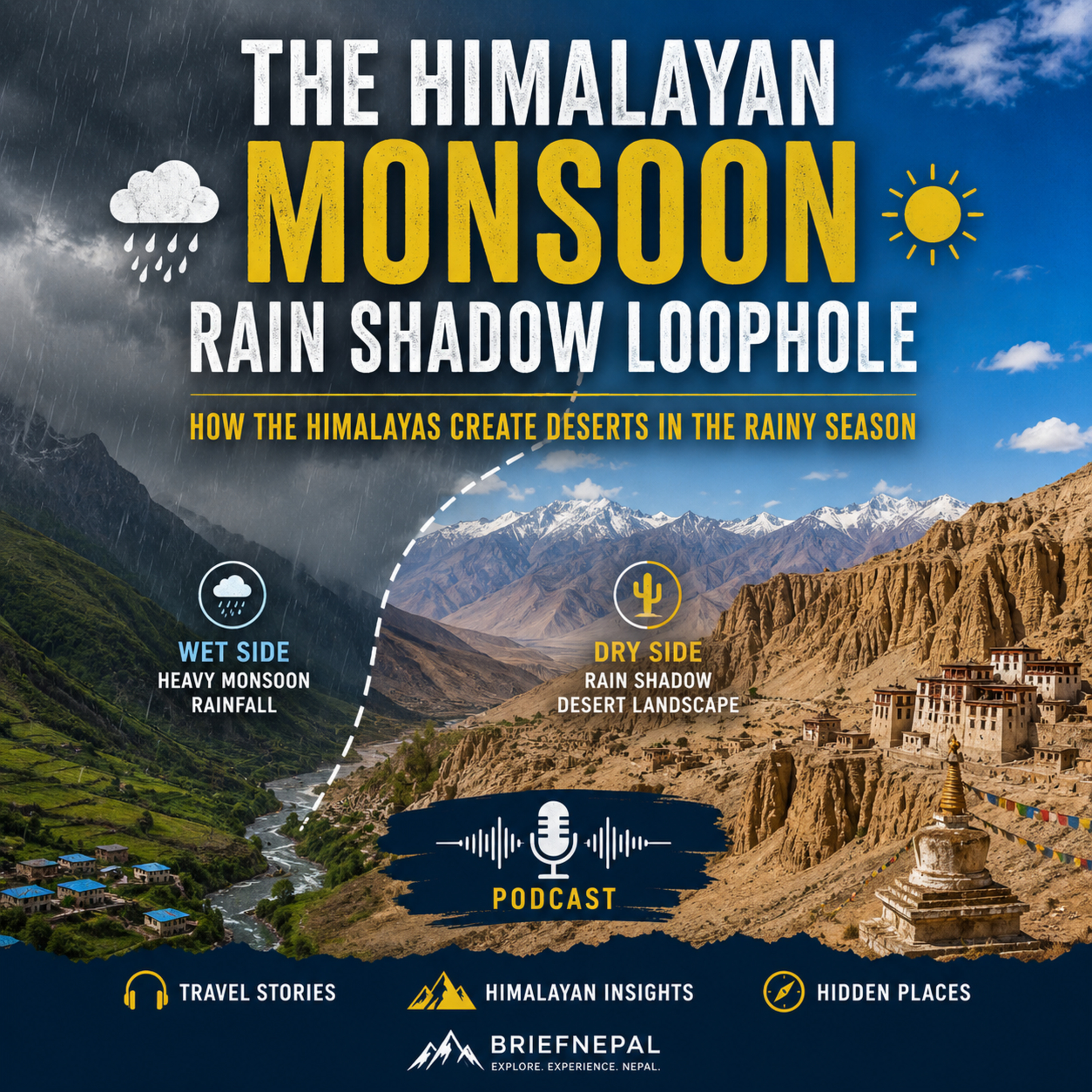
The Himalayan Monsoon Rain Shadow LoopholeJourney beyond the monsoon into one of the Himalayas' best-kept secrets. In this episode, we explore the fascinating phenome…
▶ Listen on SpotifyShow notes & transcript →Follow the show →
🎧 Also on Apple Podcasts Castbox iHeartRadio
A glimpse of Upper Dolpo


Overview
The Upper Dolpo trek is the most committing and atmospheric of Nepal's great wilderness journeys, a long, remote, fully tented expedition into the far north-west of the country, behind the main Himalayan wall and into the parched, wind-scoured world of the Tibetan rain shadow. This is the setting of Peter Matthiessen's classic The Snow Leopard and of the Oscar-nominated film Himalaya (Caravan), and it remains one of the wildest, least-visited and most expensive treks in the entire country.
Dolpo lies in the Dolpa district of Karnali province, a high desert of ochre cliffs, juniper-scented villages and medieval Tibetan Buddhist and pre-Buddhist Bon culture. Here, time has barely moved: yak caravans still carry salt traded down from Tibet, monks still tend ancient gompas perched on bare hillsides, and the seasons of barley and buckwheat dictate the rhythm of life. The crown jewel is Shey Phoksundo Lake (around 3,600 m), Nepal's deepest lake, whose impossibly turquoise water sits within the Shey Phoksundo National Park, ringed by cliffs and waterfalls.
The route crosses a string of high passes above 5,000 m, among them Kang La (around 5,360 m), Saldang La (around 5,200 m), Jeng La, and on the southern circuits Numa La (around 5,360 m) and Baga La (around 5,070 m). Along the way it visits Shey Gompa, the ancient "Crystal Monastery" beneath Crystal Mountain, and the timeless villages of Saldang, Namgung and the upper Tarap valley. This is true expedition trekking: no roads, no lodges to speak of, and no easy bailout.
Most itineraries run 21 to 28 days, including the flights to and from the Juphal airstrip. It is graded very strenuous and is strictly for experienced, fit and self-sufficient trekkers travelling with a full camping crew. What you trade for the effort, expense and remoteness is something few places on Earth can still offer, a journey into a living medieval Himalayan culture, across some of the loneliest high country in Nepal, in the heart of Upper Mustang's wilder, less-trodden western cousin.
Day-by-Day Itinerary
This is a classic Upper Dolpo "inner Dolpo" circuit built around the long approach to Shey Phoksundo Lake, the crossing of the high passes to Shey Gompa and Saldang, and the return down the Tarap valley. It is a fully tented camping trek; distances and overnights vary between agencies and seasons. The trek begins and ends with flights between Kathmandu, Nepalgunj and the Juphal airstrip.
Day 1: Fly Kathmandu to Nepalgunj (150 m)
A flight south-west to the hot Terai town of Nepalgunj, near the Indian border, the staging post for all flights into Dolpo. An overnight here positions you for the early mountain flight.
Day 2: Fly Nepalgunj to Juphal (2,475 m), trek to Dunai (2,140 m)
An early, spectacular flight into the tiny airstrip at Juphal, then an easy descending walk along the Thuli Bheri River to Dunai, the district headquarters of Dolpa, where permits are checked. (2-3 hours.)
Day 3: Dunai to Ankhe (2,660 m)
Follow the river west and turn north up the Phoksundo (Suligad) valley, climbing gently through gorges and forest to the camp at Ankhe. (5-6 hours.)
Day 4: Ankhe to Renje / Sumduwa (3,100 m)
A varied day along the steep-sided valley, with airy traverses above the river and a final climb to camp near the national park post. (5-6 hours.)
Day 5: Renje to Phoksundo Lake / Ringmo (3,600 m)
A steep climb past one of Nepal's highest waterfalls brings you to the Tibetan-style village of Ringmo and the first astonishing view of the turquoise Shey Phoksundo Lake. (4-5 hours.)
Day 6: Acclimatisation day at Phoksundo Lake
An essential rest and acclimatisation day. Walk to the old Bon gompa above the lake, stroll the shoreline, and take a short hike higher to aid acclimatisation before the high passes ahead.
Day 7: Phoksundo Lake to Phoksundo Khola (3,630 m)
Traverse the famous ledge path cut into the cliff above the lake's western shore, then follow the river through woodland to a camp on a level meadow at the head of the lake. (4-5 hours.)
Day 8: Phoksundo Khola to Kang La base camp (4,400 m)
Climb steadily up the valley into ever-more barren, glacier-fed country to a high camp below the Kang La. (5-6 hours.)
Day 9: Cross Kang La (5,360 m) to Shey Gompa (4,160 m)
A demanding day over the Kang La, the first big pass, with sweeping views into inner Dolpo, before a long descent to Shey Gompa, the ancient "Crystal Monastery" beneath sacred Crystal Mountain. (6-7 hours.)
Day 10: Rest / explore day at Shey Gompa
A day among the gompas and pilgrim trails of Shey, the spiritual heart of Dolpo, to rest, acclimatise and absorb its medieval Tibetan-Buddhist and Bon heritage.
Day 11: Shey Gompa to Namgung (4,360 m) via Saldang La
Cross the Saldang La (around 5,200 m) through stark, eroded high desert, then descend to the small monastery settlement of Namgung. (6-7 hours.)
Day 12: Namgung to Saldang (3,900 m)
A shorter day traversing to Saldang, the largest and most prosperous village of inner Dolpo, strung along terraced fields high above the river. (4-5 hours.)
Days 13-16: Saldang to the Tarap valley
Trek south and east through remote villages, yak pastures and trade trails, crossing further high ground toward the upper Tarap valley and its old gompas. Itineraries vary, with several long days through some of the loneliest country in Nepal.
Days 17-19: Tarap valley over Numa La & Baga La
Cross the twin high passes of Numa La (around 5,360 m) and Baga La (around 5,070 m), among the highest points of the trek, with grand views before descending toward the Bheri valley. Camps are high and cold. (Long, strenuous days.)
Days 20-22: Descend to Juphal, fly out via Nepalgunj to Kathmandu
Drop steadily back through forest and farmland to Dunai and the airstrip at Juphal, then fly out via Nepalgunj to Kathmandu. Build in contingency days, as the Juphal and Nepalgunj flights are weather-dependent and frequently delayed.
Difficulty & Fitness
The Upper Dolpo trek is graded very strenuous and is one of the most committing treks in Nepal. It is suitable only for fit, experienced trekkers who have already completed a high-altitude Himalayan trek and are comfortable with weeks of self-sufficient camping.
- Extreme remoteness. Dolpo is among the most isolated regions in Nepal. There are no roads beyond the trailhead, no lodges on most of the route, sparse supplies, and very little phone signal. Once you are in, there is no easy bailout.
- Multiple 5,000 m+ passes. The route crosses several passes above 5,000 m, Kang La, Saldang La, Numa La and Baga La among them, often on consecutive demanding days and exposed to wind and snow.
- Length and altitude load. Three to four weeks on the trail, with many nights above 4,000 m and repeated high crossings, puts a serious cumulative strain on the body and demands disciplined acclimatisation.
- Full tented camping. There are no teahouses to fall back on. You sleep in tents, eat food carried or sourced by your crew, and endure cold nights, dust and the discomforts of expedition life.
- Long days on rough ground. Trails are faint, rocky and steep, crossing scree, moraine and high passes, often for 6-8 hours or more a day.
You should be able to walk long days on rough terrain for three weeks or more, and ideally have trekked to 5,000 m before. Train hard for several months with long loaded hill walks, stair climbs and back-to-back days, and arrive in good cardiovascular condition.
Permits & Regulations
Upper Dolpo is a restricted area, so the paperwork is more involved and far more expensive than for an ordinary trek. You need two main documents:
- Upper Dolpo Restricted Area Permit (RAP), expensive, at around USD 500 per person for the first 10 days, plus roughly USD 50 per person per day thereafter. This is one of the costliest restricted-area permits in Nepal. (By contrast, Lower Dolpo's RAP is far cheaper, around USD 20 per week, but the Upper Dolpo region is the expensive one.)
- Shey Phoksundo National Park entry permit, around NPR 3,000 for foreign nationals (less for SAARC nationals), since the route runs through the national park.
Restricted-area rules are strict: you must trek with a registered, licensed guide, you must go through a registered trekking agency, and there is a minimum of two trekkers on a single permit. Solo trekking is not permitted. Carry your passport and several passport photos, and keep permits handy for checkpoints at Dunai and the park posts. Permit rates and rules change, so always confirm the current Upper Dolpo restricted-area fees and conditions with a registered agency before you travel.
Cost & Budget
Upper Dolpo is one of the most expensive treks in Nepal. The high cost is driven by the costly restricted-area permit, the great length of the trek, the multiple flights, and the need for a full camping crew of guide, cook, porters and pack animals carrying everything for three to four weeks.
- Guided camping expedition: a full package typically costs NPR 465,000-800,000+ per person, depending on group size, length of itinerary and standard. This usually covers the restricted-area permit, national park entry, guide and full crew, camping equipment, food, and the domestic flights.
- Restricted-area permit: around USD 500 per person for the first 10 days, plus roughly USD 50 per day after, a major component of the total cost.
- Domestic flights: Kathmandu-Nepalgunj-Juphal return is a significant and weather-dependent expense.
- On-trail spending: carry enough Nepali rupees in cash for the whole trek and a buffer for delays, there are no ATMs anywhere in Dolpo, and cash is needed for tips and incidentals.
A generous tip for the guide, cook and porters who carry loads over the high passes for weeks is customary, and you should budget a comfortable contingency for delayed flights and extra camping nights.
Best Time to Trek
Dolpo's great advantage is that it sits in the rain shadow behind the main Himalaya, so it stays relatively dry even when the rest of Nepal is under cloud. This makes it one of the very few regions that can be trekked through the monsoon.
- Late spring through early autumn (May-September) is the main trekking window. Because the high peaks block most of the monsoon rain, summer is genuinely viable here, when lush, leech-ridden trails make most of Nepal difficult, Dolpo remains a high desert under clear skies.
- Early autumn (September-October) also offers stable, clear weather as the monsoon retreats, with crisp air and good views.
Avoid winter (December-February), which is bitterly cold at these altitudes and leaves the high passes, Kang La, Numa La, Baga La and the rest, snowbound and often impassable. For the best balance of open passes, settled weather and the chance to see Dolpo's villages during their short growing season, plan for the May-to-September window. This monsoon-friendly timing is part of what makes Dolpo, like nearby Upper Mustang, such a useful summer alternative to the rest of the Himalaya.
Packing, Safety & Tips
Acclimatisation
With many nights above 4,000 m and repeated crossings of 5,000 m+ passes, altitude sickness is a serious risk on Upper Dolpo. Keep the built-in acclimatisation days at Phoksundo Lake and Shey Gompa, ascend slowly, stay hydrated, avoid alcohol high up, and watch for headache, nausea and dizziness. If symptoms worsen, descend, and remember that in Dolpo, descent and rescue both take far longer than on busier trails.
Gear & packing
Pack for a high, cold, dusty desert trek: a warm sleeping bag rated well below freezing, a good down jacket, layered clothing, sturdy broken-in boots, trekking poles, sun and snow protection, lip balm and plenty of sunscreen, and a headlamp. Because everything is carried in, bring a reliable water-purification method, basic snacks, and a thorough first-aid kit including blister care and altitude medication discussed with your doctor. Dust and strong sun are constant companions in the rain shadow.
Communications & money
Phone signal is patchy to non-existent for almost the entire trek; most groups carry a satellite phone for emergencies. There are no ATMs anywhere in Dolpo, so carry enough cash for the entire trip plus a buffer for flight delays in Nepalgunj and Juphal.
Safety & insurance
Buy comprehensive travel insurance that explicitly covers trekking to at least 5,500 m and includes helicopter evacuation, a rescue from inner Dolpo is essential to plan for and very expensive without cover. Trek with a licensed guide and a registered agency (required by the restricted-area rules), keep generous contingency days for flight delays, and stay weather-aware on the exposed high passes. Respect local Buddhist and Bon customs: walk clockwise around chortens and mani walls, ask before photographing people or monasteries, and tread lightly in these fragile villages.
Combining with other treks
Upper Dolpo is a serious, standalone expedition rather than a trek to tack onto others. Some travellers link it with the Lower Dolpo circuit, or pair a Dolpo trip with the far-western lakes by adding Rara Lake on the same north-western swing. For those drawn to Tibetan trans-Himalayan culture, the natural companion journey is Upper Mustang, another restricted region with its own monsoon-friendly window. Whichever you choose, base yourself in Kathmandu before and after to arrange the restricted-area permits, flights and full camping logistics through a registered agency.
Altitude Sickness (AMS) & Trek Safety
The Upper Dolpo trek climbs to 5,360 m, well into the zone where acute mountain sickness (AMS) is a serious, potentially fatal risk, careful acclimatisation is non-negotiable. This section covers how to recognise altitude sickness, prevent it, prepare physically, and stay insured, it is general guidance, not medical advice.
Recognise the symptoms
| Level | Signs | What to do |
|---|---|---|
| Mild AMS | Headache, nausea or loss of appetite, dizziness, fatigue, broken sleep. | Stop ascending, rest, hydrate. Do not go higher until symptoms clear; descend if they do not. |
| Severe, HAPE (lungs) | Breathlessness at rest, persistent cough, frothy or pink spit, chest tightness, blue lips. | Descend immediately and treat as a medical emergency, arrange evacuation. |
| Severe, HACE (brain) | Confusion, clumsiness or loss of balance, crushing headache, drowsiness, hallucinations. | Descend immediately, HACE is life-threatening within hours. Evacuate. |
Prevent it: the golden rules
- Ascend slowly. Above 3,000 m, raise your sleeping altitude by no more than ~300–500 m per day and take the built-in acclimatisation days.
- Climb high, sleep low. Day-hike higher, then come back down to sleep.
- Hydrate (3–4 litres/day), eat well, and avoid alcohol, sleeping pills and smoking at altitude.
- Never ascend with AMS symptoms, and descend at once if they worsen, going down is the only reliable cure.
- Consider acetazolamide (Diamox) as a preventive/treatment aid, but only after discussing it with your doctor.
Get trek-fit
Start training 6–8 weeks out: build aerobic base with running, cycling or brisk hill walking 3–4 times a week; add stair and hill repeats carrying a loaded daypack (6–8 kg) to ready your legs for long descents; and finish with a couple of back-to-back long hiking days to rehearse multi-day fatigue. Strong quads and good cardio make altitude far more manageable.
Insurance & evacuation
Buy travel insurance that explicitly covers trekking up to 5,360 m and helicopter evacuation, a rescue from altitude is essential and very expensive without cover. Carry your policy number and your operator’s emergency contact, and keep the booking details of any guide with you.
Upper Dolpo: specific hazards
This is one of Nepal’s most remote routes; evacuation can take days, so a satellite communicator, contingency days and a strong support crew are essential.
Frequently Asked Questions
How many days does the Upper Dolpo trek take?
The Upper Dolpo trek usually takes 21 to 28 days, including the flights between Kathmandu, Nepalgunj and the Juphal airstrip. It is a long, fully tented camping expedition, and you should build in contingency days because the mountain flights are weather-dependent and frequently delayed.
How hard is the Upper Dolpo trek?
It is graded very strenuous and is one of the most committing treks in Nepal. The route is extremely remote with multiple passes above 5,000 m, three to four weeks of full tented camping, many nights above 4,000 m and no road bailout, making it suitable only for fit, experienced trekkers.
Where is Upper Dolpo?
Upper Dolpo lies in the Dolpa district of Karnali province, in Nepal's far north-west, behind the main Himalaya in the arid Tibetan rain shadow. It is the trans-Himalayan setting of Peter Matthiessen's book The Snow Leopard and the film Himalaya (Caravan).
What permits do I need for the Upper Dolpo trek?
You need the Upper Dolpo Restricted Area Permit, which costs around USD 500 per person for the first 10 days plus roughly USD 50 per person per day after that, and a Shey Phoksundo National Park entry permit of around NPR 3,000. As a restricted area, it also requires a registered guide and agency, with a minimum of two trekkers.
How much does the Upper Dolpo trek cost?
A full guided camping expedition typically costs around NPR 465,000-800,000 or more per person, driven by the expensive restricted-area permit, the trek's length, the multiple flights and the need for a full camping crew. Carry extra cash too, as there are no ATMs anywhere in Dolpo.
Can I trek Upper Dolpo solo or without a guide?
No. Upper Dolpo is a restricted area, so solo trekking is not allowed. You must travel through a registered trekking agency with a licensed guide, and there is a minimum requirement of two trekkers on a single restricted-area permit.
What is the best time to trek Upper Dolpo?
Because Dolpo sits in the rain shadow behind the Himalaya, it is one of the few regions trekkable in the monsoon. The best window is late spring through early autumn (roughly May to September), when the high peaks block most of the rain. Winter is too cold and the high passes are snowbound.
Can you trek Upper Dolpo during the monsoon?
Yes. Unusually for Nepal, Upper Dolpo is a viable monsoon trek. It lies in the arid Tibetan rain shadow, so while the rest of the country is wet and cloudy, Dolpo stays relatively dry under clear skies, making summer one of the best times to go.
How do I get to the start of the Upper Dolpo trek?
You fly from Kathmandu to Nepalgunj in the Terai, then take a small mountain flight to the Juphal airstrip in Dolpo, from where the trek begins. You walk down to Dunai, the district headquarters, before heading north toward Shey Phoksundo Lake. The flights are weather-dependent, so allow contingency days.
What is Shey Phoksundo Lake?
Shey Phoksundo is Nepal's deepest lake, sitting at around 3,600 m within the Shey Phoksundo National Park. Famous for its intense turquoise water ringed by cliffs and waterfalls, it is the scenic centrepiece of the Upper Dolpo trek and lies beside the Tibetan-style village of Ringmo.
Which high passes does the Upper Dolpo trek cross?
Depending on the circuit, the trek crosses several passes above 5,000 m, including Kang La (around 5,360 m), Saldang La (around 5,200 m), Jeng La, and on the southern route Numa La (around 5,360 m) and Baga La (around 5,070 m). They are high, cold and often snow-affected.
What is Shey Gompa?
Shey Gompa is the ancient "Crystal Monastery", set beneath sacred Crystal Mountain in inner Dolpo at around 4,160 m. It is the spiritual heart of the region and a major pilgrimage site, reflecting Dolpo's deep Tibetan-Buddhist and pre-Buddhist Bon traditions.
What wildlife and culture will I encounter in Dolpo?
Dolpo is renowned snow leopard country, also home to blue sheep (bharal) and the Himalayan wolf. Culturally, it preserves a living medieval world of Tibetan-Buddhist and Bon villages, ancient gompas, yak caravans and the old salt trade with Tibet, largely unchanged for centuries.
Is the Upper Dolpo trek suitable for beginners?
No. The extreme remoteness, three-to-four-week length, multiple 5,000 m-plus passes, full camping and lack of any bailout make it unsuitable as a first Himalayan trek. It is best for trekkers who have already completed a high-altitude trek and are happy with weeks of self-sufficient expedition life.
Compare with Other Nepal Treks
How Upper Dolpo stacks up against other popular Nepal treks, at a glance, to help you choose and plan.
| Trek | Difficulty | Max Altitude | Duration | Best Season | Region |
|---|---|---|---|---|---|
| Upper DolpoThis trek | 🔴 Strenuous | 5,360 m | 21–28 days | May–Sep | Dolpa, Karnali |
| Makalu Base Camp | 🔴 Strenuous | 4,870 m | 18–22 days | Mar–May & Sep–Nov | Makalu-Barun, Koshi |
| Everest Base Camp | 🟠 Challenging | 5,545 m | 12–14 days | Mar–May & Sep–Nov | Khumbu, Solukhumbu |
Why these grades?
Upper Dolpo 🔴 Strenuous, A committing 21–28 day restricted trek crossing several 5,000 m-plus passes in the arid trans-Himalaya, fully tented and extremely remote, among the most demanding journeys in Nepal.
Makalu Base Camp 🔴 Strenuous, Remote and rugged: it reaches 4,870 m via two high passes (Shipton La and Keke La), with long days, sparse basic teahouses and several nights above 4,000 m, best after a previous Himalayan trek.
Everest Base Camp 🟠 Challenging, Reaches 5,364 m at base camp and 5,545 m on Kala Patthar over 12+ days at altitude, with the dramatic Lukla flight, but a busy, well-marked trail and excellent teahouses keep it within reach of fit first-timers.
Reviews & Ratings
No reviews yet. Be the first to share your experience of Upper Dolpo!
Official sources
Fees and rules on this page come from the bodies that set them. They do change, sometimes mid-season, so check the primary source before you pay anything.
- Dept. of National Parks & Wildlife Conservation National park & conservation area entry feesdnpwc.gov.np
By the BriefNepal Travel Desk
Researched and maintained by our Nepal-based editorial team and reviewed for accuracy. Last updated September 3, 2026. Prices, permits and conditions change, always verify before you travel. Spotted something out of date? Let us know.
Nepal Trip Planning Tools
Estimate your costs and trekking permits in seconds, built on real, current Nepali prices.
💰 Trip Cost Calculator
🎫 Trek Permit Calculator
Estimates only, fees and prices change with season and policy. Confirm with a registered agency and the Nepal Tourism Board before you travel.
Nepal Currency Converter
Live exchange rates for the Nepalese Rupee (NPR) against every world currency, handy for budgeting the prices in our guides.
Live mid-market rates. For information only, banks and exchanges apply their own margins.
Planning a trip to Nepal?
Join the BriefNepal Travel list for seasonal tips, new guides and our free Nepal trip-planning checklist. No spam, unsubscribe anytime.