




History & Legend of the Janaki Mandir: Sita, Mithila & the Naulakha Temple
The Janaki Mandir is a young temple on very old ground. The white-marble marvel that dazzles pilgrims today was completed only in 1910, but it crowns a site woven into the Ramayana itself, the capital of King Janak, the birthplace of Sita, and the stage of one of the most celebrated weddings in Hindu tradition.
King Janak & the Kingdom of Mithila
Long before the temple, there was the kingdom. The fertile plains around modern Janakpur are traditionally identified as the heart of ancient Mithila, the realm of King Janak (Sirdhwaj Janak), remembered in the epics and Upanishads not as a conqueror but as a philosopher-king, a ruler famed for wisdom, learning and detachment even amid royal life. His capital, Mithilapuri, gives its name to the whole Maithili-speaking cultural region that today spans southeastern Nepal and northern Bihar.
According to the Ramayana, Janak was ploughing a field as part of a ritual to bring rain when he found an infant girl in the furrow. He named her Sita, literally "furrow", and raised her as his own daughter. Because she is the daughter of Janak, Sita is also called Janaki, and it is under that name that the great temple honours her. For Hindus, this makes Janakpur a tirtha of the highest order: the earthly birthplace of the goddess who embodies devotion, dignity and endurance.
The Bow of Shiva & the Divine Wedding
The story that defines the city is Sita's Swayamvara, her bride-choosing ceremony. King Janak possessed the colossal bow of Shiva (the Dhanush) and set an impossible test: only the prince who could lift and string it would win Sita's hand. Kings and princes from across the land strained and failed, until the young Ram of Ayodhya, travelling with the sage Vishwamitra, lifted the bow with ease, and in stringing it, broke it in two with a crack said to have echoed through the three worlds.
The wedding that followed is one of the most beloved episodes in Hindu tradition: Ram married Sita, and his three brothers married Sita's sister and cousins in the same grand ceremony, uniting Ayodhya and Mithila. The Vivah Mandap beside the temple marks the traditional site of the marriage, re-enacted every year at Vivaha Panchami, and Dhanushadham, northeast of the city, enshrines what tradition holds to be a fragment of the broken bow, see the nearby attractions guide. Pilgrims tracing the whole story follow the Ramayana circuit between these sites.
The Golden Image & the Revival of Janakpur
Ancient Mithilapuri faded from history, and for centuries the site's sanctity survived mainly in memory and local devotion. Its revival is credited to an ascetic named Shurkishordas, who in 1657 is said to have discovered a golden image of Sita at this very spot, taken as proof that this was indeed the place of her earthly life. Shurkishordas settled here, preached the philosophy of Sita Upasana (devotion to Sita), and around his shrine the modern pilgrim town began to grow.
Tradition adds a further layer: the spot where the image was found is held to be where King Janak himself kept the images of Ram and Sita and performed their worship. Through the 18th and 19th centuries, as Ram and Sita devotion flourished across the plains, Janakpur's fame spread, temples and sacred ponds multiplied, and the city's identity as Janakpurdham, a full pilgrimage abode, took hold. What was missing was a temple to match the sanctity of the site, and that came from an unexpected patron far to the south.
Queen Vrisha Bhanu & the Nine-Lakh Temple (1910)
The temple you see today was commissioned by Queen Vrisha Bhanu of Tikamgarh, in the Bundelkhand region of central India, and completed in 1910 after roughly a decade and a half of construction. Devotional tradition holds that the childless queen vowed to build a grand temple to Sita, and she spared nothing: the build is said to have cost nine lakh (900,000) rupees, an enormous sum at the time, earning the temple its enduring nickname, the "Naulakha Mandir".
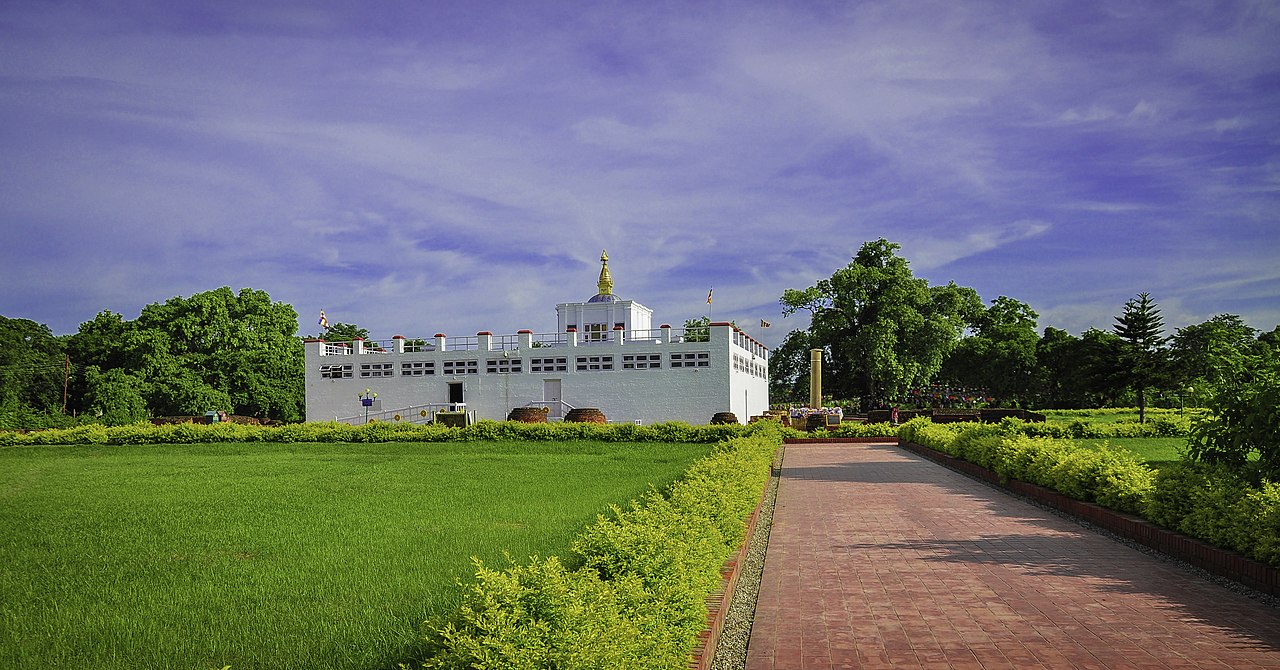
Architecturally the Janaki Mandir is unique in Nepal. Rather than the tiered pagoda style of the hills, it is built in a flamboyant fusion of Mughal-influenced and Rajput (Koiri) architecture, a three-storey palace-fortress of white stone and marble covering roughly 4,860 square metres, with domes, turrets, arched verandahs, latticed windows and around 60 rooms decorated with coloured glass, engravings and paintings. It is often compared to the palaces of Rajasthan, and it is the largest temple complex in the country. How to visit it well is covered in the darshan & puja guide.
Mithila Culture: A Living Inheritance
The temple's deepest context is not stone but culture. Janakpur remains the capital of the Maithili world, one of South Asia's great regional civilisations, with its own language and script, a celebrated literary tradition (the medieval poet Vidyapati is its brightest star), distinctive festivals such as Chhath, and above all Mithila (Madhubani) painting, the vivid folk art tradition in which women have painted gods, weddings, peacocks, fish and lotus motifs on the walls and floors of their homes for centuries.
The art and the epic feed each other: wedding scenes of Ram and Sita are among the most beloved Mithila motifs, and the city's mural-painted walls make the Ramayana feel present rather than remembered. You can watch artists at work and buy directly from them at the Janakpur Women's Development Center, covered with the city's other sights in the nearby guide. Seen this way, the Janaki Mandir is less a monument than the centrepiece of a living tradition, a place where legend, worship and everyday Maithili life have never really separated. Start with the main Janakpur guide to plan the full visit.
Frequently Asked Questions
Why is the Janaki Mandir famous?
The Janaki Mandir is dedicated to Goddess Sita (Janaki) and stands in Janakpur, the traditional capital of King Janak's ancient kingdom of Mithila, where Sita was found in a furrow and later married Lord Ram. It is one of the largest and most beautiful temples in Nepal and marks the spot where a golden image of Sita is said to have been discovered in 1657.
Who built the Janaki Mandir and when?
The present temple was commissioned by Queen Vrisha Bhanu of Tikamgarh in central India and completed in 1910. Devotional tradition holds that she vowed to build a grand temple to Sita, and the construction is said to have cost nine lakh (900,000) rupees, which gives the temple its popular nickname, the Naulakha Mandir.
Why is it called the Naulakha Mandir?
Naulakha means "nine lakh," and the temple earned the name because it is said to have cost nine lakh, or 900,000, rupees to build, an enormous sum in the early twentieth century. The nickname has stuck for over a century and is how many locals still refer to the temple.
What is the architectural style of the Janaki Mandir?
The temple is built in a striking fusion of Mughal-influenced and Rajput (Koiri) architecture, quite unlike the pagoda temples of the Nepali hills. It is a three-storey white stone and marble complex of roughly 4,860 square metres with domes, turrets, arched verandahs, latticed windows and around 60 decorated rooms, and is often compared to a Rajasthani palace.
What is the legend of Sita's birth at Janakpur?
According to the Ramayana, King Janak of Mithila was ploughing a field as part of a ritual when he found an infant girl in the furrow. He named her Sita, meaning "furrow," and raised her as his daughter, which is why she is also called Janaki, daughter of Janak. Janakpur is revered as the place of her birth and upbringing and of her marriage to Lord Ram.
What happened at Sita's Swayamvara?
King Janak set a test for Sita's suitors: to lift and string the colossal bow of Shiva. Every prince failed until Ram of Ayodhya lifted the bow and broke it, winning Sita's hand. Their wedding at Janakpur, along with the marriages of Ram's three brothers, is re-enacted every year at the Vivaha Panchami festival, and a fragment of the broken bow is said to be enshrined at nearby Dhanushadham.
Official sources
Fees and rules on this page come from the bodies that set them. They do change, sometimes mid-season, so check the primary source before you pay anything.
- Nepal Tourism Board Official Nepal tourism informationntb.gov.np

By the BriefNepal Travel Desk
Researched and maintained by our Nepal-based editorial team and reviewed for accuracy. Last updated September 3, 2026. Prices, permits and conditions change, always verify before you travel. Spotted something out of date? Let us know.
Nepal Trip Planning Tools
Estimate your costs and trekking permits in seconds, built on real, current Nepali prices.
💰 Trip Cost Calculator
🎫 Trek Permit Calculator
Estimates only, fees and prices change with season and policy. Confirm with a registered agency and the Nepal Tourism Board before you travel.
Nepal Currency Converter
Live exchange rates for the Nepalese Rupee (NPR) against every world currency, handy for budgeting the prices in our guides.
Live mid-market rates. For information only, banks and exchanges apply their own margins.
Planning a trip to Nepal?
Join the BriefNepal Travel list for seasonal tips, new guides and our free Nepal trip-planning checklist. No spam, unsubscribe anytime.
Explore More of Nepal
 JanakpurThe Mithila cultural capital and birthplace of Sita in the southern Terai.Ramayana Circuit NepalA devotional journey through Janakpur and the land of Sita and Ram.Janakpur Pilgrimage TourA devotional journey through the land of Sita and the Ramayana.
 Pashupatinath TempleNepal's holiest Shiva shrine on the sacred Bagmati.