



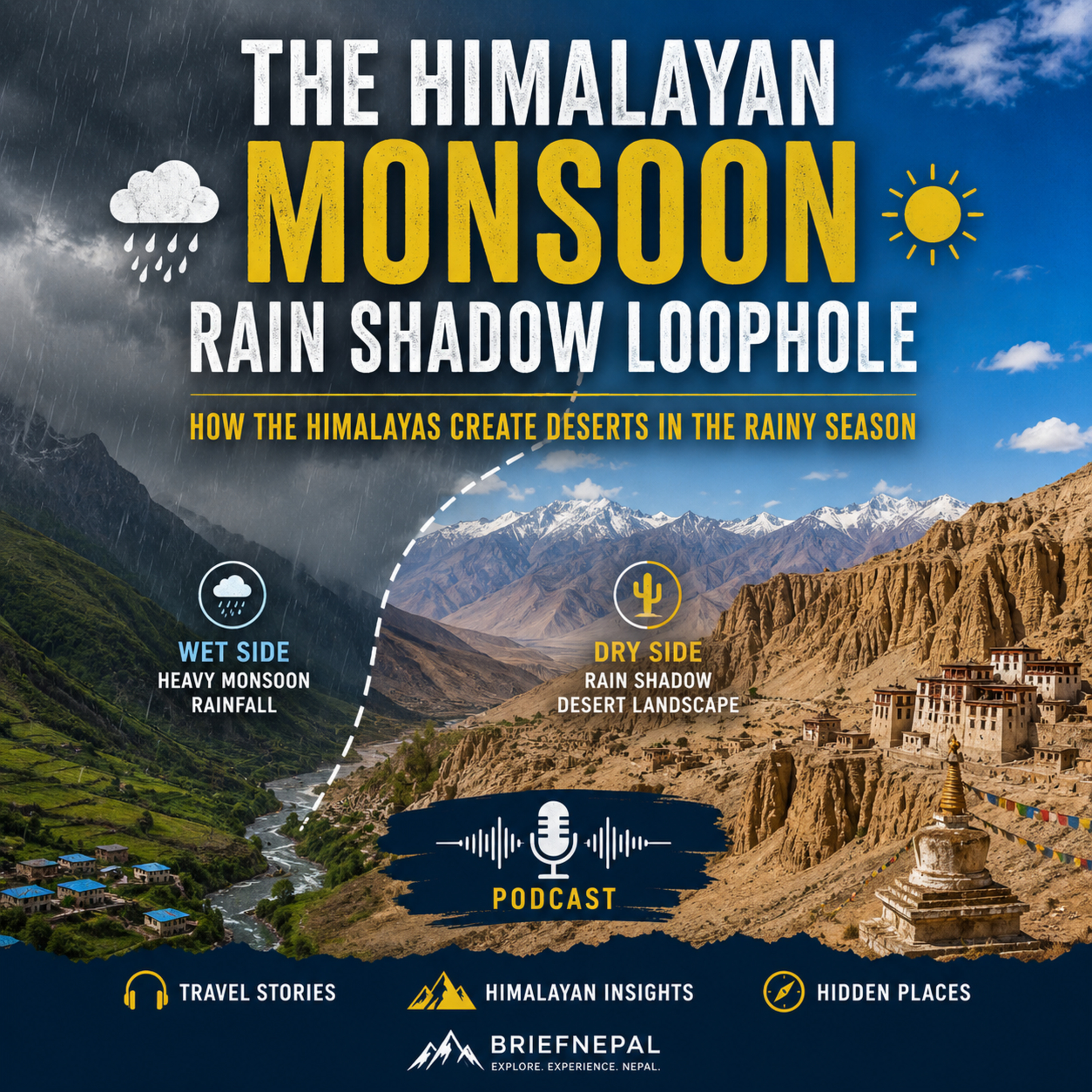
The Himalayan Monsoon Rain Shadow Loophole
▶ Listen on Spotify Follow the show →
🎧 Also on Apple Podcasts Castbox iHeartRadio
About This Episode
The Himalayan Monsoon Rain Shadow Loophole
Journey beyond the monsoon into one of the Himalayas' best-kept secrets. In this episode, we explore the fascinating phenomenon known as the Himalayan Monsoon Rain Shadow, where towering mountain ranges block seasonal rains, creating dramatic high-altitude deserts surrounded by snow-capped peaks.
Discover why destinations like Upper Mustang, Dolpo, and Manang remain dry even during Nepal's rainy season, making them some of the best trekking regions from June to September. Learn how geography, climate, ancient trade routes, and Tibetan culture come together to shape these extraordinary landscapes.
Whether you're planning your next Himalayan adventure or simply curious about the science behind the mountains, this episode reveals why the rain shadow is one of Nepal's most remarkable natural wonders.
🎙️ Produced by BriefNepal, bringing you stories, travel insights, and hidden gems from across Nepal.
Full Transcript
Auto-generated transcript — may contain small errors.
What if I told you that the absolute best time to explore the hidden kingdoms of the Himalayas is the exact moment everyone else tells you to stay away? Yeah, it sounds completely counterintuitive, doesn't it? Yeah. I mean, we are so conditioned to seek out that perfect sundry inch window for our travel plan.
Right, exactly. Welcome to today's deep dive. So the date today is July 5th, 2026. And right now across South Asia, we are sitting directly in the middle of the Himalayan monsoon.
Oh yeah, the rain is just coming down in sheets right now. It really is. And our mission today is to help you, the listener, solve a classic kind of high stakes travel dilemma using the freshly updated Nepal travel guide 2026 from brief Nepal. It's a great guide, really comprehensive.
Yeah, it is. Because, you know, if you have the urge to explore a country that physically holds eight of the world's 10 highest mountains, you're faced with a massive choice right now. A huge choice. And it can be super overwhelming.
Definitely. Do you hold off, wait out the torrential rain, and join the global crowds for the legendary autumn peak season? Or do you pack your bags right this second, brave them on soon, and try to find a loophole in the weather? It is a phenomenal dilemma.
And look, if you are feeling a bit of anxiety about making this choice, that is entirely justified. Oh, for sure. It's a big commitment. Exactly.
You are looking at investing significant time, uh, physical effort and money into a region that is just geographically extreme. Right. But the guide reveals something really incredible. The quote unquote best time to go completely shifts depending on what you value more.
Like do you want to get perfect photograph or completely untamed cultural experience? Well, to make this choice, we can't just look at July. We have to start with what everyone is actually waiting for. Right.
The baseline. Yeah. The baseline. When you close your eyes and picture trekking in Nepal, you're picturing autumn, September through November.
The guide paints this picture of, you know, crisp skies, stable weather, and those classic world famous routes like the 14 day Everest base camp track. But why is autumn so universally declared the undisputed king of Himalayan travel? So it really comes down to atmospheric mechanics. For three months during the summer monsoon, this intense heavy rain batters the country, which is what's happening right now.
Exactly. But that rain is doing something vital for the autumn traveler. It is acting as a massive meteorological power wash. A power wash.
I love that. Yeah, it basically scrubs the entire atmosphere clean all the dust, the agricultural smoke and the haze that builds up over the valleys during the dry months. It's all completely washed out of the sky. Oh, wow.
So it's not just that the clouds leave. It's that the air itself is fundamentally different. Precisely. When September arrives, the humidity drops and the air becomes unbelievably transparent.
You aren't just getting a view of the mountains. You are getting them in like ultra high definition. The visual clarity is staggering. Right.
The contrast between the brilliant blue sky and the white snow of those 8,000 meter peaks must be at its absolute peak. Oh, it's unparalleled. It's a photographer's dream. Okay.
I can see why the entire world targets that window for photography. But the source material points out that it isn't just the landscape that peaks in autumn. It's the culture too. Oh, absolutely.
The cultural side is huge. Yeah, because this window uniquely coincides with Nepal's two largest and most important festivals, Darshan and Tihar. And you really cannot understate how much these festivals transform the energy of the country. Tell me more about Darshan.
It usually falls in October, right? Yeah, usually October. It is the longest, most auspicious Hindu festival in the Nepali calendar. It lasts for 15 whole days.
Wow, 15 days. That's massive. It is. It's rooted in celebrating the victory of good over evil, specifically the goddess Durga.
But on a practical human level, it is a time of massive family reunion. Oh, so everyone goes on. Exactly. Schools and offices close.
People travel from all over the world back to their ancestral villages. The skies are filled with these traditional bamboo kites. Oh, that sounds beautiful. And the communities build these massive bamboo swings in the villages.
The energy is just joyous. It sounds incredibly vibrant. And then the guide mentions Tihar following almost immediately after Darshan. Yeah, Tihar is Nepal's equivalent of the festival of lights.
It's similar to Diwali, but with some uniquely Nepali elements, right, like the lights and lamps. Over five days, homes and cities are illuminated with thousands of oil lamps and marigold garlands to welcome Lakshmi, the goddess of wealth. But the guide mentions something about animals, which I found fascinating. Oh, yes.
What makes Tihar so special is how it honors the relationships between humans and animals. There's a specific day dedicated to honoring crows, the messengers of death. Wow. And then there was Kukur Tihar, which is a day entirely dedicated to honoring dogs for their loyalty.
They are decorated with red powder and flower garlands. Okay, honestly, you are painting a picture that sounds flawless. You get the ultra high definition mountain views, the air is scrubbed clean, and you're surrounded by these deeply rich ancient festivals where, you know, dogs are wearing flower crowns. That sounds like paradise, right?
It does. But there has to be a catch. I mean, if I'm the listener and I decide to wait for this perfect October window, what is the hidden cost here? Well, the catch is that you are not the only one reading this guidebook.
You are competing with every other traveler on earth who wants that exact flawless experience. The source is exceptionally clear about the logistics of modern travel. You surrender almost all of your spontaneity. Wait, really?
So if I just show up in Kathmandu on a Tuesday, hoping to jump on a tiny flake to the mountains on Wednesday, that's not happening. It is highly, highly unlikely. The domestic flights to the trekking hubs, places like Lucla to start the Everest track or Jomsom, they are totally bottlenecked. Oh, and the tea houses, which are the small family run lodges along the high altitude trails, they have limited beds.
During peak autumn, those trails become incredibly congested. Hiking in a line congested. You might literally find yourself hiking in a line of people. And if you haven't booked your bed months in advance through an agency, you might be sleeping on the floor of a dining room.
Oh, no way. Sleeping on a dining room floor after hiking all day. That sounds miserable. It happens more than you'd think.
So if your primary goal is to stand at Everest Base Camp under a cloudless sky, and you want to experience the magic of Dachian, you choose Path A. You wait for autumn. Right. But you have to accept that your trip must be a rigidly planned, well-oiled machine, and you will be sharing the mountains with thousands of other people.
Exactly. You get a postcard, but you pay a premium in both planning and crowd tolerance, which brings us back to the reality of right now, July 5th. Right. Let's look at Path B, because I'm reading the monsoon warnings in this guide, and I have to challenge you here.
Go for it. You want me to suggest that the listener flies to the Himalayas during the heaviest rains of the year. The guide explicitly warns about thick clouds that completely obscure the peaks. It does.
It warns about landslides delaying travel. It even mentions jungles, filled with leeches. Sell me on why anyone would intentionally walk into that. Okay.
On paper, for a traditional trekker, it is a terrible idea. I will give you that. Right. Leeches.
If you go to the standard Annapurna or Everest trails in July, you will be wet, you will be dodging leeches, and you likely won't see a single mountain peak, because the cloud ceiling is just too low. That sounds like a nightmare. But that is only true for the south side of the mountains. The guidebook reveals a massive geographical loophole.
They're called rain shadow regions. Okay. This is where the geography gets fascinating. I was trying to visualize how a country with such intense rain could have dry spots, and it's almost like, think of the Himalayas as a giant geological VIP bouncer.
Okay. I like where this is going. You have these massive monsoon rain clouds rolling up from the Indian Ocean, carrying all this moisture, trying to get into the club. But they hit this absolute wall of rock that is five miles high.
The mountains physically block the clouds from crossing over, so the clouds are forced to dump all their rain on the front steps, creating an exclusive, completely dry VIP section tucked directly behind the mountains. That is a brilliant way to picture it. Meteorologists actually call this process or a graphic lift. Or a graphic lift, okay.
Yeah. The warm moist air from the Bay of Bengal hits the southern slopes of the Himalayas and is forced upward. As it rises, the air rapidly cools, condenses, and dumps massive amounts of rain. The bounce are doing its job.
Exactly. By the time that air mass crests the 8,000 meter peaks and descends onto the northern side, it has been completely wrung out. It has zero moisture left. So while the front of the mountains is getting absolutely soaked and muddy, these northern regions are bone dry.
Own dry. And what is crucial for the listener to understand is how this unique weather pattern preserves the landscape. How do you mean? Well, because these areas are starved of rain, they aren't lush jungles.
They are stark high-altitude deserts. Yeah. And because they are so dry, they have preserved ancient architectures and cultures that would quite literally wash away anywhere else in Nepal. Let's put the listener right in the middle of one of these areas.
Because the guide highlights a few of these regions, and Mustang is at the top of the list. It's described as a forbidden kingdom. Oh, Mustang is an absolute revelation. The guide notes that the ideal window to trek there is actually May to October.
So right now, during one soon is prime time. Wow. You can do a shorter five to 10-day trek in lower Mustang, or you can commit 12 to 14 days to push deep into upper Mustang to reach the walled capital city of Lomanthang. Imagine walking through a landscape that feels completely detached from the green, snowy Nepal you see in brochures.
You are trekking through deep canyons made of red, ochre, and gray rock. It's like a lunar environment. That really is. And you mentioned architecture earlier.
What does a city look like in a place that never rains? It looks like something out of ancient history. Lomanthang is built almost entirely of mudbrick. Mudbrick?
Yes. The monasteries, the homes, the massive walls surrounding the city, they are all constructed from earth. If the monsoon rains could actually reach upper Mustang, that entire city would dissolve into mud. Wait, really?
It would just wash away. Literally melt away. Its physical survival is entirely dependent on that geographical bouncer image. That is wild.
And culturally, it is one of the last, deeply preserved enclaves of traditional Tibetan Buddhism, largely because it was physically cut off from the rest of the world by the mountains and restricted from foreign visitors until 1992. That is incredible. The weather literally dictates the building materials and the survival of the culture. And if you want something even more remote than Mustang, the guide points to upper delpo.
Now, this is not for the faint of heart. Definitely not. It's a 21- to 28-day transmalane trek. Its categorized as strenuous.
But it takes you to Shaif Oksundo, which is Nepal's deepest alpine lake. The contrast there is just breathtaking. You're in this barren, arid, brown, high desert. And suddenly, you arrive at a lake that is a blinding, brilliant turquoise.
It sounds like it defies logic. It does, but beyond the landscape, upper delpo offers an immersion into something incredibly rare. The Bonne religion. Right.
The guide touches on this. What exactly is Bonne? And why is it so significant to find it there? So Bonne is an ancient, indigenous spiritual tradition of the Tibetan plateau that actually predates the arrival of Buddhism.
Oh, wow. Before Buddhism. Yeah. It is deeply animistic, focusing on the spirits of nature, the mountains, and the lakes.
Over centuries, as Buddhism spread, true Bonne practices were largely absorbed or pushed to the absolute fringes of the Himalayas. That makes sense. So the fact that a traveler can still walk into villages in upper delpo, where Bonne is actively practiced, is astounding. But as the guide warns, reaching it requires a month of your time and intense physical stamina.
Which is a huge commitment. But let's say the listener is fascinated by this rain shadow concept, but they don't have a month to spend hiking, or they just aren't ready for a strenuous month-long expedition. Right. The guide does offer a more accessible slice of this dry zone in lower mustang.
Yes, the dramatic Kali Gandaki Gorge area. It's a much more manageable five to eight day moderate track. Okay, that's way more doable. Yeah.
You travel through distinct beautiful towns, like Jomsom and Kugdenny, which still have that stark Tibetan aesthetic. And this route leads up to the sacred temple of Mukdenath. I found the details on Mukdenath fascinating. It sits at an altitude of 3,710 meters, which is over 12,000 feet.
And it is a major pilgrimage site. It perfectly illustrates Nepal's incredible spiritual syncretism, the blending of faiths. Right. Mukdenath is deeply sacred to both Hindus, who believe it is a place of salvation and Buddhists, who view it as a place of deeply compassionate deities.
You will see Sadhus and Buddhist monks making the same pilgrimage, sharing the same sacred space in this really high harsh environment. So if you choose to travel right now during the monsoon, you are completely shifting the paradigm of your trip. You trade the classic green forests and big snowy peaks for red rock canyons, remote walled cities, and ancient untouched cultures. You are stepping off the postcard and into a living breathing history book.
Okay, so we've mapped out the two drastically different experiences. Autumn gives you the classic panoramas and the vibrant energy of Deshaen, while the monsoon gives you these exclusive hidden high deserts. Yep. Let's pivot to a major deciding factor for anyone planning this trip, the practicalities.
Because whether you go in October or July, dramatically impacts your wallet and your logistics. Oh, absolutely. Budget is always the silent dictator of travel plans. The source data gives us a very clear baseline here.
Overall, Nepal is highly accessible financially. The guide states that standard budget travel runs between 3,000 to 4,500 Nepalese rupees a day. Which is very reasonable. Yeah, based on the currency converter, 1,000 rupees is roughly $6.50 US.
So we are talking about a baseline daily budget of just 20 to 30 US dollars. Which, on a global scale, makes it one of the most cost-effective Altine destinations in the world. But that is just the baseline for food and lodging. Trekking introduces a whole separate layer of bureaucracy and cost.
Right, the permits. The guide lays us out carefully. If you are doing a general trek, like the Annapurna region, you need two pieces of paperwork. First is the ACIP permit, the Annapurna Conservation Area Project, which costs 3,000 rupees.
Okay. Then you need a Tim's card. A Trekker's Information Management System card, which is 2,000 rupees. So you're looking at roughly 5,000 rupees or about 33 US dollars, just to legally step onto the trail.
And it is vital to understand why those fees exist. The ACIP permit goes directly into environmental conservation and supporting the local communities you are walking through. Which is super important. It is.
It funds waste management and trail maintenance in deeply fragile ecosystems. Yeah. And the Tim's card is quite literally a safety net. Well, if an unseasonal blizzard hits, or a landslide occurs, or you simply get lost in a region with zero cell service, that registration system is how search and rescue teams know exactly what route you were supposed to be on.
It is non-negotiable. That makes total sense. And the guide adds a smart disclaimer. Permit policies and prices can fluctuate, especially if you are entering restricted areas like upper Mustang or upper Dolpo, which require specialized, much more expensive permits, and a registered guide.
Always verify current fees for sure. So always verify. But here is the big question for the listener trying to hack their budget. We established that Autumn requires booking ahead and fighting crowds, which usually means paying a premium.
Right. If a listener braves them on soon and heads to these rain shadow regions, does the guide book say anything about actual financial savings? It does. And this is where monsoon travel reveals itself as an incredible financial strategy.
While the guide doesn't give us a granular spreadsheet comparing the price of a bowl of del paint in October versus July, it clearly states that during the monsoon season, overall prices drop significantly. Which makes perfect sense when you think about leverage. Monsoon travel is essentially geographical arbitrage. That is the perfect term for it.
Think about it. When 100 trekkers want the absolute last seat on a tiny prop plane to Jomsom in October, the airlines and the booking agencies hold all the leverage, the price reflects that intense demand. Of course. But when you want that exact same seat in July, when most tourists are terrified of the rain, the leverage completely clips to you.
You're utilizing the mountain's massive shadow to buy a luxury-level, exclusive cultural experience at off-season backpacker prices. You gain immense solitude on the trails, your bargaining power for local Jeep transport or guides increases, and your daily budget stretches remarkably far. Plus, the guide notes are a really subtle, beautiful perk of traveling during the monsoon. Even if you are heading up to the dry, high deserts, you have to travel through the lower valleys to get there.
And in July, those lower landscapes turn a brilliant, explosive green. Oh, it's stunning. The terrace farms are bursting with new rice crops. The rivers are at their absolute most powerful.
It is an aesthetic of sheer vitality that you completely miss if you wait for the dry, dusty, post-harvest look of late autumn. So we've laid out the map. We've looked at the weather, the culture, and the economics. It is time to bring it all together for you, the listener, staring at this travel guide, trying to make the call.
It ultimately comes down to knowing yourself as a traveler. Yeah. What do you value more? Certainty or discovery?
If you value certainty, you choose pathé. You wait for autumn. You accept the higher costs. You accept the necessity of rigid, advanced planning.
You accept that you will be sharing the trails in the tea houses with thousands of other people. Right. But in exchange, nature guarantees you the absolute most flawless, crisp views of the highest mouties on earth. And you get to immerse yourself in the joyous, illuminated chaos of Deshaen and Tihar.
It is the definitive, iconic Nepal experience. It is the postcard come to life. But if you lean toward discovery, you choose path B. You pack your bags right now for the monsoon.
You embrace the fact that your arrival in Kathmandu will be wet and chaotic. Embrace the chaos. Exactly. But you use the Himalayas as your geological shield.
You head north into the rain shadows of Mustang or Dulpo. You leverage the off-season to stretch your budget. You escape the global crowds, and you walk through canyons of red rock into ancient, walled cities. Path B requires a deeply adventurous spirit.
It requires an acceptance of rougher travel conditions to reach the trailhead. But the reward is access to a world that feels completely untouched by modern time. You know, throughout this entire deep dive, one detail from the source just keeps turning over in my mind. We keep talking about the Himalayas acting as a physical barrier for the rain clouds, this massive wall stopping the monsoon.
But it makes you wonder about the human element. Did the rain shadow preserve more than just the mud brick walls of Lomanthang? How do you mean? Well, think about the ancient bond villages in Dulpo, or the restricted Tibetan culture of upper Mustang.
For centuries, the rest of the world modernized. Empires rose and fell in India to the south. Massive trade routes shifted globally. Right.
But to get to these specific kingdoms, invading armies or modernizing forces would have had to cross the highest physical barrier on planet Earth during a season when the lower valleys were hopelessly flooded and swarming with leeches. Wow. That is a profoundly compelling way to view it. The geography didn't just dictate the local weather patterns, it actively dictated the flow of human history.
The severity of the terrain and the monsoon created a fortress. Exactly. We tend to view the monsoon as just a frustrating weather event that ruins travel plans. Yeah.
But perhaps for hundreds of years, the monsoon has actually functioned as a protective shield. A protective shield, I love that. It walled off these valleys, it kept the masses out, and it kept the ancient magic locked in. That is definitely something to think about the next time it rains.
A brilliant perspective to leave on. Thank you so much for joining us on this deep dive into the Nepal travel guide 2026. Whether you decide to chase the flawless skies of autumn or seek out the hidden dry deserts of the monsoon, we hope you keep exploring, keep questioning the obvious choices, and as always, keep learning. See you next time.
Guides Mentioned in This Episode
 MustangThe forbidden kingdom, a Tibetan high desert beyond the Himalaya.
 Upper DolpoA restricted trans-Himalayan trek to Shey Phoksundo and ancient Bon villages.
 Upper MustangA restricted trek to the walled city of Lo Manthang in the old Forbidden Kingdom.Lower MustangJomsom, Kagbeni and Muktinath in the dramatic Kali Gandaki rain-shadow.Lower DolpoA remote trek to Phoksundo Lake and the trans-Himalayan valleys of Dolpa.
Planning a trip to Nepal?
Join the BriefNepal Travel list for seasonal tips, new guides and our free Nepal trip-planning checklist. No spam, unsubscribe anytime.