



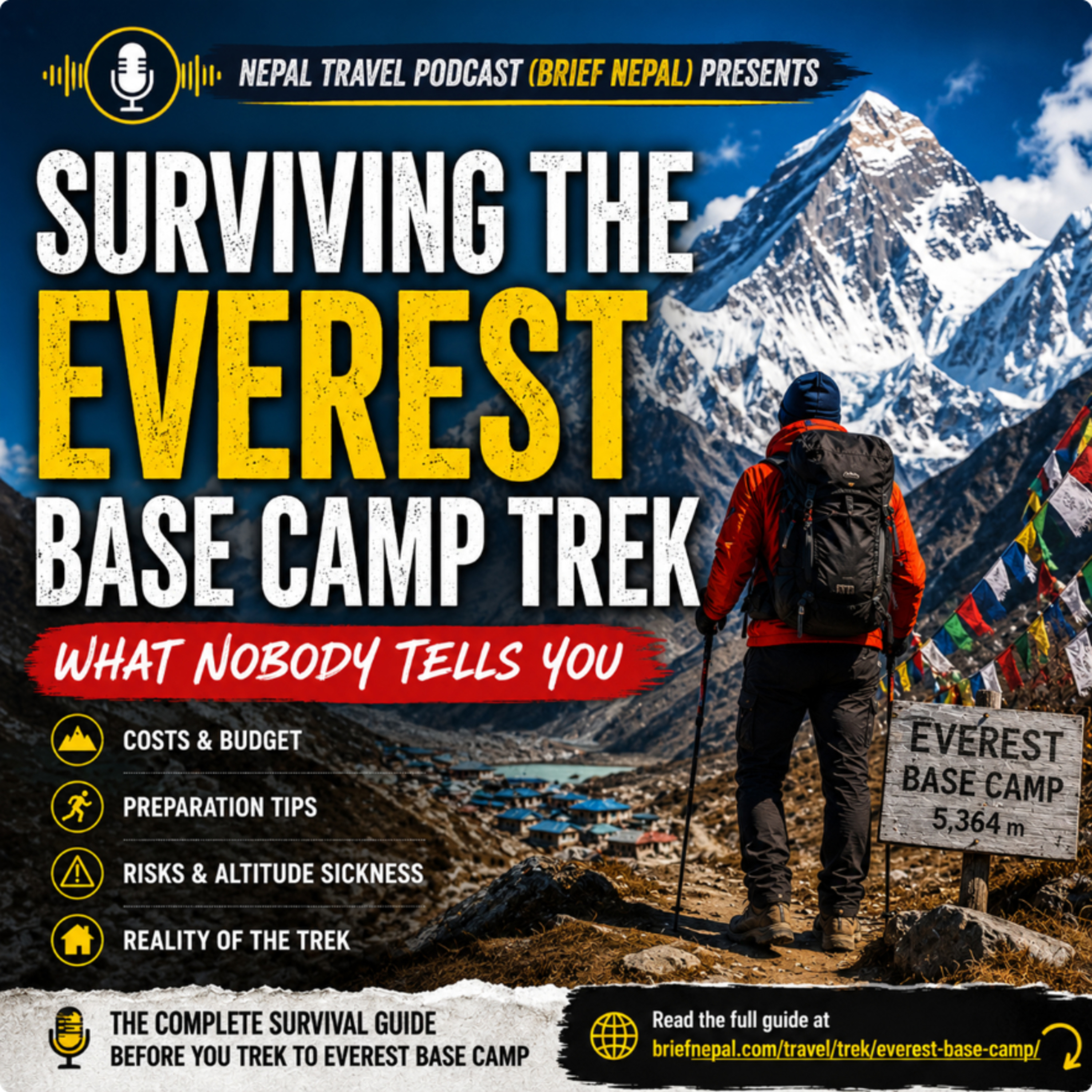
🎙️ Surviving the Everest Base Camp Trek: What Nobody Tells You
▶ Listen on Spotify Follow the show →
🎧 Also on Apple Podcasts Castbox iHeartRadio
About This Episode
Everest Base Camp is on the bucket list of thousands of adventurers every year. But beyond the breathtaking mountain views and iconic photos lies a journey filled with physical challenges, unpredictable weather, altitude risks, and unforgettable life lessons.
In this episode, we go beyond the glossy travel posts to uncover what it's really like to trek to Everest Base Camp. From budgeting and fitness preparation to altitude sickness, Lukla flights, teahouse stays, and the biggest mistakes first-time trekkers make, this podcast is your practical guide to one of the world's most legendary adventures.
Whether you're planning your own trek or simply fascinated by the Himalayas, you'll discover what every aspiring trekker should know before taking the first step.
In this episode:• Expectations vs. reality of the Everest Base Camp trek• Trek costs and budgeting tips• How to prepare physically and mentally• Altitude sickness and essential safety advice• Common mistakes that can ruin your trek• Hidden truths that most travel guides don't mention
📖 Read the complete Everest Base Camp guide: https://briefnepal.com/travel/trek/everest-base-camp/
🌍 Discover more travel guides, trekking routes, and Nepal stories: https://briefnepal.com
If you enjoyed this episode, follow the podcast, leave a review, and share it with someone dreaming of trekking in the Himalayas.
Full Transcript
Auto-generated transcript — may contain small errors.
Imagine you're coughing up pink frothy spit. You're completely disoriented, hallucinating even, and you're struggling to walk in a straight line. Every single breath feels like you're trying to breathe through a tiny cocktail straw. Yeah.
And the crazy part is, you know, you actually paid thousands of dollars for that experience. Exactly. You've trained for months, used up like all your annual leave, just for the privilege of being in that exact terrifying situation. And that is a very real scenario.
For people who underestimate the 130 kilometer trek to Everest Base Camp. It really is. I mean, it happens far more often than you'd think. People hear the word Everest and it just carries this heavy gravity.
Oh, for sure. It's the ultimate bucket list item. Right. It conjures up images of absolute extremes, you know, pushing human endurance to the absolute limit.
But the reality of what actually breaks people on this trail, well, it's rarely what they expect before they arrive in Nepal. Which is exactly why we're pulling this apart today. We're looking at a pretty incredible source a comprehensive, verified 2026 guide from the brief Nepal travel desk. Yeah, it's a fantastic breakdown.
It really is. It outlines the itineraries, the costs, the permits and the harsh physical realities of the Everest Base Camp trek or, you know, the EBC, as the veterans call it. Which is a beast of a trek. A total beast.
And I look at this trek the exact same way I look at a massive, seemingly impossible business venture. To me, it's the ultimate project. You've got logistics, risk management, supply chains and a whole lot of unpredictability. Exactly.
And you're the traveler with the practical, you know, on the ground wisdom. You actually know what it feels like when the air gets thin. I do. Yeah, it's it's a humbling feeling.
So our mission for you, the listener, is to strip away the romanticized myths. We're cutting out the Hollywood movie versions of this journey. We want to extract the real risk management and mental fortitude required to pull something like this off. So, OK, let's unpack this.
Let's do it. And I think, honestly, the best place to start is with the biggest misconception of all the technical climbing stuff. Yes, exactly. Because when people say they're going to Everest, their mental image is almost always wrong.
I'll admit, when I first read the title of this brief Nepal guide, I pictured like technical mountaineering. Yeah, I'm immediately imagining dangling off a sheer cliff of blue ice, gripping an ice axe with frozen fingers and wearing those terrifying steel spikes on my boots and ponds. Yeah, crampons and being ropes up to five other people in the middle of a blizzard. And that right there is what the guide immediately corrects.
The Everest Base Camp Trek is not a climbing expedition. Wait, really? No ice axes at all? Zero.
You will never at any point on this entire 130 kilometer round trip touch a rope, a carabiner or a crampon. That is wild to me. It's just a sustained, strenuous, 12 to 14 day hike on rocky, well trodden trails. You're walking on dirt and stone path.
You actually sleep in beds inside Sherpa run teahouses. Now not hanging off a vertical cliff in a sleeping bag. No, no bivouac sacks hanging over an abyss. It's a hike.
All right. I have to play devil's advocate here, though, because if there's no vertical ice climbing and you aren't doing technical mountaineering, it sounds like you're basically just walking five to seven hours a day for two weeks. I mean, technically, yes, but isn't that essentially a long walking holiday in the hills? Why does it have this fearsome, almost lethal reputation?
Is this like saying starting a company is just typing on a laptop? That's a great analogy because, sure, it's just walking. But what's fascinating here is the environment you're executing that walk in. You're dealing with the compounding effect of the terrain.
OK, break that down for me. You're trekking through the Khumbu region right past ancient monasteries into Sagarmatha National Park, which is a UNESCO World Heritage site. And you're dealing with these relentless, punishing ups and downs. That's not a gradual incline.
Not at all. It hike up 600 meters in elevation, feel great about it, and then instantly drop 400 meters down into a river valley. Oh, man, that sounds demoralizing. It is.
And then you have to climb right back up again. The sheer mechanical wear and tear on your joints, your knees, your hips over two weeks is massive. I can imagine. But that's just the physical terrain.
The ultimate silent adversary. The thing that stops literally incredibly fit marathon runners in their tracks is the altitude. Right. The altitude.
The guide goes into some really intense detail about what the lack of oxygen actually does to the human body. We're so used to, in business, analyzing tangible risks, you know, things we can actually see on a spreadsheet. Exactly. Things you can measure easily.
But the air pressure doesn't care how strong you look on paper. No, it really doesn't. And understanding acute mountain sickness or AMS is the single most critical part of surviving this trek. So what actually happens up there?
Well, the higher you go, the lower the atmospheric pressure gets. And because the pressure drops so drastically, the oxygen molecules in the air are literally spread further apart. So you're just getting less fuel per breath. Exactly.
You're taking in significantly less oxygen with every single inhale. At the mild end, your body's reaction to this feels like, honestly, the worst hangover of your life. Oh, great. Yeah.
A throbbing headache, total loss of appetite, dizziness, and totally broken sleep. Which already sounds absolutely miserable when you know you have to wake up at six a.m. and hike another seven hours uphill. Yeah.
But the guide outlines two severe forms of AMS that are much more dangerous, right? HAPE and HACE. Yes. Break down the actual mechanics of what's happening inside the body when those hit.
Yes. Because that pink spit thing from the intro is terrifying. It really is. So HAPE stands for high altitude pulmonary edema.
When your body is starved for oxygen, it basically panics. Right. It tries to compensate by massively spiking the blood pressure in your pulmonary artery to force more blood through the lungs. Trying to grab whatever oxygen is left.
Exactly. But that extreme pressure actually forces blood plasma to leak out of your capillaries and directly into your lung tissue. Wait. So you are essentially drowning in your own internal fluids.
Precisely. You become breathless even when you're just sitting still on a rock. You develop this persistent rattling cough and your spit turns pink and frothy because of the blood. That is horrific.
It is. And then you have HACE, high altitude cerebral edema. That is the exact same mechanism, the same leakage, but the fluid is leaking into your brain. Oh, wow.
So your brain is swelling. Yeah. The brain swells against the skull. That presents as severe confusion, a total loss of balance, drowsiness, and eventually hallucinations.
If you hit HACE, you can slip into a coma and die within a matter of hours. You know, it reminds me of a high growth startup burning through its cash reserves. Oh, that's an interesting way to look at it. It absolutely does not matter how great your product is or how fit your company looks in the press.
If you try to scale too fast without acclimatizing to the market conditions, your internal systems just rupture and the whole thing collapses. That is a perfect metaphor. You have to build the infrastructure first. Right.
You can't cheat the process. And just like in business, you have to follow stripped rules for sustainable growth on the mountain. The brief Nepal guide outlines the golden rules of altitude prevention. OK, let's hear them.
First, you ascend slowly. Once you cross the 3000 meter mark, you should never raise your sleeping altitude by more than 300 to 500 meters in a single day, which feels painfully slow if you're a fit person. It does. But you have to check your ego.
Second, you follow the rule of climb high, sleep low. I love that concept. How does that practically work on the trail? So on your scheduled acclimatization days, you don't just sit in the tea house resting.
You don't just take a day off. No, you do a strenuous day hike to a much higher elevation to expose your body to the thinner air. This forces your biological systems to adapt. Your body starts producing more red blood cells.
OK, I see. But then you hike back down to a lower altitude to actually sleep, recover and lock in those adaptations. That is essentially the agile methodology applied to human biology. Yeah, exactly.
You launch a beta test. You expose the system to extreme stress to see where the fractures are. And then you pull back to a stable version to process the data before you currently commit to the next level. That is exactly what it is.
You are stressing the system safely. The other rules are just as rigid, by the way. You must drink three to four liters of water a day. That's a lot of water.
You lose massive amounts of moisture simply by exhaling in the dry, cold mountain air. You also have to avoid alcohol and sleeping pills entirely because they suppress your respiratory drive. Well, that makes sense. You don't want to slow down your breathing when you already don't have enough oxygen.
Exactly. And the golden rule above all others, you never, ever ascend if you have mild symptoms. Knowing that the only real cure is bailing out and getting down the mountain really recontextualizes the preparation phase for me. The guide mentions a mandatory six to eight week training block before you even fly in Nepal.
Yeah, you cannot just show up off the couch. But given the terrain you described, just running on a treadmill isn't going to cut it, is it? No, not at all. Cardiovascular fitness is just the baseline.
You need muscular endurance. The guide specifically recommends finding the tallest building or stadium you can, putting six to eight kilograms in a day pack, and just doing endless stair repeats. Just up and down stairs for weeks. Because you're preparing your quadriceps and your knees for a multi-day fatigue and incredibly jarring steep descents.
And the mental part of that has to be huge. Oh, absolutely. You need to do back to back long hikes on the weekends to rehearse the psychological feeling of putting your boots on when your body is already exhausted. from the day before.
So given that altitude sickness can strike anyone at random and the only cure is to go down, that completely shatters the idea of a rigid travel itinerary. It does throw your tight schedule out the window. Right. You can't just book a tight two week vacation window and expect it to go perfectly.
How do you even begin to budget or schedule a project with that much biological unpredictability? So what does this all mean for the logistics? It means you have to bake flexibility into every single aspect of the planet. Yeah, lay them out.
Okay, so what is that in U.S. dollars, roughly? But the guide highlights a really interesting economic phenomenon on the trip. It's like an extreme version of supply chain economics.
Yes, it's what we call altitude inflation. Altitude inflation. I love that term. It's very real.
When you start the trek in the lower villages, your daily budget for meals, hot tea and charging your phone is around 3,500 to 6,000 rupees. Seems reasonable. But as you climb higher up toward Gorak Shep at 5,164 meters, that daily cost skyrockets to 6,000 to 9,000 rupees a day. Which makes complete sense when you visualize the terrain.
Exactly. That's spot on. And speaking of labor, the brief Nepal guide highlights a crucial regulatory shift from 2023 that changes the budget for everyone. Oh, the guide rule.
Yeah. Fully independent solo trekking is now illegal in the region. You absolutely must hire a licensed Nepali guide. Which honestly sounds like a very smart regulatory move.
It really is for safety. When you look at the sheer volume of tourists and the very real lethal risks of HACE and HAPE, having a local project manager who knows the signs of altitude sickness isn't a luxury. It's a baseline safety requirement. Absolutely.
They save lives up there every day. Plus, you have to sort out the permits. You need the Sagarmatha National Park entry permit and the Khumbu Pasang Lhamu rural municipality permit, which together cost about 5,000 rupees. But here's the kicker.
All of the permits, the budget, the stair climbing prep, it can be thrown into absolute chaos before you even take your first step on the trail. Yes. The Lukla flight. I was reading the section of the guide and my palms were sweating.
It seems like the ultimate bottleneck for the entire expedition. The Tenzing Hillary Airport in Lukla sits at 2,860 meters. It is universally considered one of the most dangerous airstrips on the planet. Just looking at pictures of it is terrifying.
Oh, it's wild. The runway is incredibly short. It is pitched at a steep upward angle to help planes slow down. And it ends literally at a mountain wall.
A solid rock wall. Yeah. If the pilot doesn't stop in time, they hit rock. If they don't take off in time on the way out, the other end of the runway drops off into a bottomless gorge.
So there is zero margin for mechanical error. Zero. And in volatile mountain geography, there's no instrument landing system. So it's all visual.
Yeah. The pilots use visual flight rules. They have to physically see the runway to land, which means flights only operate in crystal clear weather. A single patch of low clouds can shut down the airport for days.
And they completely wrecks your schedule. Oh, totally. During peak seasons, the guide notes that flights are frequently diverted to Manthali Airport. What happens then?
That forces trekkers to endure a brutal four to five hour drive from Kathmandu in the middle of the night just to catch a diverted plane. That is the ultimate argument for risk mitigation. The guide specifically insists that trekkers build multiple buffer days into their itinerary. You have to.
In a corporate environment, we sometimes view a buffer like cash reserves or extra development time as a luxury or an inefficiency. But when a cloud over a runway can literally cause you to miss your international flight home, a buffer is essential survival infrastructure. You have to engineer failure tolerance into the system. You really do because the mountain does not care about your international connection.
Nope. But let's assume you navigate the flight, the weather holds, and you actually land in Lukla. The airplane door opens. This is where the abstract planning collides with the gritty reality of the trail.
I was looking at the elevation map in the guide and day two looks absolutely brutal. You have this massive sheer climb up to Namche Bazaar. Is that where the reality of this trek usually hits people? It is definitely the first real test.
Day one is deceptive. You know, it looks easy. Yeah. You're trekking alongside the Dudh Koshi River crossing these gorgeous towering suspension bridges draped in colorful prayer flags.
The adrenaline is pumping. Everyone's taking selfies. Exactly. But day two is a relentless steep vertical ascent to Namche Bazaar at three thousand four hundred and forty meters.
Namche is this bustling Sherpa trading hub built like an amphitheater right into the side of the mountain. It's really beautiful. But it's also where you take your first mandatory acclimatization day, right? Yeah.
Because your body starts feeling the lack of oxygen. Yes. And from there, the sensory experience completely shifts. It's not just the altitude, it's the daily grind of the environment.
Right. Because you're leaving the tree line. Exactly. As you push past Tengboche Monastery at three thousand eight hundred and sixty meters, the trees start to disappear entirely.
You enter this stark alpine desert and the tea houses themselves become a psychological battle. Because of the cold. They are not heated. The only warmth comes from a single pot belly stove in the communal dining room.
And what are they burning? There's no wood. They're burning dried yak dung because, like you said, there's no wood at that elevation. The smell of burning yak dung permeates everything you own.
So you're sitting in a dining room huddled around a dung fire and you have to go sleep in an unheated plywood room where the temperature drops well below freezing. Yes. You sleep in your thermal layers inside a heavy duty sleeping bag and you wake up to find the water in your bottle has frozen solid overnight inside the room inside the room. You have to force yourself out of that sleeping bag.
Pack your gear with numb fingers and go hike another six hours on half the oxygen you were used to. But I found something incredibly counterintuitive in the guide about this part of the trip. You assume you're going completely off the grid enduring this ancient, ascetic lifestyle. But that is not the reality anymore, is it?
Not at all. There is a very modern twist to the Khumbu region now. You can actually buy an Ncell mobile SIM card in Kathmandu that provides cell service for a large chunk of the truck. That's wild.
And you can buy Everest Link Wi-Fi data cards right at the tea houses. It is wild to think you could be sitting in a freezing tea house at 4000 meters smelling yak dung while casually scrolling through your emails or checking stock prices. It is a bizarre juxtaposition, though true to the altitude inflation rule, that connection gets significantly slower and more expensive the higher you climb. Natural.
You even have to pay by the hour just to plug your phone or power bank into a wall socket because the tea houses rely entirely on limited solar power. The juxtaposition of raw survival and paying by the hour for solar Wi-Fi is fascinating. But let's push forward to the climax of the project. You grind through the freezing, barren landscapes of Lobuche.
You reach Gorak Shep, the final outpost. You are physically exhausted. The air is incredibly thin. And finally, on day eight, you arrive at Everest Base Camp.
Five thousand three hundred and sixty four meters. The ultimate goal. And if we connect this to the bigger picture, this moment is where the most surprising twist of the entire journey happens. Oh, man, this part blew my mind.
Because reaching Everest Base Camp, the namesake of the trek, the finish line everyone visualizes isn't actually the highest point of the trek. And it doesn't even have the best view. Wait, wait, wait. You train for months.
You spend thousands of dollars. You walk one hundred and thirty kilometers for a view of Everest and Base Camp isn't even the best spot to see it. I know. It is a harsh realization for a lot of people.
When you stand at Base Camp, you are on the Khumbu Glacier. You are so close to the mountain tucked right underneath it that you can't actually see the peak of Mount Everest because it's blocked. The summit is completely blocked by the massive shoulder of the mountain itself. You see the icefall.
You see the expedition tents, but you do not see the top of the world. So what do you do? You didn't come all this way, suffer through altitude sickness and frozen ice. And you have to take a walk to the summit of the highest mountain on Earth.
You have to hike back to Gorak Shep, sleep and then wake up in the freezing dark at 4 a.m. the next morning at 4 a.m. Yes. 4 a.m.
You have to push your exhausted body even higher, climbing a steep dark ridge to a viewpoint called Kala Patthar. Kala Patthar, five thousand five hundred and forty five meters. Yes. And at that elevation, you are breathing roughly half a meter.
Half the oxygen available at sea level. Every single step is a brutal agonizing battle. I can't even imagine the willpower that takes. But when you drag yourself to the top of Kala Patthar, just as the sun rises, you get a panoramic, completely unobstructed view of Everest's summit pyramid glowing in the dawn light.
It is the view you came for. Here's where it gets really interesting for me. When you synthesize all the lessons from this brief Nepal guide, it stops being just a travel itinerary and becomes a masterclass in how to achieve massive goals. Think about the discipline required.
Reaching the top requires a painfully slow, deliberate pace. The rule of climb high, sleep low is the ultimate framework for pushing your limits, gathering data and then forcing yourself to take the time to consolidate those gains before moving on. And the data proves that framework is successful. The guide notes that the completion rate for this trek is incredibly high, but only if you respect the environment and strictly follow those rules of acclimatization.
Right. People who fail who get loaded on to rescue helicopters are almost always the ones who try to ascend too quickly. Ego is the enemy of altitude. If you let your ego convince you that your sea level fitness makes you tougher than the thin air, the mountain will shut you down.
Ego is the enemy of altitude. I absolutely love that framework and leads me to one final provocative thought that I want to leave you with today. You know, something to mull over as you look at your own massive projects and ambitions. Let's hear it.
So think about the massive goal you're working toward right now. Are you just trying to get to the base camp where everyone else stops and takes a picture? And sometimes taking a deep dive into someone else's journey is exactly the perspective we need for our own. Thank you so much for joining us and unpacking this massive expedition today.
Stay curious. pushing your limits and we will see you on the next deep dive.
Guides Mentioned in This Episode
Planning a trip to Nepal?
Join the BriefNepal Travel list for seasonal tips, new guides and our free Nepal trip-planning checklist. No spam, unsubscribe anytime.