



Shri Dineshwarnath Mahadev: Discovering a Hidden Shiva Temple in Nepal’s Mithila Heartland
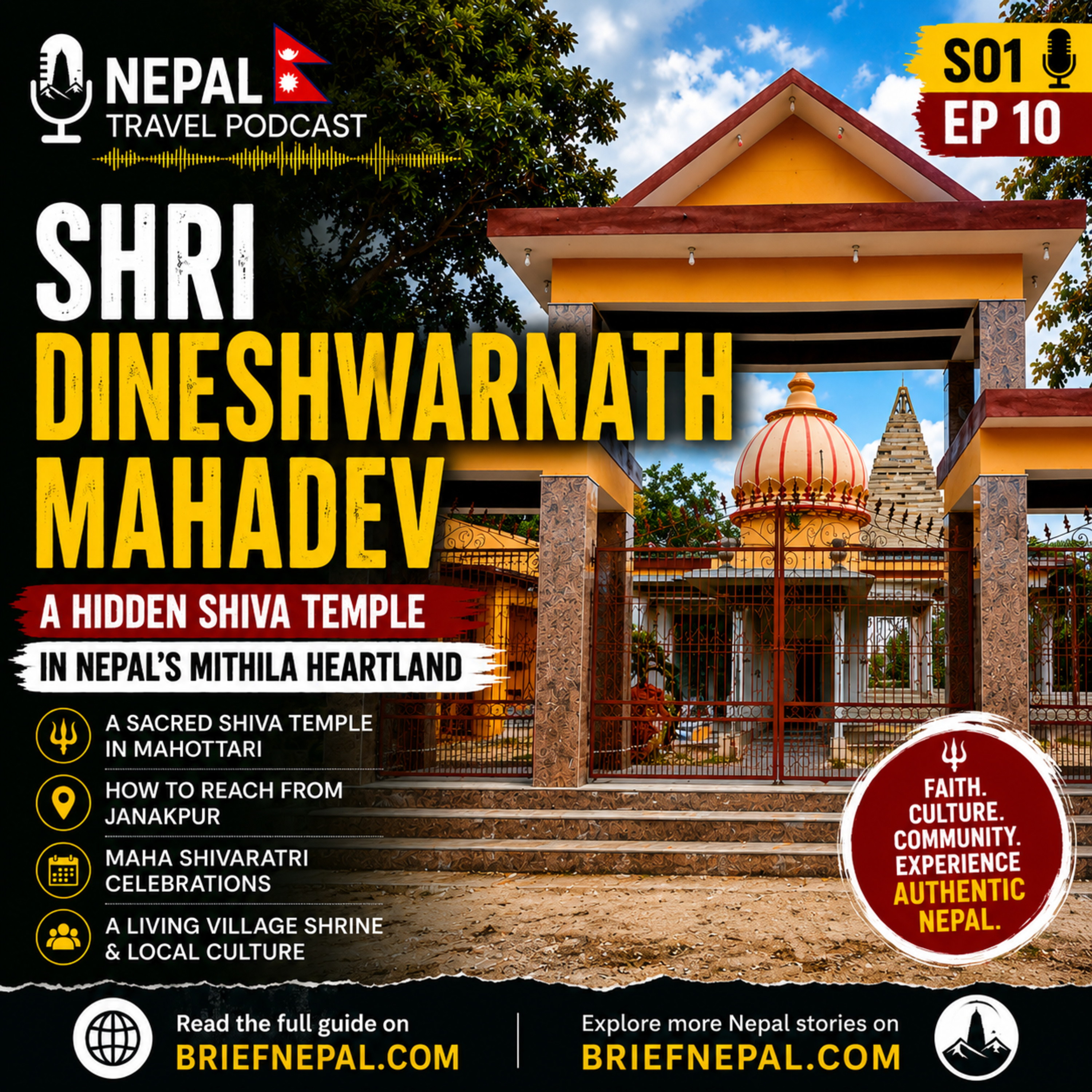
▶ Listen on Spotify Follow the show →
🎧 Also on Apple Podcasts Castbox iHeartRadio
About This Episode
What happens when you leave Nepal’s famous tourist trails and discover a living temple deeply connected to the local community?
In this episode of Nepal Travel Podcast, we explore Shri Dineshwarnath Mahadev Mandir, a local Hindu pilgrimage site in Nepal’s Mahottari district, surrounded by the cultural landscape of Mithila and the eastern Terai.
This isn't simply a monument to photograph. It is an active community-funded place of worship, where religious traditions, village life, and Mithila culture come together.
We explore the temple’s spiritual significance, the cultural traditions surrounding it, and why Maha Shivaratri is an especially important time to experience the site. We also look at practical travel information, including how travelers can reach the temple from Janakpur, what to expect when visiting a living village shrine, and the etiquette visitors should follow.
For travelers looking beyond Nepal’s well-known destinations, this episode offers a glimpse into a side of Nepal that rarely appears in mainstream travel guides: local pilgrimage, community traditions, and authentic Terai culture.
🎧 Listen to the episode and discover one of Nepal’s lesser-known spiritual destinations.
📖 Read the full travel guide on BriefNepal:
https://briefnepal.com/travel/pilgrimage/manara-mahadev
🌐 Explore more Nepal travel stories:
https://briefnepal.com
- 🛕 Shri Dineshwarnath Mahadev Mandir
- 🇳🇵 Hidden pilgrimage destinations in Nepal
- 🕉️ Lord Shiva and the significance of Shiva temples
- 🌿 The Mithila cultural landscape
- 📍 Mahottari and Nepal’s eastern Terai
- 🚗 How to travel from Janakpur
- 🙏 Visiting a living village temple respectfully
- 🔱 Maha Shivaratri celebrations
- 🏘️ Community-funded religious sites
- 🌏 Authentic Nepal beyond mainstream tourism
- 📸 What travelers can expect when visiting
- 🧭 Why lesser-known destinations matter for Nepal travel
Forget the crowded tourist trails for a moment. Deep in Nepal’s Mithila heartland lies a living Shiva temple where faith, village life, and centuries-old culture meet. This is the story of Shri Dineshwarnath Mahadev.
Full Transcript
Auto-generated transcript — may contain small errors.
Imagine stepping into a temple courtyard. You aren't greeted by, you know, a velvet rope or some polished ticket counter. Right. Definitely no gift shop either.
Yeah, no gift shop. Instead, you are standing in ankle deep monsoon mud. Oh, and you are surrounded by literally hundreds of fasting devotees. Exactly.
And you're looking at a central shrine that appears to be, well, only half built. It's got these raw concrete pillars just jutting into the sky. It's quite the scene. It really is.
So today, we are asking a bit of a controversial question. Does our modern obsession with, you know, preserving historical monuments actually frees them in time? And in the process, does it totally kill their soul? That is the core tension we are exploring today.
Welcome to the Deep Dive. When we think of heritage, we usually picture a finished product, right? Like something trapped behind glass in a museum. Definitely.
But we are rarely taught how to engage with a sacred space that is still evolving, something that's still getting messy. And still being built by the people who use it every single day. So we are turning our focus to Shri Dineshwarnath Mahadev Mandir. Though I should mention most people in the region just call it Manara Mahadev.
Yeah, it's a Hindu temple dedicated to Lord Shiva. Right. And it's hidden away in the Mahatourie district of Nepal. Our main source material today is this highly detailed 2026 visitor guide from Brief Nepal.
It's a fantastic guide. It really is. And our mission here is to shortcut you, the listener, to understanding the profound spiritual, cultural, and even practical layers of this off the beaten path shrine. To really grasp the gravity of Manara Mahadev, you first have to understand its geography.
This temple sits in the eastern Taraya plains. And for anyone unfamiliar with Nepal's topography, the Taraya is, well, it's the flat, intensely farmed, subtropical southern lowland region. Right. The part that borders India.
Yeah. It is drastically different from the snowy Himalayan peaks that, you know, most people immediately associate with Nepal. Completely different vibe. And this specific temple, it's nowhere to be found in national tourism inventories.
No English signboard welcoming you at all. Nope. You are stepping into the private, working spiritual hub of the local Maithil families. I was looking at the seasonal breakdown in the guide and I want to pause on the sheer contrast of the atmosphere here.
Oh, the contrast is wild. Right. Because if you or I were to walk in on a random Thursday in, say, November, the experience seems almost purely domestic. Very quiet.
Yeah. You might share this entire temple courtyard with maybe just a dozen locals. It's super peaceful. The quiet is deceptive, though, because that everyday stillness sets the stage for the true heartbeat of the shrine.
Which erupts during the Nepali month of Srirang, right? Exactly. This period falls roughly between mid-July and mid-August. So right in the thick of the monsoon season.
The wettest, muggiest part of the year. Yeah. And in the Hindu calendar, Srirang is fiercely dedicated to Lord Shiva. The Mondays of this month, they're known as Srirang Samvara.
They are the absolute peak of religious fervor. OK, let's unpack this. The guide details how families from the surrounding villages will undertake lifelong spiritual vows during this month. It's a huge commitment.
Help me visualize what that actually looks like on the ground because we aren't just talking about, you know, dropping a coin in a donation box, are we? Oh, no, far from it. This involves really intense physical and spiritual endurance. Entire families will fast throughout the daylight hours.
Wow. And you will see devotees walking barefoot for miles across the plains, carrying these vessels of holy water to the temple. Just walking all that way in the heat. Yeah.
Or in the pouring rain because when they arrive, they stand in these massive winding queues, often just getting soaked by the monsoon. And all that just for a brief moment at the shrine. Exactly. Just to make their personal offering at the central shrine.
It is a profound, tactile expression of faith that ties generations together. I have this image in my head from the guide's description of the central shrine itself. It's this white tiled building. Yeah.
Topped with a strike and fluted dome. Painted in this vibrant orange and cream. And inside that shrine is the focal point of all this devotion, the shivling. Right.
The absolute center of it all. For a listener who might not be super familiar with Hindu iconography, what exactly are these devotees making offerings to? Because it's not like a statue of a human figure. No, that is a really crucial distinction.
A shivling or lingam is an anaconic representation of Lord Shiva. Meaning it's abstract. Exactly. Rather than depicting him as a man with a face and limbs, the shivling is a smooth, cylindrical pillar.
It represents the infinite, formless nature of the divine. Like a pure column of cosmic energy. Beautifully put. Yes.
And the way devotees interact with it, especially during Srawan, is highly specific. And offering bell leaves, which come from the wood apple tree. Right. Along with incense, vermilion paste, and detour of flowers.
I want to unpack the detour of flowers specifically. Oh, it's such a fascinating detail. It is. Why are they offering a flower that is widely known to be highly poisonous?
This is where the physical offering perfectly mirrors the ancient mythology. According to Hindu texts, during the churning of the cosmic ocean, this lethal poison called Halahala emerged. And it was threatening to destroy all the creation. Exactly.
So to save the universe, Lord Shiva consumed the poison. He held it in his throat, which actually turned his throat blue. Oh, wow. Yeah.
So because he took on this immense world destroying heat and toxicity, devotees offer things that are either cooling, like the water, milk and bell leaves, or things that are inherently toxic, like the detour of flower. Symbolic of him absorbing the poison. Exactly. It symbolizes his unique ability to absorb the poisons of the world and grant protection.
That completely changes how you view a simple flower resting on a stone pillar. You aren't just looking at a floral arrangement. Not at all. You are looking at a physical reenactment of a cosmic rescue mission.
And doing this during Srawan means you are sharing that courtyard with hundreds of other people enacting that exact same story. The energy is just incredible. The lanes outside get packed with vendors selling bangles and sweets. And the courtyard floor is this chaotic mix of poured holy water and heavy monsoon rain.
It is a sensory overload in the best possible way. And you know, that intense localized devotion doesn't just evaporate when the festival ends. It actually is a permanent mark, doesn't it? Yeah.
A physical mark on how the temple is constructed over time. Here's where it gets really interesting. This might be my favorite insight from the entire brief. The architecture itself is a loving record.
It tells such a story. A shikhar. A shikhar, right. And right next to that stands a ruthless, unfinished colonnade.
It's literally just bare concrete pillars jutting up, waiting for a roof that just doesn't exist yet. Just exposed rebar in some places. Yeah. So from a traditional Western tourist perspective, wouldn't an unfinished colonnade just make the place feel like a neglected construction site?
Well, if you judge it by the standards of, say, a curated European cathedral, yes, it looks chaotic. Right. But consider the underlying mechanics of how a terai village shrine grows. Let's compare that raw gray concrete to the temple's main entrance gateway.
The gateway is brand new, right? Yes, and highly finished. It features these polished granite clad columns, a pitched yellow and maroon pediment, and these grand red metal gates. So you have slick, modern granite right next to raw unfinished concrete.
Did they just run out of money halfway through? In a sense, yes. But that is the beauty of the system. I like to think of this architecture as open source software.
Oh, I like that analogy. It is never truly finished in a final, static sense. These temples are not built by a single wealthy monarch or funded by a massive government grant. So how do they get built?
They are built in staggered phases, piece by piece, relying entirely on grassroots community funding. Oh, wow. So just local families pitching in? Exactly.
So that unfinished colonnade isn't an eyesore or a sign of neglect at all? Not even a little bit. It's actually a profound, visible testament to a community's ongoing dedication. It's like a living ledger of their faith.
Precisely. It reflects what the community can afford at this exact moment in history. When you look at those bear pillars, you are looking at the hopes of the village waiting to materialize into a roof. That is so cool.
And this communal care extends beyond just the bricks and mortar. The supporting cast of deities within the courtyard is meticulously maintained every single day. Yes, very prominent. So he's always watching.
And the fact that Nandi is freshly painted and dressed in clean cloth shows that this isn't something the museum piece gathering does. Right. The community is actively dressing and interacting with him daily. This constant daily interaction with the divine really bleeds right out of the temple gates and into the surrounding landscape.
Yeah. You can't isolate menorah madhe from the unique culture of the region it sits in. No, you really can't. We need to talk about the mythological cultural context.
The environment you pass through to reach the temple is honestly just as important as the destination itself. Walking or driving into menorah, you are fully immersed in the agricultural heart of the Eastern Terai. And the heat is palpable, right? Oh, the humidity is incredibly thick.
The sensory details in the guide are so vivid, you're passing endless flat paddy fields, towering stalks of sugar cane, dense mango groves, and these traditional brook kilns baking in the sun. It's a very striking landscape. And scattered throughout this landscape are mud walled village houses. But these aren't just plain mud walls.
They are covered in intricate traditional mythola wall paintings. Featuring both geometric patterns and figurative designs. Mythola art is iconic and traditionally it is created by the women of the region, right? Yes.
Originally painted using natural dyes on freshly plastered mud walls. And these designs aren't just decorative. What's their purpose? They are often created to invoke divine blessings for marriages, festivals, and just everyday domestic peace.
It is a culture that visually wears its spirituality on the walls of its homes. Which brings us to a massive practical point for any listener thinking about visiting. Engaging with this culture requires adjusting how you communicate. It really does.
The everyday tongue here is not English. And surprisingly to some, it isn't even Nepali. It is Methylie. Language is the ultimate key to shifting your status from an observing tourist to a welcomed guest.
The guide actually offers a brilliant, actionable piece of advice here. Learn just two words of Methylie. Yes, just two words can change everything. Pranam is the respectful greeting used in the region.
It basically functions like Namaste, but carries a very specific local resonance. Right. And Danyabad is thank you. If you are an international traveler pulling up to a remote village temple and leading with Pranam instead of a confused English hello, that completely changes the dynamic.
Totally. It signals to the locals that you recognize and respect their specific localized identity. It disarms people immediately. And that local engagement naturally leads you to the local food, which is a huge part of the Mecula experience.
Oh, the food is incredible. Let's dive into that because I was thrilled to read that you are not going to find a standard backpacker menu here. There's no generic tourist dalpat in Manera. Not a chance.
You are eating authentic Methyl village food. The guide mentions Baguia or Dikri, which are these distinctive steamed rice flour dumplings. Yes. And they also highlight Tilkor, which is a unique preparation of fried gourd.
Sounds amazing. And Chiridahi, which is beaten rice served with fresh, thick curd. Just reading about Chiridahi made sense to me geographically. Beaten rice and yogurt sounds incredibly refreshing.
Is there a climate connection to why this is such a staple? Absolutely, there is. The terri planes are punishingly hot, especially right before the monsoon break. So you wouldn't want a heavy hot meal.
Exactly. Chiridahi requires no active cooking over a hot fire right before eating. And the curd is biologically cooling for the body. That makes perfect sense.
It is highly caloric, easily digestible fuel designed for farmers working long hours in sweltering heat. The food is just perfectly adapted to the geography. So we have this rich, intensely local culture, this evolving open source architecture, and this massive spiritual energy. It's a lot to take in.
For a listener who wants to actually experience this, we have to map out how you physically pull off a trip to a place that's hyper local. Where does an international traveler even start? Well, the guide is very practical about this. There is no tourist accommodation in the village of Manara itself.
Right. So your base camp has to be Johnakpur. Johnakpur is a bustling historic city about 20 kilometers to the east. And getting there is pretty easy.
Yeah. The easiest way is a quick 25 minute domestic flight from Kathmandu. So you wake up in the cool air of Kathmandu, hop on a puddle jumper, and less than half an hour later, you are standing in the sweltering, vibrant heart of the terri. Exactly.
And from Johnakpur, the guide outlines a highly efficient, culturally rich, day trip. It's essentially a regional Shiva circuit that builds in intensity. Okay. Walk us through it.
You start your morning right in Johnakpur at the Janaki Mandir. This is a massive, highly ornate marble temple marking the birthplace of the goddess Sita. So you start with the monumental, the finished, the polished architecture. Yes.
From there, you hire a taxi and head west to the district headquarters of Jaleshwar. And Jaleshwar is famous for the Jaleshwar Mahadev temple. This site introduces a really fascinating mythological twist. It really does.
The shivling at Jaleshwar is submerged entirely in water. Right. The guide says they only drain the tank so devotees can see the actual stone on very special occasions. Like the Shrawan Mondays.
Right. But why keep the deity underwater for most of the year? It goes back to that concept of Shiva's immense cosmic energy or heat. Remember the poison, Halahala?
Yeah. The world destroying poison. Right. So a submerged shivling is a continuous ritual of cooling that fierce potentially destructive energy.
But water basically acts as a spiritual buffer. That is so interesting. It really is. It is a completely unique regional variation of Shiva worship.
I love how this feels like building the perfect indie travel playlist. You've seen the grand marble of Janaki Mandir. You've witnessed the submerged deity at Jaleshwar. And then you push into the finale of the circuit.
The final 15 kilometers into the village of Manara. Right. Which is where the polished tourist infrastructure completely disappears. Navigating this final stretch is an exercise in total flexibility.
You might be in your hired taxi or perhaps you've hopped into a crowded shared jeep or even a vibrating auto rickshaw. Sounds like an adventure. It is. Eventually you leave the main highway and hit the village lanes.
There are no signs pointing to a tourist attraction. So how do you find it? You literally have to roll down your window and actively ask locals on the street to point you toward the Mahadev Mandir or Dineshwarnath. And the guide issues a massive warning about the road conditions here.
Depending on when you visit those village lanes can turn into impassable traps. Oh absolutely. If you go during the wet season the dirt roads turn into thick sucking mud. You absolutely need a high clearance vehicle if you're attempting this during the monsoon.
Which brings up the most critical logistical decision a visitor has to make. There is a severe climate trade off here and it fundamentally alters what kind of experience you will have. Walk us through this because if a listener is planning a trip they basically have to choose between physical comfort and cultural energy. Precisely.
If your priority is pure physical comfort you should plan your visit between October and March. Because the monsoon has passed. Right. The weather is dry the skies are clear and the temperatures are relatively mild.
Your taxi won't get stuck in the mud. But and there's a big but here. Yeah. If you visit then you are going to experience the temple in its quiet subdued domestic state.
You might only see a handful of people. But if you want to experience the true heartbeat of the temple. If you want to see the thousands of devotees the fasting the massive cues and that peak straw on Monday energy you have to visit between mid July and August. You are trading comfort for atmosphere.
You will be dealing with torrential downpours intense humidity and deep mud. It sounds physically exhausting. It will be. But you will witness a spiritual phenomenon that you simply cannot see any other time of the year.
Let's assume our listener has chosen to brave the monsoon mud. They've used their Maithili greetings. They've navigated the village lanes and they have arrived at the gates of Manara Mahadev. OK.
They made it. Because this final stretch brings you directly into the heart of a tight knit community. We have to talk about etiquette. If you are a Western traveler your instinct might be to treat this space like a public park or a museum.
And that instinct will lead you to deeply offend the community. Strict etiquette applies here and it is non-negotiable. First and foremost no leather items. I want to dig into that because to a secular visitor being told you can't wear a leather belt might seem completely arbitrary.
It's not arbitrary at all actually. Why is leather completely banned from the temple precinct. It comes down to the core Hindu principle of Ahimsa which translates to nonviolence. A Hindu temple is designed to be a space of absolute purity and reverence for life.
OK. I'm following. Leather is the byproduct of taking an animal's life. So bringing a leather belt a leather leather trim bag or leather shoes into the courtyard isn't just breaking a superficial rule.
You are bringing the energy of violence and death into a sacred space. Exactly. You're bringing it into a living sacred ecosystem that reframes it entirely. You aren't just following a dress code.
You are actively participating in a zone of nonviolence. And that extends to the dietary rules as well. Very much so. The guide states absolutely no meat no eggs and no alcohol anywhere near the temple ground.
Especially during Charon when hundreds of the people around you have been fasting and purifying their bodies for weeks to make their offerings. It's just a matter of basic respect. Yes. You also must dress modestly keeping shoulders and knees covered.
And when you navigate the central shrine you always circumambulate clockwise clockwise keeping the central deity to your right side which is traditionally considered the auspicious side. Correct. You also must take your shoes off before stepping onto any raised platforms or pavilions. Right.
And there's a rule about accepting prasad too isn't there. Yes. If a priest or a local offers you prasad which is a portion of the food that has been blessed by the deity you must always accept it with your right hand. Never the left.
Right. In South Asian culture the left hand is traditionally reserved for sanitary purposes. So using it to accept a blessing is highly offensive. If we connect this to the bigger picture what about photography.
We live in an era where the first instinct upon seeing a vibrant colorful festival is to pull out a smartphone. Yeah. The guide draws a very hard line here. This is not a photo set.
So no photos at all. The general grounds and the exterior architecture are usually fine to photograph but taking pictures of the deity inside the main shrine or taking photos of worshippers who are mid puja meaning they are in the active vulnerable state of ritual prayer is strictly off limits. Unless you have explicit permission I assume. Exactly.
Unless someone has granted you explicit verbal permission. I think this is the crucial psychological pivot for a visitor. You have to recognize that you are stepping into someone's active spiritual life. This isn't a tourist attraction designed for your Instagram feed.
Right. These families are undertaking lifelong vows. They are praying for sick relatives. They are seeking spiritual shelter.
When you strip away your demands as a consumer of tourism and act purely as a respectful guest something amazing happens. The locals notice it. They do. They will recognize that reverence by honoring their space.
You are often granted the rare privilege of being welcomed into a completely authentic uncurated expression of faith. So let's take a step back and look at the massive journey we've mapped out today. We started by exploring the dramatic contrast between the quiet piece of a torai weekday and the raw crowded monsoon soaked energy of a shrine Monday. We unpack the mechanics of the mythology to like why cooling water and toxic to tour flowers are offered to the shivling and why Nandi the bull keeps eternal watch outside.
We looked at how an unfinished colonnade and a raw concrete tower are actually beautiful symbols. They represent a community funding its own spiritual home piece by piece like an open source building project. We wove through the Mithila cultural tapestry understanding the weight of a simple Mithili greeting and the climate logic behind a refreshing ball of churidahi. And we mapped out an incredible escalating travel circuit starting at the grand marble of Janaki Mandir moving to the submerged mysteries of Jhilishwar and finally navigating the muddy village lanes to the hyper local heart of Manara Mahadev.
Which leaves us with a real paradigm shift to take away from all of this. What's the takeaway. We are so often conditioned to believe that true cultural preservation means putting a fence around a building and keeping it exactly the same forever. Like a museum piece.
Right. But Manara Maha challenges that. It asks us to consider that maybe true preservation doesn't look like a pristine museum at all. It looks a bit messier.
Yeah. Maybe true cultural preservation looks like a messy muddy active construction site. One that's constantly being reshaped by the devotion of the people who actually live there. The living shrine versus the froze monument.
It's a beautiful concept to carry with you on your next journey. Thank you for joining us on this deep dive into Manara Mahadev. We warmly invite you to keep seeking out the stories the art and the faith hidden just off the main road. Until next time.
Guides Mentioned in This Episode

Planning a trip to Nepal?
Join the BriefNepal Travel list for seasonal tips, new guides and our free Nepal trip-planning checklist. No spam, unsubscribe anytime.