



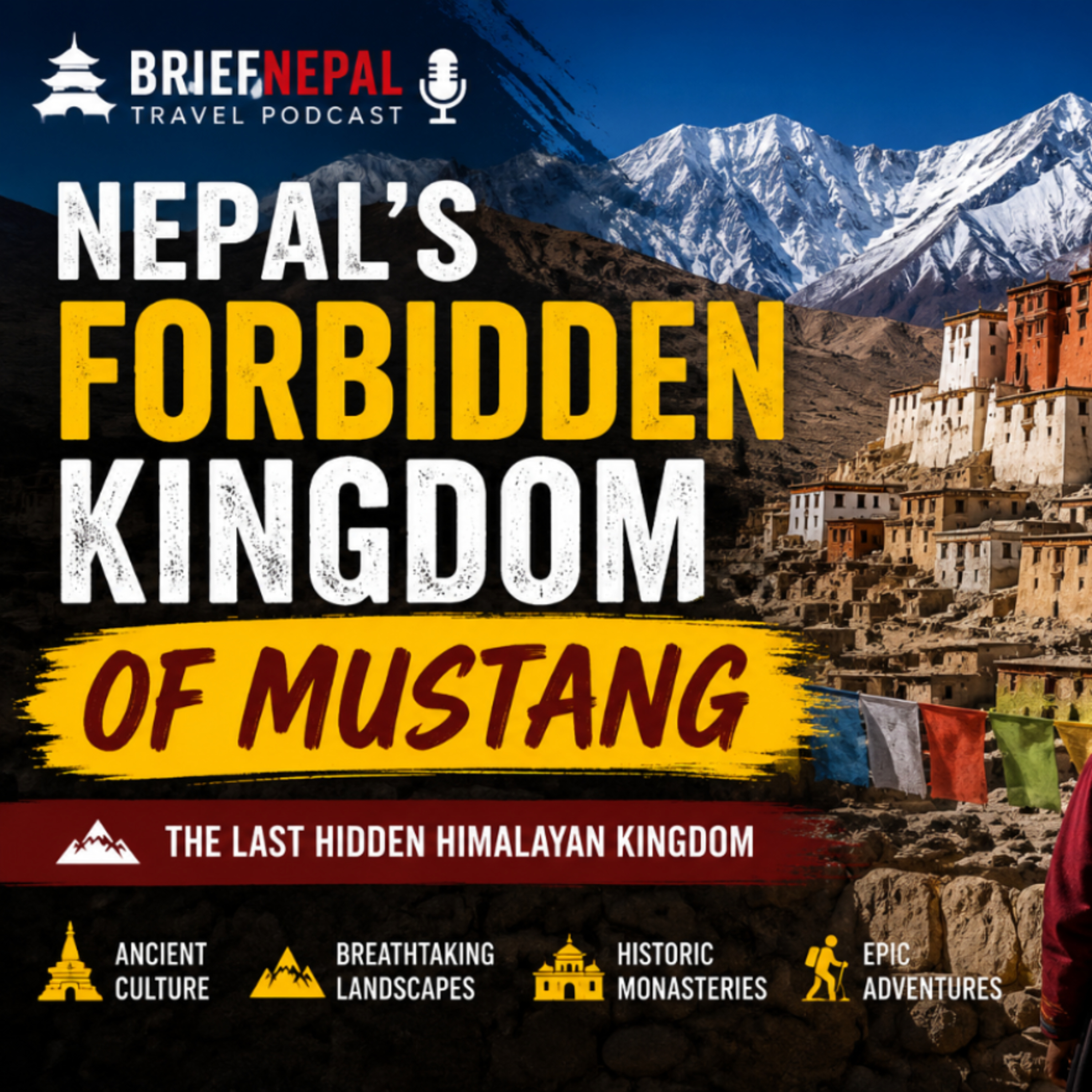
Nepal's Forbidden Kingdom of Mustang | The Last Hidden Himalayan Kingdom
▶ Listen on Spotify Follow the show →
🎧 Also on Apple Podcasts Castbox iHeartRadio
About This Episode
Step into the mystical landscapes of Upper Mustang, Nepal's legendary Forbidden Kingdom, where ancient Tibetan culture, medieval monasteries, dramatic desert valleys, and centuries-old cave settlements remain beautifully preserved beyond the towering Himalayas.
In this episode of the BriefNepal Travel Podcast, we uncover the fascinating history of the former Kingdom of Lo, explore why Mustang remained closed to the outside world for centuries, and discover what makes it one of Nepal's most extraordinary travel destinations. From the walled city of Lo Manthang and colorful Buddhist festivals to breathtaking mountain scenery and unforgettable trekking routes, this episode is your complete guide to the hidden kingdom beyond the Himalayas.
Whether you're planning an adventure to Upper Mustang or simply fascinated by Himalayan history and culture, this journey will transport you to one of the world's most remarkable places.
🌄 Highlights • History of the Forbidden Kingdom of Mustang
• Lo Manthang and ancient Tibetan culture
• Best time to visit Upper Mustang
• Trekking routes and travel tips
• Monasteries, caves, and Himalayan landscapes
• Local traditions and festivals
📖 Read the complete travel guide: https://briefnepal.com/travel/destination/mustang
🌐 Discover more destinations across Nepal: https://briefnepal.com
#Mustang #UpperMustang #Nepal #TravelPodcast #Himalayas #LoManthang #Trekking #VisitNepal #Buddhism #AdventureTravel #BriefNepal #TravelGuide #HiddenKingdom #NepalTourism #Travel
Full Transcript
Auto-generated transcript — may contain small errors.
I want you to close your eyes for just a second and picture Nepal. Like what comes to mind? Right. If you're like most people, you're probably imagining lush green valleys, maybe the dense jungles of Chitwan or those torrential summer monsoon rains or, you know, the towering snow-capped peak of Everest.
It's a very specific image. Oh, absolutely. It's an iconic picture. But today we are going to completely shatter that picture because we're going somewhere that honestly looks a lot more like the surface of Mars than the Nepal that you're probably imagining.
Yeah, it really is an entirely different world. I mean, we are looking at this high altitude wind-carved desert full of these ochre and red cliffs is completely hidden away from the rest of the soap continent. So today our mission is to take you on a deep dive into the 2026 brief Nepal travel guide for a region called Mustang. We are going to decode the logistics, the incredible history and the absolute mysteries of this place.
We're talking about everything from finding literal ocean fossils at the top of the world to uncovering exactly why the upper half of this region is still referred to as the forbidden kingdom. It's quite a title. Right. So OK, let's unpack this because before we can even talk about hidden kingdoms, we really have to talk about the extreme geography that isolates this place to begin with.
The guide keeps using the term rain shadow. What exactly is happening there mechanically? Well, geography is truly destiny when it comes to Mustang. A rain shadow is this incredible meteorological phenomenon.
So Mustang is tucked away in the far north central part of Nepal, right up against the border with Tibet. OK, but standing between Mustang and the rest of Nepal are two absolute giants, the Annapurna and Dolly Gary mountain ranges. So when the summer monsoon sweeps up from the Indian Ocean, carrying all that heavy moisture, it hits those 8,000 meter physical walls. Right.
The air is forced upward, it cools and it essentially drops all its rain on the southern lush side of the mountains. So by the time those storm clouds actually crest the peaks, they're just completely wrong out. Exactly. That kind of thing.
Yeah, the air descending into Mustang is just bone dry. So Mustang sits in this luminous arid Tibetan plateau, which by the way, makes it one of the very few places in the Himalayas that is actually a fantastic trekking destination during the summer monsoon months. Oh, really? Yeah, from June to August when the rest of the country is completely washed out by mudslides and, you know, leeches, leeches.
It's wild to think about a dry desert just tucked behind the world's tallest mountains, but the guide makes it clear that to even get into this region, you have to pass through something equally extreme, like the Kali and Nikki gorge. Yes, it claims this is the deepest gorge on earth, but how do geologists even measure something like that? Like, where does a gorge start and end? It's a great question.
And you might be wondering how they calculate a 5,500 meter drop. Yeah, geologists basically measure the depth of the gorge by taking the peak of Annapurna heart on the eastern side and the peak of Dalligiri on the western side, and they run a virtual plumb line straight down to the elevation of the Kali Gandaki riverbed. Okay. And because those peaks are well over 8,000 meters high and the river runs at about 2,500 meters, you get this staggering 5,500 meter deep crack in the earth, I mean, you are literally walking or driving through a fissure between giants.
That scale is just it's hard for the human brain to even process. And down in that massive fissure, the guide mentions trekkers and pilgrims are constantly looking at the ground for chalagrand. Right, the fossil? Yeah, these black Ammonite fossils, ocean fossils, up in the Himalayas, finding ocean fossils in the Himalayas is like finding a seashell on the moon.
How does an ocean floor end up, you know, floating in the sky between the tallest mountains on earth? What's fascinating here is the sheer scale of geological time we're dealing with, it all comes down to plate tectonics. So millions of years ago, before the Indian subcontinent smashed into the Eurasian plate, this entire area was actually the floor of the ancient Tethys Sea. Wow.
Right. And when those land masses collided, the immense pressure buggled the earth's crust, thrusting the ancient ocean floor upwards to create the Himalayas. That is insane. It is those black Ammonite fossils, which, by the way, are deeply revered by Hindu pilgrims as sacred forms of the deity Vishnu.
They are literal, physical proof that this high desert used to be under saltwater. Unbelievable. And getting to this ancient ocean floor is an adventure in itself. The guide outlines two main ways to start your journey into lower Mustang from the lakeside city of Pokar.
First, you can take a 20 to 25 minutes stall flight. That's a short take off and landing plane up to a town called Jumpsum. But it sounds like you can't just, you know, book a flight and expect to go at noon. Oh, not at all.
No, those tiny planes are threading the needle between those massive peaks and they can only fly early in the morning because of the wind. Exactly. By late morning, the thermal shifts create incredibly dangerous winds in the gorge. Plus, because they operate entirely on visual flight rules, any cloud cover just grounds the planes immediately.
You have to build in buffer days because weather cancellations are literally a daily reality. So if you don't want to fly, or if you can't, the alternative is taking the road. And the guide uses the word road quite generously here. Very generously.
Yeah. It's a rough, unpaved track that follows the Kali Gundaki Valley up through towns like Benny and Gasa. It sounds like a full day, sometimes too, of just getting tossed around in a shared Jeep or a local bus. It's an endurance test before the trip even begins.
It is punishing on the body. I mean, truly, but whether you fly or drive, once you arrive in Jumpsum, which exists at about 2,720 meters, you are officially in lower Mustang. This is the accessible half of the region. And to be here, the paperwork is relatively straightforward, right?
You need a standard Annapurna conservation area permit, an AC key, which runs about 3,000 Nepali rupees. But the guide also says you need a Tim's card. I know AC cat goes toward conservation, but what exactly is a Tim's card doing for you? So Tim stands for Trekkers Information Management System.
It's essentially a massive safety database. OK, because the weather in the Himalayas can turn deadly in a matter of hours, the government really needs a registry of exactly who was on the trail, what route they're taking and when they entered. If a freak blizzard hits or if a trekker goes missing, rescue teams use the Tim's data to know exactly where to start searching. It is a non-negotiable safety net.
Good to know. So from Jumpsum, we start moving up the valley and the guide highlights this village called Marfa. The photos show the spotless settlement of flat roofed, whitewashed houses and these beautiful flagstone lanes. It mentions this is a Thakali village.
Who are the Thakali people and why does their village look so different from a typical rugged mountain outpost? Well, the Thakali people historically controlled the salt and wool trade routes along the Kali Gandaki gorge. Oh, interesting. Yeah, for centuries, this corridor was the only viable pathway between the Tibetan plateau and the Indian lowlands.
Because they controlled the flow of goods, the Thakali became incredibly prosperous and you see that wealth reflected in the pristine architecture of Marfa. But today, they are famous for something entirely different. Apples. Apples.
Marfa is essentially the apple capital of the Himalayas. Yeah, the guide is very enthusiastic about the apples. Fresh slider, dried apple slices, jam, and the infamous local apple brandy. I can imagine a glass of fresh Himalayan apple cider hits the spot after a dusty jeep ride.
No, definitely. But you also need real fuel, which brings us to the food. Mustang is the heartland of Thakali cuisine, widely considered the absolute best version of Dalbot in Nepal. It is incredible.
We're talking a massive tholly plate, rice, lentil soup, tangy vegetable curry, fermented greens, spicy pickle, and usually some grilled meat. It sounds delicious, but why is this specific meal so culturally dominant here? It goes far beyond just flavor. I mean, it is a strict issue of physiological survival.
When you were traveling at altitude, your digestive system actually slows down and your body requires a tremendous amount of sustained energy simply to oxygenate your blood in the thinner air. Right. So the Thakali Dalbot provides a perfect dense balance. You get complex carbohydrates from the rice and buckwheat, high quality protein from the lentils and meat, and crucial probiotics and vitamins from the fermented pickles and greens.
It is quite literally survival fuel refined over centuries to keep humans functioning in a low oxygen environment. And you're going to need every ounce of that dense energy because the next major stop on the trail really demands it. We're talking about Muktinath. It's a temple set at a breathless 3,800 meters, deeply sacred to both Hindus and Buddhists.
Pilgrims travel from all over the subcontinent to bathe under its 108 water spouts. The guide also mentions an eternal natural flame inside the temple. How does a fire burn constantly in the freezing Himalayas without anyone tending to it? It's another brilliant geological quirk.
The flame is actually fed by an underground natural gas seep. Really? Yeah. The gas vents up through the rock right inside the temple, creating a fire that burns endlessly alongside a natural spring.
For the pilgrim, seeing fire and water harmoniously coexisting from the earth is just a profound spiritual symbol. It sounds stunning, but we really need to give you the listener a warning here. Three hours and 800 meters is no joke. The guide strongly advises ascending gradually and staying hydrated because altitude sickness is a very real threat here.
A very real threat. Yeah, the thin air can cause severe headaches, nausea and dizziness. If you feel it, the only cure is to descend immediately. That's a critical safety point.
And you weren't just battling the thin air up there. You were battling the wind. The geography of that deep gorge creates what meteorologists call an anabatic wind as the Tibetan plateau heats up during the day. The hot air rises and it literally sucks the cooler high pressure air from the southern lowlands violently up through the gorge.
Almost every single afternoon. Fierce gale force winds funnel up the Kali Gandaki Valley. You are constantly fighting the elements, which is why the guide says getting your walking done in the morning is absolutely essential. So we've explored lower Mustang.
We've had our Dalapat. We visited Muktinath, but if you keep following the river north, the geography fully shifts into a wide open Tibetan plateau. And eventually you hit a medieval village called Kagbeni. Yes.
The guide describes it as this tightly packed place of mud houses and a red walled monastery sitting exactly where the green barley fields end and the bare desert begins. But Kagbeni isn't just a village. It's a literal line in the sand. It's the threshold.
Kagbeni houses the police checkpost that officially divides lower Mustang from upper Mustang. Right. And when you cross that line, the rules change drastically to go past Kagbeni into upper Mustang, which is the old kingdom of low, you are entering a tightly controlled restricted area. You have to get a restricted area permit or RAP.
And the cost listed here is 65,000 to 70,000 Nepali rupees. That is roughly 500 US dollars per person, just for the first 10 days. And if you stay longer, it's 50 bucks for every extra day. Oh, and you can't go alone.
You must have a government registered guide hired through an agency and you must be in a group of at least two truckers. Those are the non-negotiable regulations set by the federal government. OK, I have to step in here on the listeners behalf because, um, wait, five hundred dollars just for the right to walk there for 10 days, plus you're forced to hire a guide and pay their wages. That feels wildly restrictive and incredibly expensive, especially when lower Mustang costs basically nothing in comparison.
Is this just a massive cash grab by the government to squeeze tourists? Well, it's easy to look at it that way. But if we connect this to the bigger picture, the historical context paints a very different story. It's primarily about geopolitics and preservation.
If you look at a map, upper Mustang juts out into Tibet, almost like a thumb during the 1960s and 70s at the height of the Cold War, that sensitive border made Mustang a strategic staging ground. Tibetan gorilla fighters known as the compa resistance were using upper Mustang as a base to launch cross-border raids against Chinese forces in Tibet. Wow. The guide barely touches on the military history, but that explains a lot.
I imagine the government didn't want chorus wandering into a covert conflict zone. Exactly. I mean, the geopolitical stakes were massive, especially since the CIA was covertly backing some of those fighters. Because of that extreme sensitivity, the Nibley's government completely and totally sealed upper Mustang off from all foreign travelers until 1992.
1992, that is incredibly recent. It is. And when they finally decided to reopen it, they realized they had a very unique situation on their hands because it had been isolated for so long. The fragile high desert environment was pristine and its Tibetan Buddhist heritage was astonishingly well preserved.
Think of the isolation acting like a geological vacuum seat. Right. Untouch. Exactly.
By implementing this high fee and mandating guides, the government purposefully limits the amount of foot traffic. It serves as a filter to prevent the area from being overrun by mass tourism, which would just quickly degrade the very culture that makes it special. Okay. So you're essentially paying to ensure the place isn't destroyed by the very active view visiting it.
I get that. So let's say we've paid the 500 bucks. We've got our guide. We crossed the check post at Cag Beni.
What exactly do we find in this isolated medieval world? You find the kingdom of low and the absolute jewel of this region is its capital. Low man thing. You are sitting at 3,840 meters and rising out of the desert is this incredible walled city built entirely of mud brick.
It was founded way back in 1380 by a warrior named Amapala. The guide mentions there was actually a recognized king here until relatively recently, which is wild to think about. How does a modern country just have a localized king operating out of a mud walled city? That would be King Jigme Dourger, Paul Barbista.
Because of Mustang's historical autonomy and their control over the trade routes, the national government and Kathmandu formally recognized the king of Mustang all the way up until Nepal abolished its national monarchy in 2008. Oh, wow. Yeah. And even after losing his official title, he remained a deeply respected cultural leader for the people until his death in 2016.
It was a living kingdom in our lifetimes. And the architecture inside those walls sounds majestic. The guide highlights a former royal palace and three magnificent 15th century monasteries, Jampa, Tubchin and Chode. It says they are filled with towering Buddha statues and incredibly rare Tibetan murals.
It sounds like if you want to see pure intact Tibetan culture, this is the place to be, but is there a best time to witness that culture in action? If you want to see the culture at its most vibrant, the guide strongly recommends timing your trip for May to witness the TZ festival. It's a massive three day celebration held right in the central square of low man thing. The monks come out in these elaborate colorful costumes and traditional masks, performing sacred cham dances that reenact the triumph of good over evil.
The entire region gathers for it. That sounds amazing. It is, but just keep in mind, because beds are scarce. You have to book your permits in T-houses months in advance.
Right. Good tip. Okay. We have to talk about the archaeological mysteries because the guide has these photos near a village called Choser that look absolutely unreal.
These cliff faces look like Swiss cheese. Yes. You're looking at the sky caves. Yeah.
Honeycombing the sheer cliff faces across Mustang are thousands of mysterious man made caves. Wait, the guide says some of these, like the Jean Cave complex, are five stories high and they date back up to 2000 years. Here's where it gets really interesting and honestly a bit baffling. How did humans, two millennia ago, carve a five story apartment complex into a sheer vertical rock face?
Did they have ancient scaffolding where they like hanging from ropes? That is the ultimate archaeological question. And researchers have a few theories about how they achieved it. First, you have to look at the geology.
The cliffs are made of conglomerate rock, basically a mix of pebbles, sand and silt glued together. It's relatively soft and easy to carve into when exposed, but it hardens over time. Okay, makes sense. Second, archaeologists believe that 2000 years ago, the valley floor was actually much higher over centuries.
The river eroded the valley down, meaning the people who originally carved those caves might not have been hanging 150 feet in the air. They might have been walking right up to the rock face. Oh, so the ground literally fell away over the centuries, leaving the cave stranded high up on the walls. That's the leading theory for the highest caves.
For the intricate multi-story complexes like Xiong, they likely tunneled inward from a lower accessible point and then carved their way upwards through the soft rock from the inside, essentially building internal staircases to create those higher rooms. They use them over the centuries for burials, for deep meditation chambers, and during times of war as impenetrable refuges. It is a masterpiece of ancient human endurance and engineering. I mean, it's an incredible journey of extremes from start to finish.
We started in a world record gorge, looking at tectonic ocean fossils, fought our way up through wind tunnel seats, survival fuel, dalbot, and ended up climbing into 2000 year old cliff dwellings in a forbidden kingdom. For you listening, Mustang isn't just a place you check off a travel bucket list. It's a masterclass in how extreme physical isolation preserves a culture. Absolutely.
It holds on to a world that has largely vanished everywhere else. Before we wrap up, let's quickly recap some vital practical advice from the brief Nepal guide. First, bring thick wads of physical cash, Nepali rupees. ATMs are incredibly scarce beyond Jomsom.
And even the ones there are frequently offline. Second, pack a solid windproof jacket for those brutal afternoon antibiotic gales we talked about. And finally, when you get up high, ease into the local diet, embrace the Tibetan book binoodle soup and the salty butter tea to keep you warm in those unheated tea house dining rooms. This raises an important question, though, as we think about the future of this region.
The guide actually mentions that rough but increasingly drivable roads are now pushing up the Kali Gandaki Valley. Right. We've talked extensively about how extreme geography and isolation perfectly preserve the kingdom of Lois. But those ancient places are finally being connected.
If the very thing that preserve Lomanthang's 15th century monasteries and the 2000 year old sky caves was its absolute physical isolation from the world. What happens when the road finally finishes catching up? Exactly. Will the $500 permit be enough to save the forbidden kingdom from the modern world or is its long isolation already over?
That is a fascinating thing to chew on. It makes you wonder how much time is left to experience this place as it was. So keep exploring, stay curious. And the next time you picture Nepal, don't just think of the lush jungles or the snow on Everest.
Remember that somewhere up there, hidden in the wind and the ochre cliffs, there's a piece of the ancient ocean floor floating near the sky.
Guides Mentioned in This Episode

Planning a trip to Nepal?
Join the BriefNepal Travel list for seasonal tips, new guides and our free Nepal trip-planning checklist. No spam, unsubscribe anytime.