



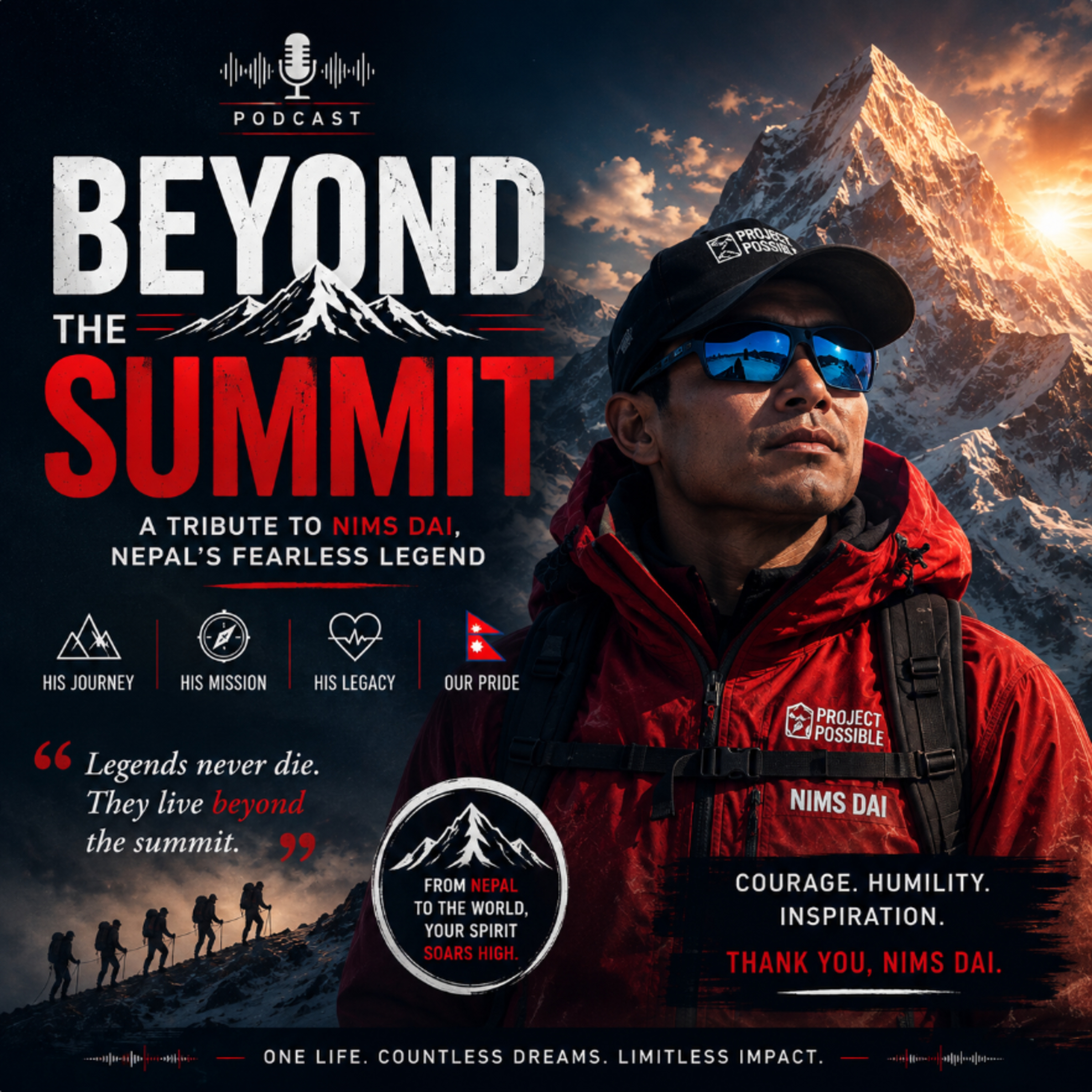
🎙️ Beyond the Summit | A Tribute to Nims Dai, Nepal's Fearless Legend
▶ Listen on Spotify Follow the show →
🎧 Also on Apple Podcasts Castbox iHeartRadio
About This Episode
Some people climb mountains. Others redefine what is possible.
In this special tribute episode, we celebrate the extraordinary life and legacy of Nims Dai (Nirmal Purja), the Nepalese mountaineer whose courage, determination, and unwavering belief shattered limits and inspired millions across the world.
From his humble beginnings in Nepal to serving as a Gurkha and UK Special Forces soldier, and ultimately making history by climbing all 14 of the world's 8,000-meter peaks in just 6 months and 6 days, Nims Dai proved that impossible is often just another starting point.
This episode journeys through his greatest achievements, his leadership on the world's highest mountains, his passion for Nepal, and the legacy he leaves behind following the tragic Broad Peak expedition.
This is not merely the story of a mountaineer. It is the story of resilience, purpose, and a man who inspired generations to dream beyond the summit.
"Legends never truly leave the mountains. They become part of them."
Thank you, Nims Dai. Your spirit will forever rise with the Himalayas. 🇳🇵
Full Transcript
Auto-generated transcript — may contain small errors.
Some people leave footprints not only on mountains, but in history. And if you really try to imagine standing at an altitude where human life is just, well, biologically impossible. Right. The death zone.
Exactly. The death zone above 8,000 meters. The atmosphere pressure is what, a third of what it is at sea level? Yeah, roughly a third.
I mean, your body is just completely starved of oxygen at that point. Right. Your digestive system shuts down. Your blood thickens.
Every single step requires this like agonizing negotiation. Which is why most people would do absolutely anything to escape that environment. But our deep dive today is about a man who intentionally chose to live there. Yeah.
Today, we're honoring the life and the incredible legacy of Nirmal Purja, universally known to everyone as Nims Dai, who tragically passed away on Broad Peak in July 2026 at just 43 years old. And, you know, we're not just looking at a list of records today. We really want to explore a figure who fundamentally redefines human endurance, and he elevated an entire nation's standing in global mountaineering. He really proved that anything is possible.
But I think what's so fascinating is, well, the irony of his origins. Oh, it's the ultimate contrast. Right. Because you picture someone dominating the high Himalayas and you naturally assume they were born in some high altitude Shopa village, right?
Like acclimatized from birth. Yeah, you'd think so. But he was actually born in a village called Dana, which is only about 200 meters above sea level. Wow.
Just 200 meters. Yeah. And then when he was just four, his family moved down to Chitwan, which is in the flat, hot plains of Nepal. I mean, for those who don't know the geography, Chitwan is a lowland jungle.
We're talking heavy humidity, elephant grass, rhino safaris. It is a world away from glaciers. Exactly. He didn't even really lay eyes on the high Himalayas in any meaningful way until he was an adult.
So he didn't have that traditional mountaineering background. And his initial drive, it had nothing to do with chasing summits, did it? No, not at all. His drive was entirely fueled by his family.
He, you know, he really wanted to support his mother who had a severe heart condition. Right. And for a young man in rural Nepal, joining a foreign military is one of the most reliable and prestigious ways to secure your family's future, which led him to the brigade of Gurkhas in 2003. Yeah.
And just getting in as an elite achievement, you have to survive the Doko race, which is just brutal. Oh, I was reading about this. You have to run miles up a steep Himalayan foot hill against the clock, carrying a traditional woven bamboo basket on your back. Right.
And it's loaded with like 25 kilograms of rocks and sand. And the weight is mostly supported by a strap across your forehead. Just wild. It's designed to break you mentally before it breaks you physically.
But then he pushes it even further. Right. In 2009, he becomes the first Gurkha ever to pass selection for the UK's special boat service, the SPS, which is tier one special forces. It's the maritime equivalent of the SAS.
And this is where I kind of struggle to make the connection. Like, how does being a maritime special forces soldier prepare you for the highest, most frozen peaks on earth? It sounds like, I don't know, training for a marathon while holding your breath and trying to solve complex logistical puzzles. That's actually a really perfect analogy because the bridge between the SPS and the death zone.
Well, it isn't about the specific terrain. It's about operating competently when you are completely exhausted, terrified and oxygen starved. So it's more of a mental conditioning. Exactly.
Tannic control and managing hypoxia. Military training teaches you to treat an objective, not as some romantic adventure, but as a highly staged logistical mission. Right? Like forward operating bases, supply lines, weather windows.
Yeah. He brought that tier one operational mindset directly to the mountains. And he came to climbing pretty late, didn't he? His first 8,000 meter peak was Dalagiri in 2014.
And he just did that while on military leave. Yeah. He was already in his thirties. And then instead of writing out a comfortable military pension, he pitches Project Possible 147 in 2018.
Which sponsors thought was literally an impossible stunt. They just laughed at him. They did. I mean, his goal was to climb all 14, 8,000 meter peaks in seven months.
The previous record was nearly eight years by Kim Chang Ho. Almost eight years. And he wanted to do it in seven months because traditionally you need months of recovery at sea level just to survive the next climb. So when sponsors said no, he just what remortgaged his house.
He did. He walked away from his pension and risked his family's home to fund the first phase. The level of conviction required to risk everything on a feet, experts say, will kill you. It's just staggering.
It really is. So walk us through the execution. Did he actually hit that seven month target? He actually shattered it.
He finished in just six months and six days. Wait, 189 days? That's insane. It is.
And the phase in Nepal was breathtaking. He climbed six major peaks in just 31 days. It relied on using helicopters to jump directly from base camp to base camp, completely skipping the weeks of trekking and an ironclad team of Nepali climbers. The highlight was in late May.
He summited Everest, Lhotse and Makalu in a single 48 hour window. A 48 hour push. Just unbelievable. And that's also when he took that viral photograph right there.
One of the Hillary's step cue on Everest. Yeah. The one showing all those climbers pack nose to tail in their downsuits on that terrifying ridge. It sparked this huge global debate about the commercialization of Everest.
But, you know, while the media was obsessed with the speed records in that photo, I feel like the true measure of him as a climber was what happened when the cameras were off. Oh, absolutely. Because you have to remember he's racing a six month clock. Every single hour matters.
There is zero margin for delays. Right. But he repeatedly abandoned his own summit pushes to save the lives of strangers. Like the rescue of Dr.
Yeah, Dr. Chin was stranded high up without food, water or oxygen for over 40 hours. Nims and his team didn't even hesitate. They just turned around and went back into the death zone to extract him.
And then just a month later, they run into that heartbreaking nightmare on Kanchenjunga. They're at 8,450 meters and they find two stranded Indian climbers. And Nims literally gave up his own supplemental oxygen to try and carry these men down through the night. Why not just call for an evacuation?
Because at that altitude, helicopters generally cannot generate enough lift. The air is too thin for the rotors to catch. If you're stranded at 8,450 meters, the only way down is if another human being physically drags you down. Imagine the sheer willpower required to abandon a world record to carry a stranger through the death zone.
And there is no organized high altitude rescue system up there. None. Rescues rely entirely on the moral courage of individual climbers willing to throw away their own lives and money to help someone. And sadly, despite fighting through the night, both of those men passed away.
That is just tragic. But that moral courage, that deep sense of responsibility, it extended directly to how he treated his own team, too. He had this massive impact on the Nepali climbing community. Yeah, for decades, the local Nepali climbers were just treated as background crew, you know, just referred to as support staff or porters.
Right. They were barely ever mentioned by name in the history books despite doing the most dangerous work. He proudly credited his teammates to the global media, guys like Mingma, David Sherpa and Gisman Tamang. He insisted they were the principals, the elite athletes leading the expeditions, not just the infrastructure.
That fierce pride sets the stage perfectly for the K2 winter ascent in 2021, which many consider his absolute masterpiece. Why is K2 in winter such a big deal? Because for 34 years, K2 in winter was considered completely impossible. Right.
It sits directly in the path of the jet stream. We're talking ambient temperatures plunging below negative 50 degrees Celsius with hurricane force winds, just exposed skin freezing solid in minutes. Instantly, every expedition had failed. But Nims declared that this record would belong to Nepal and he and his own Nepali team conquered it.
The way they executed that final push is so cinematic. The 10 climbers, originally from different teams, decide to merge together near the summit. Yes. Instead of racing each other for the individual glory, they stopped 10 meters below the summit.
They waited in the freezing death zone until all 10 men were together. They linked arms and they walked onto the summit side by side, singing the Nepali national anthem. A completely shared victory. And we have to mention the biological miracle hidden in that moment.
Among those 10 elite climbers, Nims Dai was the only one who completed the climb entirely without supplemental oxygen. It really does. Let's just pause and reflect on what that meant for young Nepalis. For generations, they watched their people carry heavy loads so foreigners could be celebrated as heroes.
Then a kid from the flatlands of Chitwan leads an all Nepali team to the most dangerous summit on Earth. It was incredibly empowering. He basically became a walking empowerment campaign for the Nepali team. Right, the purists.
In a community obsessed with style, many took issue with his 2019 project possible run. Yeah, they argued that relying on helicopters to bypass the base camp tracks, using prefixed ropes and using bottled oxygen meant it wasn't a true pure alpine climbing record. Because physiologically, using bottled oxygen lowers the physical toll by about a thousand meters, right? So how did he respond?
Did he get drawn into debates in the climbing record? He didn't waste time arguing the philosophy at all. He simply went back to the mountains and did it all over again entirely on the purists' terms. By October 2024, he completed all 14 peaks a second time, this time entirely without supplemental oxygen.
He just silenced everyone by becoming the first person to hold both versions of the record, and his momentum just kept building. By 2025, he had an unprecedented 50 summits of 8,000 meter peaks. But you know that massive appetite for rifts, that absolute refusal to back down from deteriorating conditions, it's a double-edged sword in the mountains. It is.
We have to contrast his seemingly invincible track record with the absolute power of nature, which brings us solemnly to his final expedition in July 2026. He was back in the Karakoram range, climbing Broad Peak. If he summited, he would have been just one peak shy of holding a double no oxygen record. But the weather systems were incredibly hostile.
Heavy snow had fallen continuously for days. When heavy snow falls, it doesn't immediately bond to the older, harder layers of ice beneath it. It sits on top like a heavy slab. Without days of clear weather to consolidate, those steep gullies become loaded with unstable slabs just waiting for a trigger.
And because of this extreme avalanche danger, almost every other team had packed up and left base camp. But Nims Dai's team decided to stay and push for a weather window. Yeah. On the morning of Thursday, July 30th, the team was navigating the terrain between Camp 2 and Camp 2.
Camp 3, and a massive avalanche released into the main west facing gully. The sheer scale of it was catastrophic. According to the GPS trackers, there was an immediate terrifying drop of over 600 meters. Bad weather kept rescue helicopters grounded for an agonizing day.
When they finally reached the site, the worst possible outcome was confirmed. All 10 climbers caught in that avalanche had perished. It's a devastating reminder of the shared risk that binds everyone on the mountain. A concept Nim's always championed.
The mountain environment just doesn't care about your fitness, your fame, or your records. The forces of nature are absolute. But when we evaluate his legacy today, it extends far beyond the physical records he set. His most enduring impact is structural.
Through the Nims Dai Foundation, he fought aggressively for the rights of high altitude workers. He campaigned for fair pay, comprehensive insurance, and the basic respect that had been denied to Nepali climbers for decades. He fundamentally transformed the economic landscape. You know, I keep coming back to a thought that builds on everything we've discussed.
For centuries, exploration was geographic. We mapped the continents. We climbed the highest peaks. Maybe the true final frontier of modern exploration isn't geographic at all.
That's a great point. I think he proved the final frontier is discovering the absolute limits of human physiology and altruism. Like finding out how much a human being can endure and how much they are willing to suffer to save a stranger in the dark. If a kid from the flatlands of Nepal can remortgage his house to shatter an eight-year record in six months, what impossible barrier in your own life is just waiting for a different kind of planning, belief, and refusal to give up?
The powerful lens to view his life through. He showed us that the limits we accept are often just delusions. Legends never truly leave the mountains. They become part of them.
Thank you, Nims Dai. Nepal will never forget you.
Planning a trip to Nepal?
Join the BriefNepal Travel list for seasonal tips, new guides and our free Nepal trip-planning checklist. No spam, unsubscribe anytime.